 MineArchive
Kinlet Colliery
| Location | South of Borle Brook, near Highley, Shropshire — 52.4265, -2.3830 (approximate) |
|---|---|
| Commodity | Coal |
| Type | Coal |
| Worked | From late 1890s–September 1937 |
| Maximum depth | Unknown. |
| Operators | Highley Mining Company (1894–1937) |
Overview
The most southerly of the Highley Mining Company’s Wyre Forest pits, opened after coal was struck in the parish of Kinlet in 1894. The site had no road access at all, so the mining leases granted by the Kinlet Estate provided for a railway connection instead, worked by a small Andrew Barclay saddle tank named Kinlet. About 150 men worked here at the turn of the century and around 300 by 1914, raising some 50,000 tons a year — but the only productive seam was spoiled by basalt, the workings undermined the nearby Borle Viaduct, and the colliery was abandoned in September 1937 when the estate leases expired.
History
The Highley Mining Company began prospecting for coal in the neighbouring parish of Kinlet at the start of the 1890s and struck it in 1894. A new railway was built to connect the mine to the Severn Valley line — the site had no road access, and the mining leases granted by William Lacon Childe’s Kinlet Estate made provision for it. The branch was taken off the Severn Valley Railway around 1900 and worked by a small 0-4-0 saddle tank named Kinlet, built by Andrew Barclay & Sons as works number 782 of 1896 and delivered new to the colliery. Production began in the late 1890s. Underground conditions proved much harder than at Highley and remained poor throughout, but the pit was large: about 150 men by the turn of the century, rising to around 300 by the start of the First World War, when the annual output was about 50,000 tons. In 1914, 306 men worked at Kinlet against 391 at Highley. The colliery was abandoned in September 1937, when the leases on the Kinlet Estate expired — the same year the company’s Highley and Alveley workings met beneath the Severn and its effort moved north.
Geology
The Wyre Forest Coalfield at its southern end, where the company found coal in 1894. Only one seam produced, and it was affected by basalt — an intrusion of igneous rock into the measures that hardens or destroys the coal it meets. That, rather than exhaustion, is what made Kinlet difficult to work throughout its life, in contrast to the good conditions a few miles north at Highley.
Workings
A shaft colliery just south of Borle Brook with no road access, served entirely by its own railway: a short branch off the Severn Valley Railway laid around 1900, worked by the Barclay saddle tank Kinlet, and sharing sidings with the Billingsley Colliery line after 1910. Mining here was responsible for subsidence affecting the nearby Borle Viaduct.
Closure
The colliery was abandoned in September 1937 when the leases on the Kinlet Estate expired. Underground conditions had been poor from the start, the productive seam being affected by basalt, and the company’s new shaft at Alveley had just met the Highley workings under the river.
What remains
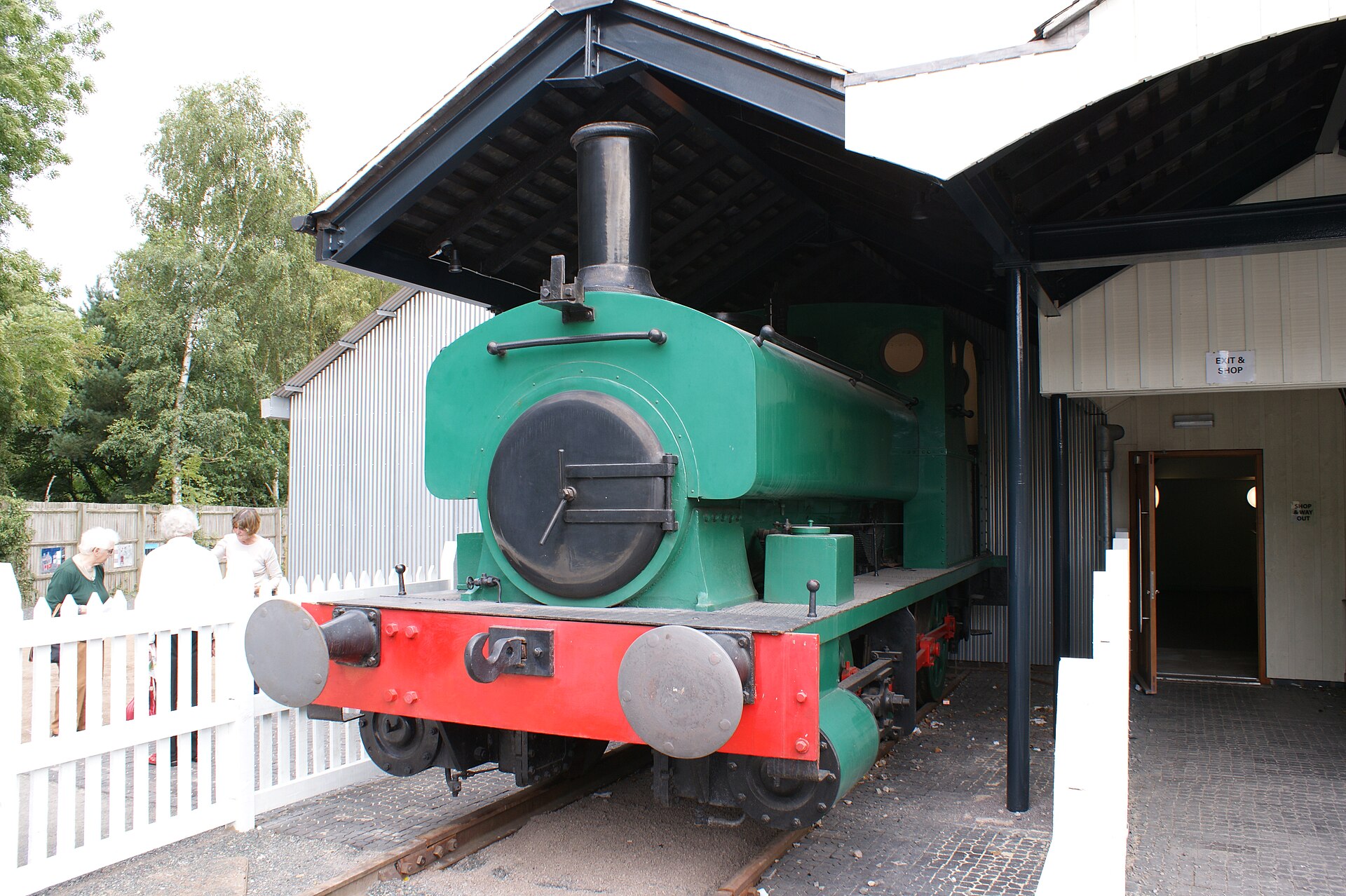
The colliery locomotive survives. After Kinlet closed, Barclay 782 was sold to H. S. Pitt & Co. of Pensnett and renamed Peter; it is now a static exhibit at the Ironbridge Gorge Museum’s Blists Hill Victorian Town. No description of the pit site itself is recorded.
The route of the colliery branch railway, shared latterly with Billingsley, and Borle Viaduct, which the workings undermined. No surviving colliery structure is recorded.
Related mines
- Billingsley Colliery — The Billingsley Colliery Company’s railway, laid after 1910, joined the existing Kinlet Railway and reached the Severn Valley line through the same sidings; in 1915 Billingsley was sold to the Highley Mining Company, which already owned Kinlet.
- Highley Colliery — Both were Highley Mining Company pits. The company prospected in Kinlet parish from the early 1890s and struck coal there in 1894; in 1914 it employed 391 men at Highley and 306 at Kinlet.
Nearby mines
- Highley Colliery — 1.4 miles (2.3 km) N
- Alveley Colliery — 1.7 miles (2.8 km) N
- Billingsley Colliery — 2.6 miles (4.3 km) NW
- Bayton Colliery — 5.8 miles (9.3 km) SW, Worcestershire
- Mamble Colliery — 6.9 miles (11.1 km) SW, Worcestershire
Straight-line distance, within 9 miles (15 km). Show on the map.
Recorded claims
Individual factual claims, each attached to the source(s) that support it below. Where sources disagree, both are kept.
- When built by the Highley Mining Company the site had no road access, so the mining leases granted by the Kinlet Estate of William Lacon Childe also made provision for a railway connection; a short branch was taken off the Severn Valley Railway around 1900. 1
- The branch was worked by a small 0-4-0ST named Kinlet, built by Andrew Barclay & Sons as Works No 782 of 1896 and delivered new to the colliery. After the colliery closed it was sold to H.S. Pitt & Co of Pensnett and renamed Peter; it survives as a static exhibit at Blists Hill Victorian Town. 1
- Production started in the late 1890s but the mine proved difficult to work, due to basalt rock affecting the only seam to produce coal. 1
- The colliery employed around 150 men by the turn of the century, rising to around 300 by the start of the First World War, by which time the annual output was about 50,000 tons. In 1914 the figure recorded is 306 men at Kinlet against 391 at Highley. 1,2
- Mining at Kinlet Colliery was responsible for the subsidence affecting the nearby Borle Viaduct. 1
- The colliery was abandoned in September 1937, when the leases on the Kinlet Estate expired. 1
Photographs & further reading
The Kinlet section covers the lease that provided a railway in place of a road, the Barclay locomotive and its later life, the basalt that spoiled the seam, and the subsidence under Borle Viaduct.
View sourceSources
- (secondary) Collieries served by the Severn Valley Railway — SVR Wiki, Severn Valley Railway
- (secondary) The Highley Mining Company — Discovering Shropshire's History
- (primary) BGS mine plans catalogue: Kinlet — British Geological Survey
Record created: 7 September 2026 · Last researched: 7 September 2026