 MineArchive
Ironstone
| Category | Commodities |
|---|---|
| Commodity page | Ironstone → |
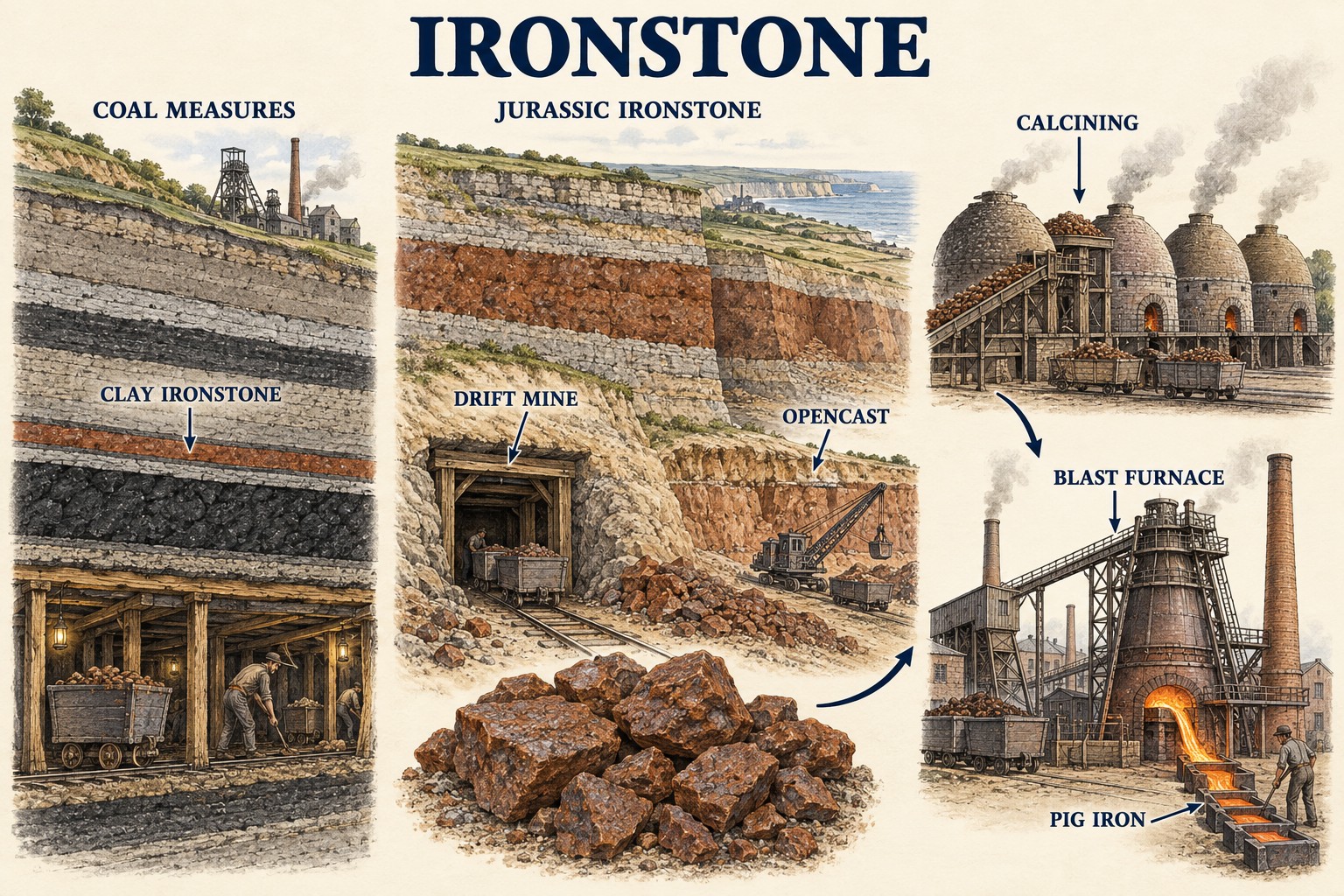
A sedimentary rock — clay ironstone in the Coal Measures, or the distinct Jurassic ironstones of the Cleveland, East Midlands and southern England belt — containing enough iron carbonate or oxide within a clay or shale matrix to be worked commercially as an iron ore.
Historical usage
Ironstone has been worked in Britain since at least the Iron Age, with continuous production from the Roman period onward in the Weald, the Forest of Dean, Northamptonshire and southern Lincolnshire. Coal Measures clay ironstone became the principal ore of the early Industrial Revolution once coke smelting was developed in the eighteenth century, extraction concentrating on coalfields such as the Black Country, Derbyshire, and South and West Yorkshire, where it was conveniently found alongside the coking coal and limestone a blast furnace also needed. The industry's greatest expansion came after 1850, when John Vaughan and John Marley discovered the thick Main Seam of Jurassic ironstone at Eston, triggering large-scale mining across the Cleveland Ironstone Formation of north-east Yorkshire; by 1870 Cleveland ironstone was supplying 38% of Britain's iron and steel, and regional output peaked in 1883 at around 6.75 million tonnes, when Cleveland was considered the world's leading iron-producing district. The last commercial ironstone mine, North Skelton, closed in January 1964.
How it worked
Coal Measures clay ironstone was generally worked alongside coal seams by the same room-and-pillar and longwall methods used for coal itself. The thicker Jurassic ironstones of Cleveland and the East Midlands supported dedicated ironstone mines and quarries: shaft mining reached considerable depths in eastern Cleveland (720 feet at North Skelton), most drift mines and shallower workings used pillar-and-bord extraction, and some districts (Grosmont) used a 'double-stall' variant; early coastal sites simply quarried exposed ironstone from beaches and cliffs. In Northamptonshire and similar softer, shallower Jurassic ironstone districts, opencast quarrying dominated instead, needing no timber propping and lending itself readily to mechanisation. Some ore, notably at Rosedale, was roasted (calcined) with coal at the mine to drive off impurities and reduce the weight hauled to the furnace.
Why it was used
Ironstone was, for most of the Industrial Revolution, the cheapest and most accessible iron ore available near Britain's coalfields — found in the same Coal Measures as the coking coal and limestone a blast furnace needed, avoiding the cost of importing ore from elsewhere. The later, much larger Jurassic deposits of Cleveland offered a similar advantage at far greater scale, letting Teesside grow into one of the world's major iron and steel districts within a single generation of the Main Seam's 1850 discovery.
Value over time
The Cleveland ironstone boom of 1850-1883 fed directly off the ready availability of coking coal and limestone in the same district, driving Teesside from open marshland into one of the world's major iron-producing regions within little more than a generation; the industry's subsequent collapse came not from exhausted demand but from cheaper, purer ore becoming available elsewhere as the richest Cleveland seams thinned and deepened, a decline compounded by the 1920s recession and 1930s depression. North Skelton, the last commercial ironstone mine anywhere in Britain, closed in January 1964.
Hazards & challenges
Roof falls were the principal hazard in pillar-and-bord ironstone workings, particularly once pillars themselves were being extracted (a 'judd' formed and the roof deliberately allowed to collapse behind the retreating face) — a documented Cleveland fatality in May 1885 records a miner killed by a roof fall he and his workmates had already judged unsafe but did not expect to collapse so soon. Subsidence from worked-out ironstone ground caused serious surface damage in Cleveland mining villages, in one recorded case at Boosbeck leaving 700 people homeless, and an inrush of water closed workings there in 1887; polluted drainage from abandoned ironstone mines continued to affect local becks for decades after closure. Compared with coal mining, firedamp was less of a defining hazard in most ironstone districts, though roasting/calcining ore at the mine introduced its own separate risks of heat and fumes.
Risks & limitations
Most ironstone, whether from the Coal Measures or the Jurassic belt, carried enough phosphorus to make troublesome ('cold-short') brittle wrought iron unsuited to fine work or to the acid Bessemer steelmaking process, which demanded low-phosphorus ore; this economic limitation, not any shortage of ore, was why purer haematite from Furness and West Cumberland was shipped in as a blending supplement throughout the nineteenth century. Ironstone's own iron content was also comparatively low — as little as 17-37% as mined, against 55-70% for the haematite and magnetite ores worked elsewhere in Britain — meaning a large tonnage of rock had to be raised and often roasted for every tonne of usable iron. Cleveland ironstone's fortunes ultimately turned on cost rather than chemistry: by the interwar period, opencast Northamptonshire ore could be delivered some five shillings a tonne cheaper than deep-mined Cleveland stone, and the richest, most accessible Cleveland seams were by then increasingly worked out, leaving what remained deeper and more expensive to raise just as cheap imported ore from Sweden and elsewhere became readily available at Teesside's own quaysides.
Regional variation
Clay ironstone was worked wherever it occurred alongside coal across the English and Scottish coalfields, most heavily in the Black Country, Derbyshire, South and West Yorkshire, and central Scotland. The much thicker Jurassic ironstone belt runs from Oxfordshire and Northamptonshire north to Lincolnshire and on to Cleveland and the North York Moors, with mining methods varying by depth and thickness along its length: shallow, easily worked Northamptonshire ironstone was mostly opencast, while the deeper, harder Cleveland seams needed proper shaft and drift mining. The Forest of Dean and parts of south-west England instead worked haematite and limonite ores, outside the ironstone tradition proper.
Related terminology
Blackband Ironstone, Coal Measures, Iron
Mines associated with this term
5 examples chosen from 112 linked records — the term page is not an index.
- Flockton Collieries — West Yorkshire (well documented example)
Named twice in this record, first in the history: “…at Emroyd Common in 1796 with the right to make railways, took the ironstone rights two years later, and a plan of 1801 shows nine ironstone pits…” - Greetwell Ironstone Mines — Lincolnshire (well documented example)
Named 11 times in this record, first in the summary: “An extensive system of ironstone quarries and shallow adit mines in Greetwell Hollow, on the…” - Aldridge Colliery — Staffordshire (well documented example)
Returned alongside the coal from both pits from 1900 onwards — South Staffordshire ground where the ironstone and the coal lie together. - Auchenbegg Colliery — South Lanarkshire (well documented example)
Named in this record’s geology: “…and Six Feet and Smithy coals of the Lesmahagow coalfield, with ironstone.” - Aysdalegate Mine — North Yorkshire (well documented example)
Named twice in this record, first in the summary: “A Cleveland ironstone mine above Lockwood Beck, worked by the Barninghams from 1863 and by…”
See every mine that worked ironstone →
Disasters associated with this term
Included only where MineArchive's own research gives a reasonable evidential basis, with the nature of the relationship stated — not every disaster where this term might plausibly apply.
- Barrwood Colliery explosion and fire, 1878 (contextual relationship)
Named in this record’s summary: “…and the bottom of the downcast shaft filled with flame. Men in the ironstone workings escaped to the upcast, but those in the main dook were cut…” - Boosbeck subsidence, 1883 (contextual relationship)
Named 7 times in this record, first in the cause: “Improper working of the ironstone by pillar extraction and goafing close beneath the village, found at…” - Oakley pit explosion, 1856 (contextual relationship)
Named 3 times in this record, first in the summary: “…near Dunfermline. The three colliers working on it to open an ironstone seam were killed, and the blast threw missiles out of the shaft that…” - Rosehall Colliery electrocution, 1903 (contextual relationship)
Named in this record’s narrative: “…until a miner struck the wires with a hammer; the bottomer at the ironstone mid-working was shocked too. At the same moment, on the haulage…”
Sources
- (secondary) Iron and Ironstone — National Association of Mining History Organisations
- (secondary) Ironstone mining in Cleveland and North Yorkshire — Wikipedia
Record created: 3 September 2026 · Last researched: 3 September 2026