 MineArchive
Greetwell Ironstone Mines
| Also known as | Greetwell Ironstone Mines & Quarries, Greetwell Mine, Wilson's Mine, Long Harry Mine, Rudgard's Mine, Greetwell Hollow |
|---|---|
| Location | Greetwell Hollow, Lincoln, Lincolnshire — 53.2397, -0.5038 (exact) |
| Commodities | Ironstone, Limestone |
| Type | Ironstone |
| Worked | c. 1873–1939 |
| Maximum depth | Unknown. The mines were shallow by nature, entered by adits driven into the quarry faces and rising at about 1 in 70, though a shaft is recorded at Grundy's No. 1. |
| Operators | Mid-Lincolnshire Ironstone Company (?–1938), Lincoln Stone Quarries (1939–?) |
Overview
An extensive system of ironstone quarries and shallow adit mines in Greetwell Hollow, on the north-eastern edge of Lincoln, worked by the Mid-Lincolnshire Ironstone Company from the 1870s until ironstone getting ended in the late 1930s. Greetwell was the northernmost occurrence of Northampton Sand ironstone, which was wanted at the Frodingham furnaces near Scunthorpe because it could be mixed with the local ore to give a self-fluxing charge. Around five million tons of ore came out over some sixty years, roughly two thirds of it from underground pillar-and-stall workings rather than from the quarry faces. It was a famously conservative operation: horses were still drawing the 2 ft 6 in gauge tubs into the 1930s, long after comparable ironstone tramways had mechanised. The site later produced limestone, and Greetwell Hollow is now a Lincolnshire Wildlife Trust nature reserve.
History
The ironstone beds of the Northampton Sand formation break surface along the Lincoln Cliff at about the 100-foot contour, and where a small tributary of the Witham has cut the shallow valley of Greetwell Hollow the ore was exposed on the gently sloping flanks. The date work began is not settled. J. D. Kendall, in the Geological Survey's 'The Iron Ores of Great Britain' (1893), gives 1873 for the earliest workings at Greetwell but does not fix their location, and the local historian Tim Hudson, drawing on Eric Tonks, suggests that date may belong to Monks Abbey quarry and mine a few hundred yards to the west, with 1878 the likelier start at Greetwell itself. The county Historic Environment Record, citing Stewart Squires's 2010 study in Lincolnshire History and Archaeology, dates the quarries east of Lincoln to 1875 and Greetwell Mine proper to 1879.
White's Directory of Lincolnshire for 1882 lists the Mid Lincolnshire Iron Co. under Greetwell as ironstone quarry lessees and miners of the Monk's Abbey and Greetwell ironstone mines, with Benjamin Ramsden as manager and resident in the parish. The company was renamed the Mid-Lincolnshire Ironstone Co. Ltd from 27 July 1885. Its timing was fortunate: the ironworks of the Frodingham and Scunthorpe area were opening, and Frodingham ore alone would not serve in the furnace. Mixed with Northampton Sand ore it gave a self-fluxing charge, and Greetwell was the nearest source of that ore to the north. The Manchester, Sheffield and Lincolnshire Railway ran at the foot of the hill.
Development was quick. Some twenty acres were being worked opencast near the road by 1886, with mining from 1878; Wilson's quarry was started in 1888, and from one of its faces an adit was driven rising at about 1 in 70 into Wilson's Mine, the largest of the group. By 1904 the tramway reached almost to Wragby Road. Other workings followed east of the main line — Grundy's No. 1 and No. 2 mines and Grundy's quarry, the East Drift, Long Harry, and finally Rudgard's, named for the farmer whose land it lay under and worked from about the turn of the century until roughly 1938.
Employment returns in the government Lists of Mines show the shape of the operation: 116 people in 1894, 46 of them below ground; a peak of 178 in 1900, with 87 below; then decline to 92 in 1905, 74 in 1910 and 67 in 1915. From 1905 onward the great majority of those employed worked underground, which reflects how far the quarries had already been worked out.
Greetwell's importance fell away through the 1920s and 1930s. Much of the good stone had gone and what lay to the east was poorer. Despite the short haul to Scunthorpe, costs were higher than at the newer quarries in the south of the county, where winning and haulage had been mechanised. Plans of abandoned mines were deposited for Wilson's Mine on 29 September 1937 and for Grundy's, the East Drift, Long Harry and Rudgard's on 9 July 1938. Some limestone and a little ore were still got, but by 1939 ironstone working had ceased. The property passed to Lincoln Stone Quarries, which stepped limestone output up, largely for aerodrome runways, and turned to lorry haulage about 1944; the tramway was dismantled after a period of idleness. Quarrying on the site continued on a far larger scale under later operators and was still going in August 2003.
Geology
The ore was the ironstone of the Northampton Sand formation, a Middle Jurassic bed that crops out along the Lincoln Cliff at roughly the 100-foot contour and was exposed again on the flanks of Greetwell Hollow where a tributary of the Witham had cut into it. Greetwell was the most northerly occurrence of this ore, and that fact governed the economics of the site: Frodingham ore from the Scunthorpe field was not suitable on its own, but blended with Northampton Sand ore it produced a self-fluxing furnace charge. Because the bed lay near surface and roughly horizontal, it could be taken first by opencast quarrying and then followed underground on the level through adits. Beneath and around the ironstone is the Jurassic limestone of the cliff, which the quarries turned to once the ore was worked out; its faces carry shelly and coral debris from the shallow tropical sea in which it formed.
Geological setting: Sedimentary Beds and Seams (well documented example)
Workings
Underground work was by pillar and stall, the ore reached through adits driven into the quarry faces rather than by shafts, so the mines were shallow. Wilson's Mine, the largest, covered about a quarter of a square mile on both sides of what is now Outer Circle Road. When an area was finished the pillars were robbed of their ore on the retreat, and the surface above came down. Tim Hudson records a local story that the men, unpaid when the mine closed, pulled the supports out and sold them for scrap, and reads it as a garbled memory of pillar robbing.
The whole system was tied together by a 2 ft 6 in gauge tramway of light spiked track running down Greetwell Hollow to a tipping stage set astride a standard gauge siding, where a metal chute let the side-tipping tubs discharge into main line wagons. The company owned a number of dumb-buffered standard gauge wagons lettered MLIC. The tramway passed under the Lincoln to Fiskerton road in a brick-lined bridge and, from about 1925, under Outer Circle Road by the red girder structure known as Wilson's Bridge.
Haulage stayed with horses for almost the whole life of the mines. Two attempts at mechanisation failed. An unusual front-tank Andrew Barclay 0-4-0T (works number 1246 of 1911), numbered 1 and built without a cab, was too heavy for the light track, could not work underground, and was confined to the run between the adits and the tipping stage before being advertised for sale in March 1916. A 16 hp Ruston and Hornsby diesel (170374 of 1934) arrived in August 1934, possibly for Wilson's Mine, but by then little workable ore was left; it lasted under a year and went on to the company's new mines at Nettleton. That locomotive survives, later running on the Welshpool and Llanfair Railway as No. 3 Raven.
Closure
Ironstone getting ended by 1939 after a long decline: the better stone was gone, the eastern ore was poor, and an operation still using horses could not match the mechanised quarries of south Lincolnshire even with a shorter haul to Scunthorpe. Abandonment plans for the underground mines were deposited in 1937 and 1938. The Historic Environment Record, following Squires, puts the working out of Greetwell Mine itself by 1909 with the associated quarry running to 1933, and closure of the wider quarries by 1923; Hudson's account has Long Harry and Rudgard's still at work into the mid 1930s. The site did not fall idle at that point: Lincoln Stone Quarries bought it and worked limestone, and quarrying of one sort or another continued until 2003.
What remains
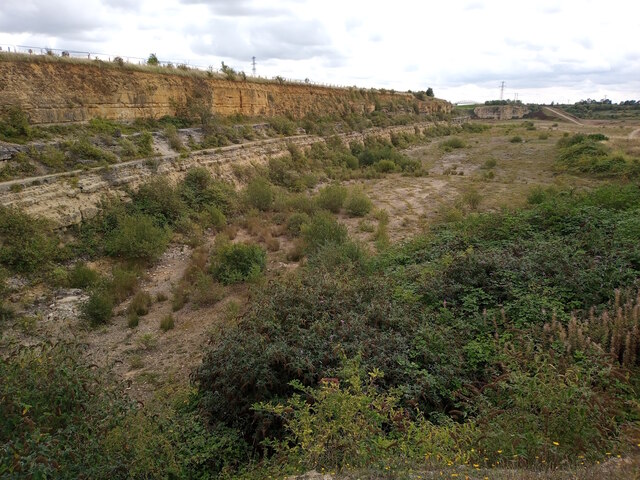
Greetwell Hollow is a Lincolnshire Wildlife Trust nature reserve of undulating grassland, scrub and marshy ground with a stream running through it, and the adjoining Old Quarry is open ground of bare bedrock, spoil and limestone faces. The southern part of the Hollow and much of the Old Quarry are designated Sites of Special Scientific Interest. Writing in Lincolnshire Life in April 2013, John Bennett described the pits, gullies and hollows left by the ore working as softened by vegetation, with long level terraces marking the courses of the narrow gauge tramways, and noted that the limestone quarry to the west had still been active as late as August 2003. A Geograph photograph taken in August 2023 shows the quarry cliff edge with the ground below reclaimed by scrub and grass.
Little of the industrial fabric survives. The tramway tunnel under Greetwell Road has collapsed, though the site can be identified, and the course of the line is marked by a hedge and a bush-lined embankment; a trace of embankment on ironstone-red soil survives in a small field within the Allenby Road trading estate. Greetwell Hollow Farm is reduced to a boundary wall along Greetwell Road. Later large-scale quarrying removed all trace of the Long Harry and East Drift mines, and operators have occasionally cut into the old workings and found props and rails still in place. The approach to Rudgard's Mine could still be made out in 1984, the adit filled but a little fallen away. Rotting tramway wagons lay in the bushes into the 1950s and were largely taken in a scrap drive; one tub, transferred to Nettleton and rescued in 1966, is preserved at the Museum of Lincolnshire Life beside a Ruston and Hornsby locomotive.
Redevelopment
The southern end of the site, around the former tipping stage and stables, was levelled for the Allenby Road trading estate, and the Outer Circle Road frontage that once carried Wilson's Bridge is now commercial development. Writing in 2013, John Bennett noted proposals for several hundred houses on the Old Quarry and a projected Lincoln Eastern Bypass passing close to its south-eastern corner; the City of Lincoln Archaeology Unit had assessed the bypass corridor as early as 1992.
Related mines
- Nettleton Top Mine — Both worked by the Mid-Lincolnshire Ironstone Company, which developed Nettleton Top in the Wolds specifically to replace its nearly exhausted Greetwell workings; the Ruston and Hornsby diesel locomotive and some of the tramway wagons went from Greetwell to Nettleton in the 1930s.
What's uncertain
Points where sources disagree or the record could not be settled; both accounts are kept. All open questions in the archive.
- J. D. Kendall's Geological Survey memoir 'The Iron Ores of Great Britain' (1893) gives 1873 for the earliest workings at Greetwell, without fixing their location; Tim Hudson, following Eric Tonks, suggests that date may belong to Monks Abbey and puts the start at Greetwell itself at 1878. (disputed) 1
- The county Historic Environment Record, citing Stewart Squires's 2010 study, dates the ironstone quarries east of Lincoln to 1875 and Greetwell Mine to 1879. (disputed) 2,3
- The BGS mine-plans catalogue holds a Mining Remediation Authority abandonment plan titled 'Greetwell' (catalogue OM13147, Ironstone, dated 1881); the catalogue gives no location and the plan's details do not clearly tie it to this working, so it may belong to another of the same name. (uncertain) 6
Recorded claims
Individual factual claims, each attached to the source(s) that support it below. Where sources disagree, both are kept.
- About five million tons of ore were raised over some sixty years of working, roughly two thirds of it from underground rather than from the quarry faces. 1
- J. D. Kendall's Geological Survey memoir 'The Iron Ores of Great Britain' (1893) gives 1873 for the earliest workings at Greetwell, without fixing their location; Tim Hudson, following Eric Tonks, suggests that date may belong to Monks Abbey and puts the start at Greetwell itself at 1878. (disputed) 1
- The county Historic Environment Record, citing Stewart Squires's 2010 study, dates the ironstone quarries east of Lincoln to 1875 and Greetwell Mine to 1879. (disputed) 2,3
- Government Lists of Mines record 116 employed in 1894 (46 below ground), a peak of 178 in 1900 (87 below), then 92 in 1905, 74 in 1910 and 67 in 1915. 4
- Frodingham ore was not suitable for the furnace on its own but could be mixed with Northampton Sand ore to give a self-fluxing charge, and Greetwell was the northernmost occurrence of that ore, so its output went to Frodingham. 1
- Plans of abandoned mines were deposited for Wilson's Mine on 29 September 1937 and for Grundy's, the East Drift, Long Harry and Rudgard's mines on 9 July 1938. 1
- Horses were still moving the ore tubs into the 1930s, until the last mine closed, long after other ironstone tramways of any consequence had mechanised. 1,5
- After the ironstone was exhausted the site was quarried for limestone, and the quarry west of Greetwell Hollow was still active as late as August 2003. 5
- The BGS mine-plans catalogue holds a Mining Remediation Authority abandonment plan titled 'Greetwell' (catalogue OM13147, Ironstone, dated 1881); the catalogue gives no location and the plan's details do not clearly tie it to this working, so it may belong to another of the same name. (uncertain) 6
Photographs & further reading
Tim Hudson's detailed account of the Greetwell and Monks Abbey workings, drawn largely from Eric Tonks, covering the company, the individual mines and quarries, the tramway and its locomotives, and what was left on the ground. Includes a table of grid references for each working.
View sourceA map of the tramway and the mines and quarries it served, abstracted from Eric Tonks's work, with links to further illustrations and to notes on the Greetwell locomotives.
View sourceOwners, output years and employment figures taken from the government Lists of Mines between 1894 and 1915, with the names and circumstances of eight men killed at the mines and the Inspector of Mines reports the entries come from.
View sourceJohn Bennett's April 2013 article for Lincolnshire Life describing the Hollow and the adjoining quarry as they are now: the pits and tramway terraces left by the ore working, the SSSI designations, the limestone faces and the wildlife that has taken the ground over.
View sourceThe county Historic Environment Record entry for the mine, dating it 1879 to 1909 with the associated quarry worked until 1933, citing Stewart Squires's 2010 study in Lincolnshire History and Archaeology.
View sourceSources
- (secondary) Greetwell Ironstone Quarries & Mines: a short history — T. J. Hudson, photrek.co.uk
- (primary) MLI97797 - Greetwell Mine, Lincoln — Lincolnshire Heritage Explorer (Historic Environment Record)
- (primary) MLI89950 - Ironstone quarries east of Lincoln — Lincolnshire Heritage Explorer (Historic Environment Record)
- (primary) Greetwell (Ironstone) — Durham Mining Museum
- (observational) Greetwell Hollow and Old Quarry — John Bennett, Lincolnshire Life, April 2013
- (primary) BGS / Mining Remediation Authority mine plans: GREETWELL — British Geological Survey / Mining Remediation Authority
Record created: 10 September 2026 · Last researched: 10 September 2026