 MineArchive
Ore Chute
| Also known as | Chute (the shorter, more common form used in most British mine records), Ore Pass (modern international mining usage for a chute connecting multiple levels) |
|---|---|
| Category | Mine Workings & Access |
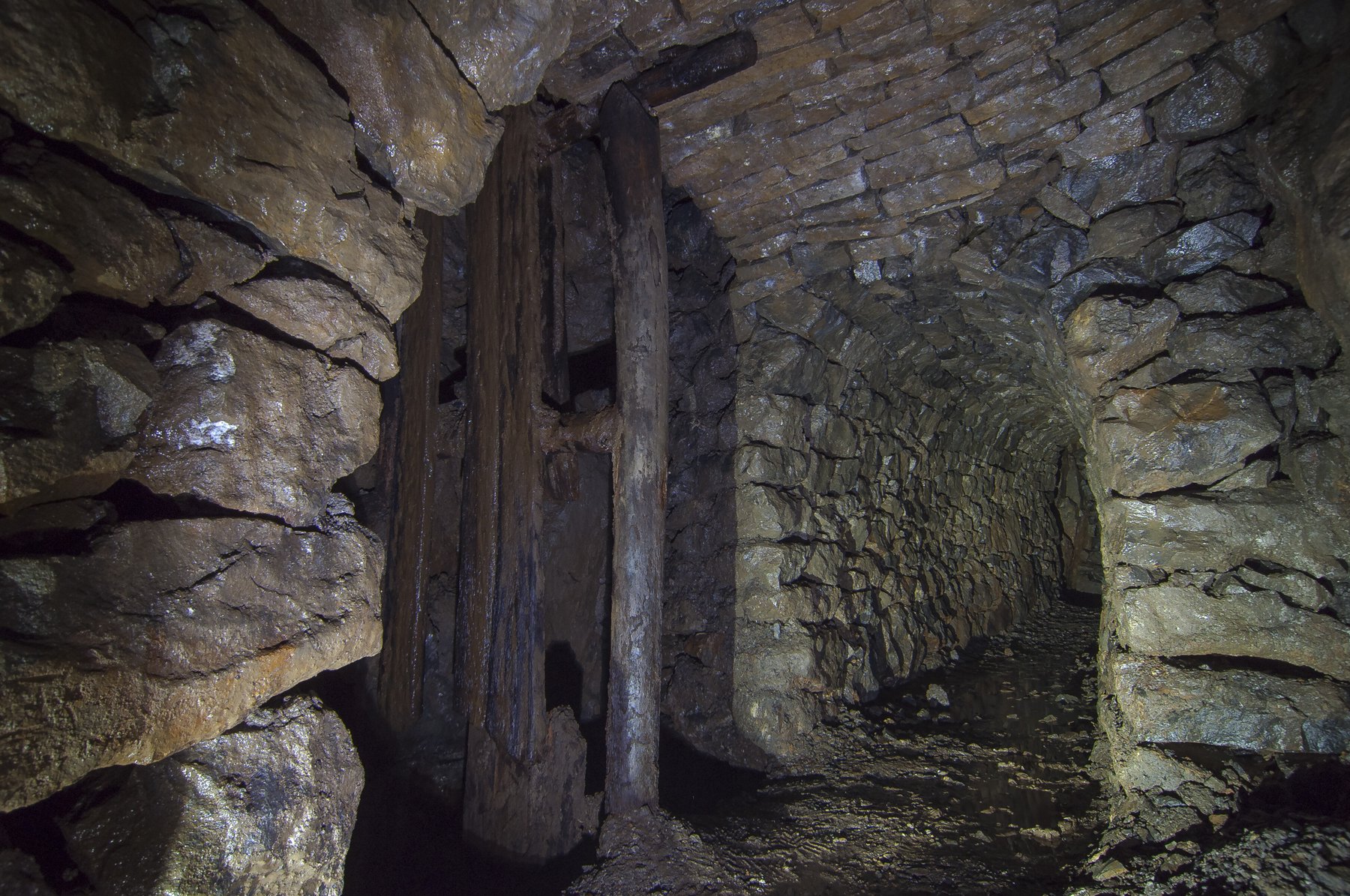
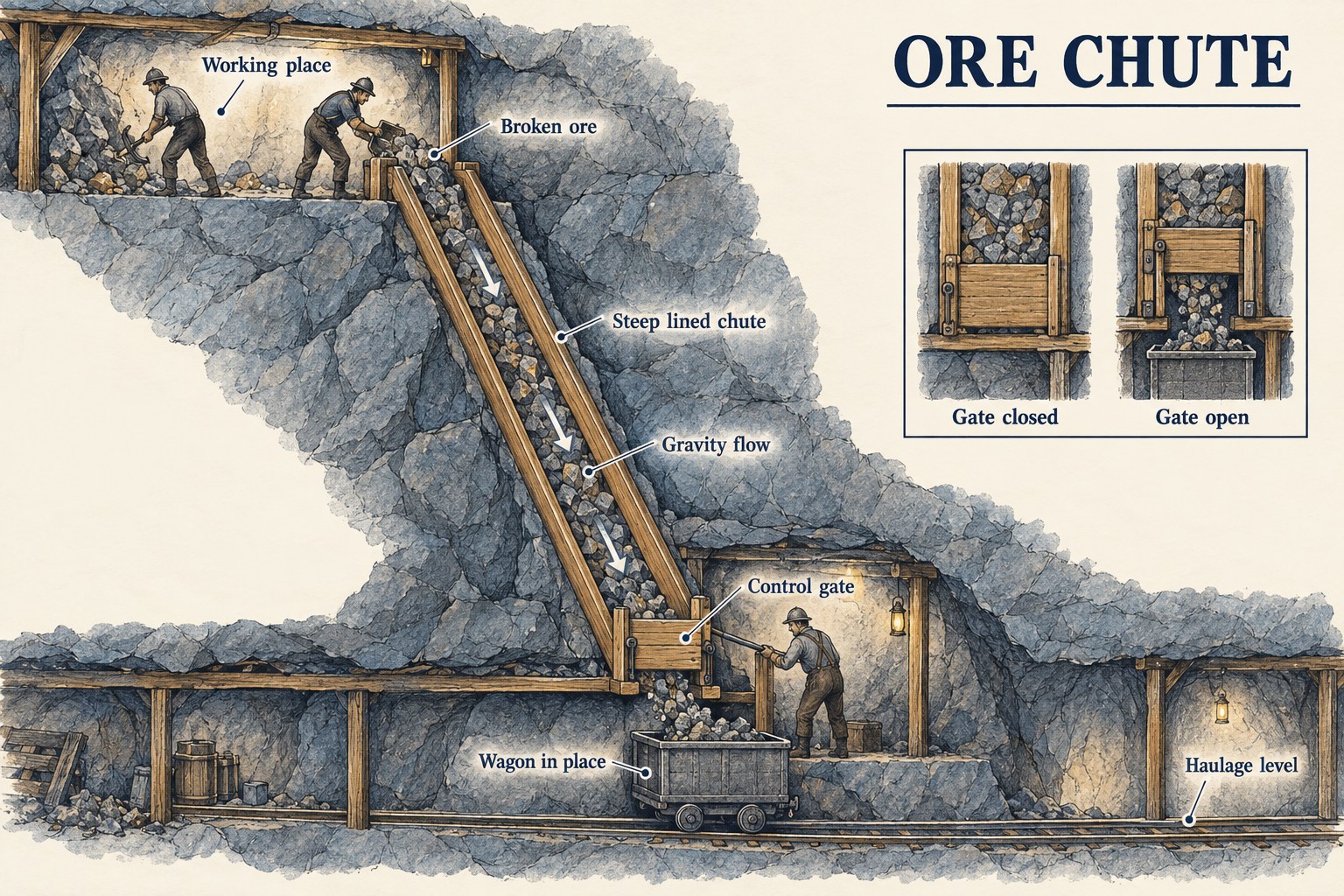
A stone- or timber-lined channel, usually near-vertical, used to move broken ore or rock down from a working place to a haulage level or directly into a wagon by gravity alone.
Historical usage
Chutes have been part of underground ore handling for as long as mines have worked more than one level, since gravity is the cheapest possible way to move broken rock downward. British metal mines commonly cut or timbered a chute alongside a working stope so that broken ore dropped straight to the level below rather than being carried or hoisted the full height by hand — Long Rake Spar Mine's underground workings, for instance, connected three levels with timber ore chutes running beside the tramway roads. At surface, the same gravity principle loaded ore straight from a stockpile or bin into a waiting wagon or cart, as recorded at the Good Luck Mine in Derbyshire, where ore was hauled in small tubs to chutes at the surface for loading out. The same basic device, under the same name, remains standard in modern underground mining, feeding ore passes into skips, trucks or conveyors.
How it worked
A chute was built as a timber, stone or (later) steel- or concrete-lined channel steep enough for broken rock to slide under its own weight, typically at an angle of 45 degrees or more with as flat a bottom as practicable to keep the ore moving rather than jamming. A gate at the discharge end controlled the flow and held back the column of ore above it until a wagon or tub was in place — early gates were often no more than a hinged or sliding board (a 'stopboard'), while heavier installations used a vertical guillotine door or, for coarser broken rock that could jam a simple board, an arc-shaped gate that closed upward.
Why it was used
Letting gravity do the work of moving broken ore down through a mine, or from a surface stockpile into a wagon, avoided the cost and labour of carrying or re-hoisting rock that had already been broken once — a chute needed no power beyond occasional maintenance of the gate and lining.
Risks & limitations
A chute's chief hazard was blockage: large or wet, sticky ore could arch or jam inside the channel, and clearing a blocked chute by hand or with a bar was a genuinely dangerous task, since a jam could give way suddenly and bury the man clearing it. Timber linings also wore quickly under the constant abrasion of moving rock and needed regular renewal.
Related terminology
Mines associated with this term
5 examples chosen from 19 linked records — the term page is not an index.
- Good Luck Mine — Derbyshire (surviving physical example)
Ore was hauled underground in small tubs to chutes at the surface for loading out -- one of the features that makes Good Luck Mine an unusually complete surviving example of a small Derbyshire lead mine. - Carrock Fell Mine — Cumbria (well documented example)
Named in this record’s workings: “…elevation; ore from the upper workings descended through internal ore-passes into hoppers at the main adit level for loading into tubs. No…” - Glenariff Iron Ore Mines — County Antrim (well documented example)
Named in this record’s history: “…Red Bay Pier itself, where the ore was shovelled by hand down wooden chutes into waiting schooners bound for smelters in Scotland, south Wales…” - Greetwell Ironstone Mines — Lincolnshire (well documented example)
Named in this record’s workings: “…a tipping stage set astride a standard gauge siding, where a metal chute let the side-tipping tubs discharge into main line wagons. The…” - Carnlough Limestone Quarries — County Antrim (well documented example)
Named twice in this record, first in the history: “…railway ran about three-quarters of a mile from the quarry to chutes on the quay, crossing the main street on the Arches; the inscription…”
Disasters associated with this term
Included only where MineArchive's own research gives a reasonable evidential basis, with the nature of the relationship stated — not every disaster where this term might plausibly apply.
- Caprington Colliery Inrush (contextual relationship)
Named in this record’s rescue and recovery: “…once worked as a roadsman, climbed the back air-course known as the chute towards the Ell coal, met water running down it, was caught by a…” - Creswell Colliery fire, 1950 (contextual relationship)
Named in this record’s cause: “…and not fully repaired; a piece of ironstone had wedged in the No.2 chute, pushing the belt aside and wearing at the rollers and belting until…”
Sources
- (secondary) ORE CHUTE — Thesaurus term — Aberdeenshire Council Historic Environment Record
- (secondary) Orepass and Chute — Underground Mining Glossary — MINE 2504 Glossary
- (secondary) Underground Ore Loading Chutes; Ore Chute Design — 911 Metallurgist
Record created: 29 August 2026 · Last researched: 29 August 2026