 MineArchive
Creswell Colliery fire, 1950
A conveyor-belt fire at a transfer point in Creswell Colliery's High Hazel seam killed 80 men by carbon monoxide poisoning on 26 September 1950, after fire cut off the only intake route and toxic smoke filled the sole usable return airway — one of the worst British coal-mining disasters of the post-war era.
| Date | 26 September 1950 |
|---|---|
| Mine | Creswell Colliery |
| Region | Derbyshire |
| Type | Fire |
| Fatalities | 80 (Of 131 men working inbye of the fire (232 were underground in total, 133 in the South-West District, of whom two left just before the fire started), 51 escaped by the return airway and 80 died. The 80 dead were recovered in two stages, corresponding to the official 1952 report's own Table 1 and Table 2: the majority on the day of the fire itself, and the remainder on 25 March 1951 after the sealed-off district was reopened.) |
| Context | During active mining |
Cause
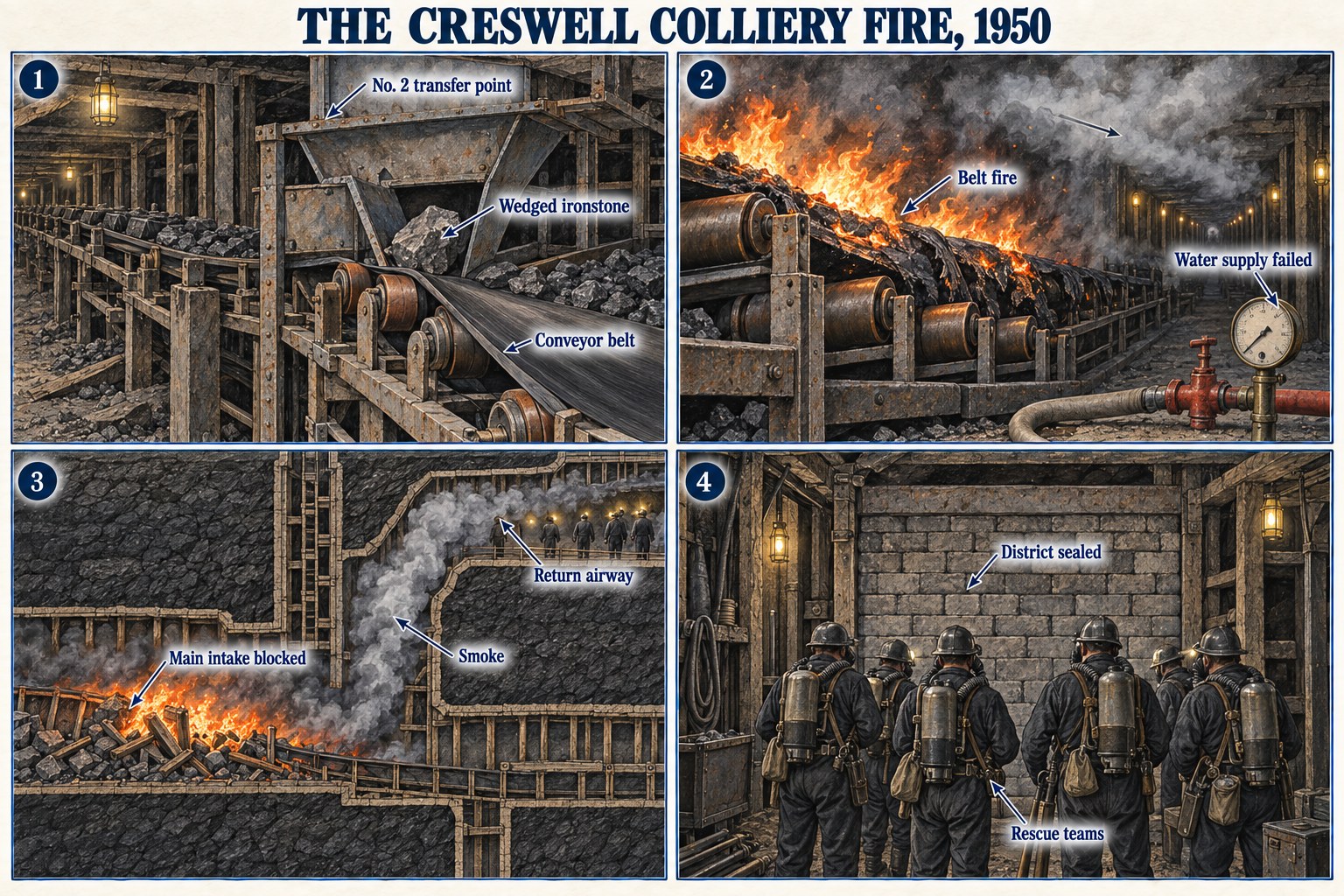
A conveyor belt had been damaged the previous day and not fully repaired; a piece of ironstone had wedged in the No.2 chute, pushing the belt aside and wearing at the rollers and belting until the belt itself — fuelled first by its cotton material and then by its rubber — caught fire at the No.2 transfer point around 3:45am.
Contributing factors
The Chief Inspector's inquiry identified four successive failures: the fire itself spread rapidly along the intake airway; firefighting failed because the water supply collapsed when a pump broke down on the night shift and surface officials were never told, so no backup was activated; men working inbye were not warned immediately; and the return airway — the only viable escape route, since the intake was blocked by the fire — filled with dense, fatal smoke before the trapped men could reach safety.
What happened
The fire began at the No.2 transfer point in the South Western Main Intake Haulage Road around 3:45am and spread rapidly. Of 131 men working beyond the fire, 51 escaped via the return airway before it too filled with smoke; the remaining 80 were overcome by carbon monoxide and died where they were trapped, in some cases in dead-end workings they had retreated into after finding both the intake and, eventually, the return route blocked.
Rescue & recovery
The fire's intensity made it impossible to fight directly; the affected district was sealed off to starve it of air, and it was not until the district was reopened, roughly a year later, that investigators could fully establish the fire's origin and the course of events inbye. Bodies were recovered in two stages: most on the day of the fire, and the remainder on 25 March 1951 once the sealed district reopened.
Investigation & inquiry
Chief Inspector of Mines Sir Andrew Bryan's inquiry opened at Creswell's Miners' Institute on 17 October 1950, heard 26 witnesses on conditions up to the point the fire was sealed, then adjourned; it resumed on 27 November 1951, once the district had been reopened, hearing eight further witnesses and re-examining four of the original ones, and concluded the next day. The Ministry of Fuel and Power published Bryan's full report in June 1952, listing the names, ages and occupations of every man who died.
Changes to practice & legislation
The report recommended fireproof construction around conveyor transfer points, non-inflammable belting where available, automatic overload and damage-detection devices, trained conveyor patrols, guaranteed water pressure before every shift with automatic shutdown if it proved inadequate, fire stations moved to the intake side of vulnerable points, distinctive emergency telephone signals, a dedicated evacuation official, and — its most far-reaching change — a statutory requirement for two separate main intake airways in major ventilation districts of new mines and new districts of existing ones, so that a single blocked route could never again leave men with no way out.
Memorials & commemoration
A memorial to the 80 dead stands in Skinner Street Cemetery, Creswell; a separate memorial garden with a sundial, on land donated by the Duke of Devonshire, was opened in Creswell churchyard in 1953.
Recorded claims
Individual factual claims, each attached to the source(s) that support it below. Where sources disagree, both are kept.
- A piece of ironstone wedged in the No.2 transfer chute wore at an already-damaged conveyor belt until it caught fire, fuelled first by its cotton material and then its rubber. 1
- Of 131 men working beyond the fire, 51 escaped via the return airway and 80 died of carbon monoxide poisoning after both the intake and return routes became blocked. 2,1
- The inquiry's most far-reaching recommendation was a new statutory requirement for two separate main intake airways in major underground ventilation districts, so a single fire could not again cut off both a district's supply route and its only escape route at once. 1
Related terminology
Mining terms this disaster is structurally linked to, with the nature of the relationship.
- Colliery (contextual relationship)
Named in this record’s summary: “A conveyor-belt fire at a transfer point in Creswell Colliery's High Hazel seam killed 80 men by carbon monoxide poisoning on 26…” - HM Chief Inspector of Mines (contextual relationship)
Named in this record’s investigation: “Chief Inspector of Mines Sir Andrew Bryan's inquiry opened at Creswell's Miners' Institute on…” - Ore Chute (contextual relationship)
Named in this record’s cause: “…and not fully repaired; a piece of ironstone had wedged in the No.2 chute, pushing the belt aside and wearing at the rollers and belting until…” - Return Airway (contextual relationship)
Named 9 times in this record, first in the summary: “…monoxide poisoning on 26 September 1950, after fire cut off the only intake route and toxic smoke filled the sole usable return airway — one of…”
Sources
- (secondary) Cresswell Colliery Conveyor Fire - Cresswell - 1950 — Northern Mine Research Society
- (secondary) A Tragic Loss of 80 Lives – A Village in Deep Mourning — Nottinghamshire Mining Museum
Record created: 27 August 2026 · Last researched: 27 August 2026