 MineArchive
Return Airway
| Also known as | Return air course (Older usage), Intake (The paired fresh-air roadway, given here because the two are only meaningful as a pair) |
|---|---|
| Category | Ventilation & Mine Gases |
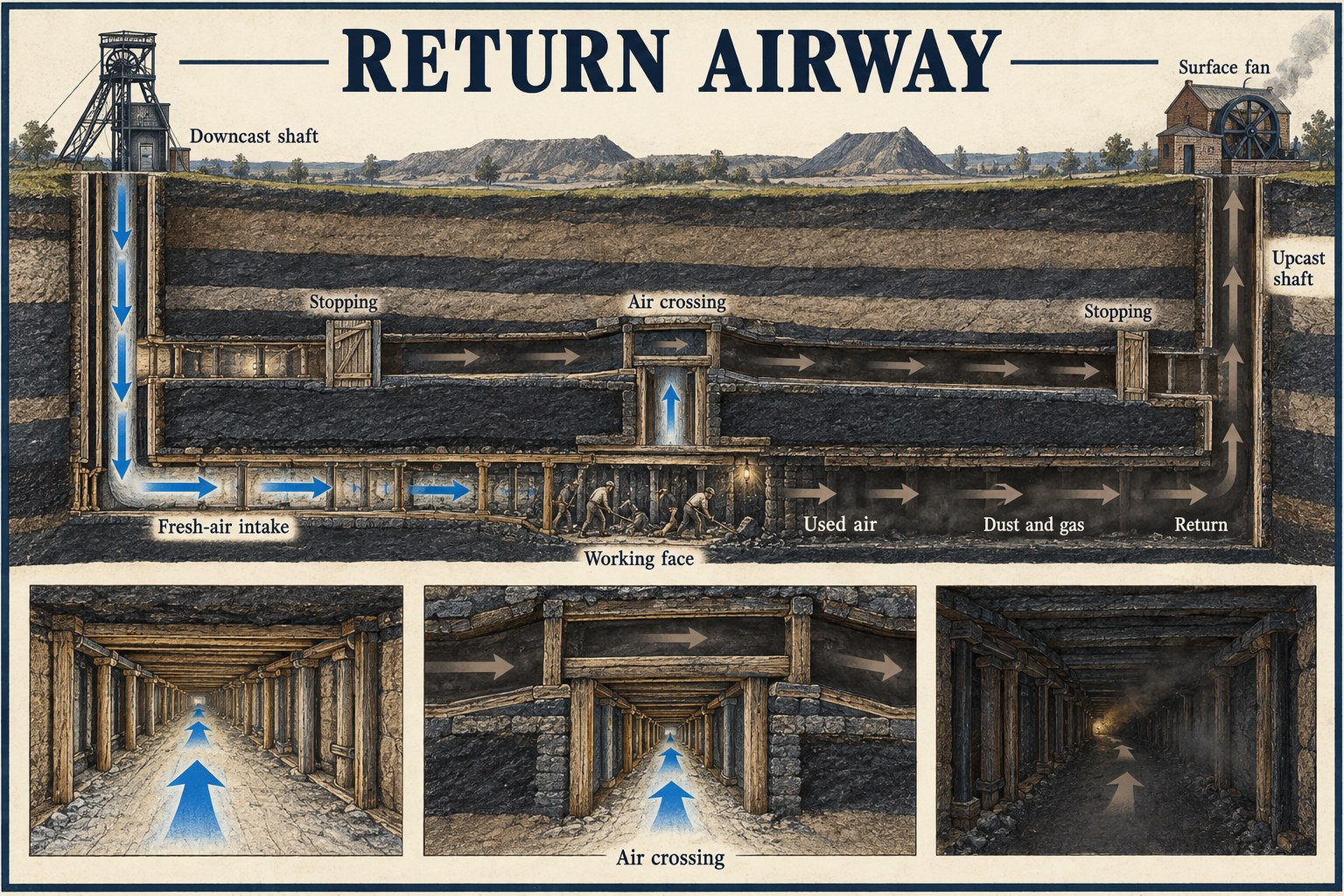
The roadway that carries used air back out of the workings. A ventilated mine has two separate air courses — the intake bringing fresh air in to the men, and the return taking the spent air, gas and dust away — and keeping the two apart is the whole basis of mine ventilation.
Historical usage
The intake-and-return arrangement is as old as mechanical ventilation in British mines, first driven by a furnace at the bottom of the upcast shaft and later by a fan at the surface. Where more than one district was being worked, the air was divided into separate circuits, or splits, so that air already used at one face could not be sent on to ventilate another.
How it worked
Air is drawn down the downcast shaft, along the intake roadways, past the working faces and back along the returns to the upcast shaft. Doors, stoppings and brattice keep the two streams from short-circuiting into each other, and where a return has to cross an intake an air crossing carries one over the other. Men work in the intake by design; the return carries whatever the workings have put into the air, so it is the most gaseous and dustiest part of the mine and is entered as little as possible.
Why it was used
Without a return there is no circuit, and without a circuit there is no ventilation — just a dead-end filling with firedamp, blackdamp and dust. Splitting the air into separate returns for separate districts also limits how far a problem in one district can travel.
Risks & limitations
Because the return is the gassiest and dustiest roadway in the mine, anything put in it that can produce heat or flame is exceptionally dangerous. The Baddesley Colliery disaster of 1882 is the clearest British case: a steam boiler was installed in the return airway at the extreme deep of the workings to drive a pump, with its roof cut away so that smoke and flame passed along the top of the airway and coal on either side. The engineer specified a brick archway around it, which was never built. The coal caught, the smoke filled the only road in or out, and thirty-two men died. The coroner's jury found it an error of judgement to have placed the engine and boiler so far from the shaft bottom in the return airway, in such an imperfect and unprotected manner. The other standing risk is more ordinary: a return that is too small, too long or leaking into its intake will not shift enough air, and inadequate ventilation is a recurring finding in colliery disaster inquiries — including William Pit in 1947.
Regional variation
'Return' and 'intake' are standard across the British coalfields; the shafts they end at are the upcast and downcast. Older accounts speak of the 'return air course'.
Related terminology
Afterdamp, Bad Air, Brattice, Chokedamp, Downcast Shaft and Upcast Shaft, Firedamp, Gate Road, Man-riding, Shaft
Mines associated with this term
5 examples chosen from 29 linked records — the term page is not an index.
- Auchengeich Colliery — North Lanarkshire (well documented example)
The No. 2 Pit workings, where the 1959 fire killed 47 men, were reached along a return airway — the route that carried the carbon monoxide to them. - Creswell Colliery — Derbyshire (well documented example)
Named in this record’s workings: “Coal was hauled to the surface along intake roadways served by a trunk belt conveyor system; it was a fault in…” - Bamfurlong Colliery — Greater Manchester (well documented example)
Named in this record’s history: “…Many of the men got out through the air doors into the clean return airway, but sixteen did not and suffocated. The fire began with a paraffin…” - Barley Hall Colliery — South Yorkshire (well documented example)
Named in this record’s history: “…305 yards long was driven at 1 in 4 to the Parkgate seam as a second intake for Thorncliffe, and named the Wembley Drift after the stadium…” - Brookhill Colliery — Derbyshire (well documented example)
Named in this record’s workings: “…of 1908-09. The old Pinxton No. 1, No. 3 and No. 6 shafts became air intakes and No. 2 the upcast, pumping water until Brookhill closed.”
Disasters associated with this term
5 examples chosen from 60 linked records, most direct relationship first.
- Cardowan Colliery explosion, 1960 (contributing factor)
Men were sent into the return while gas remained. - Ince Hall Arley Pit explosion, 1854 (contributing factor)
Return air was drawn downhill. - Weetslade Colliery Explosion (contributing factor)
Floor heave and falls in the flooded return airway blocked the second means of egress and forced the ventilation to be short-circuited. - Woodhorn Colliery explosion (contributing factor)
Gas had accumulated 58 to 93 yards beyond the last ventilation point, with the fan at reduced speed over the weekend. - Bamfurlong Colliery fire, 1892 (rescue/recovery concept)
Seventy-three escaped by the return airway.
Sources
- (primary) Baddesley Colliery Explosion — Atherstone — 1882 — Northern Mine Research Society
- (secondary) Ventilation — Basic Mining Process and Terminology — underground COAL
Record created: 25 August 2026 · Last researched: 25 August 2026