 MineArchive
Man-riding
| Also known as | Manrider, Man rider, Paddy Mail (the usual name for a rope-hauled set of man-riding tubs), Paddy train |
|---|---|
| Category | Mine Workings & Access |
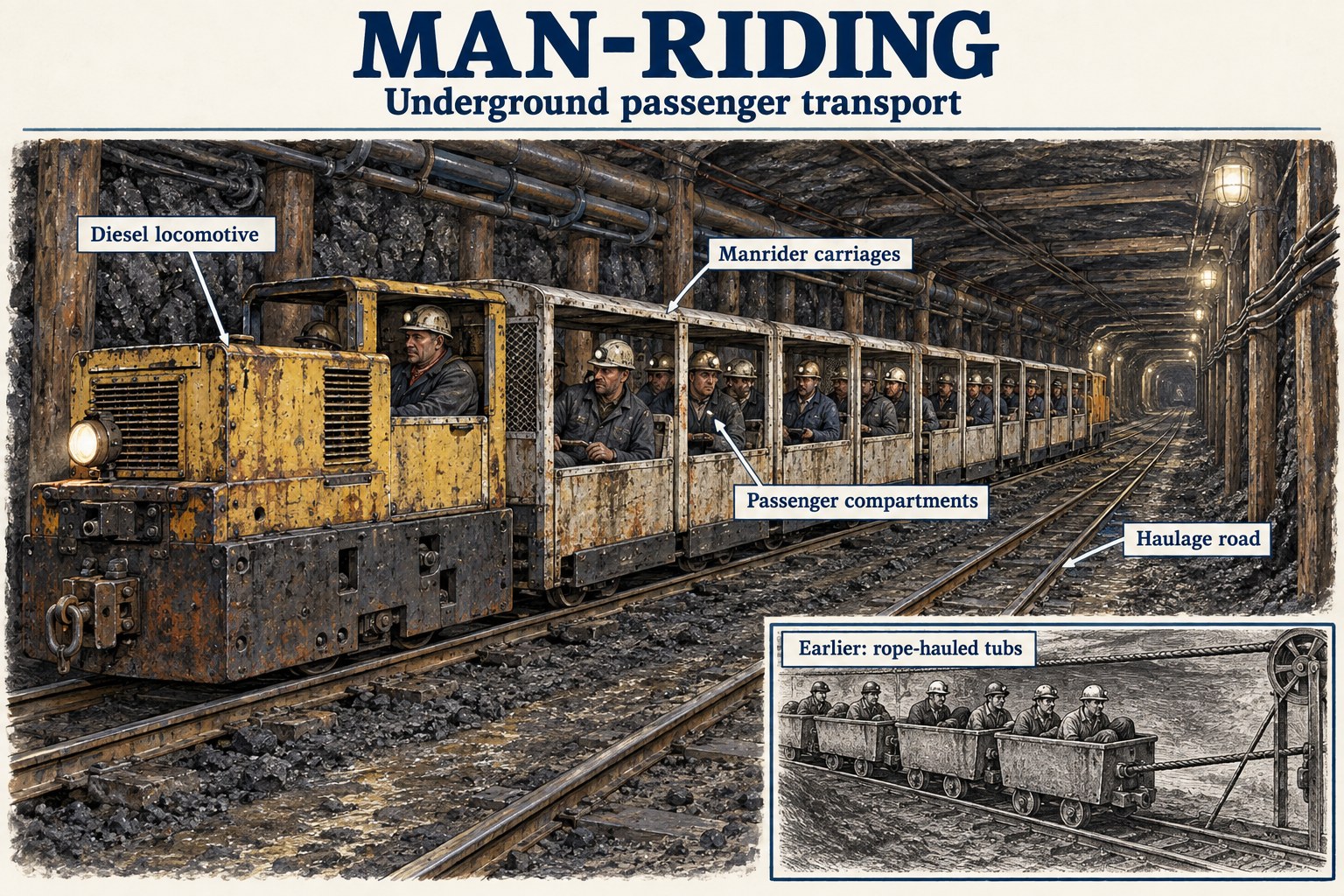
Carrying men underground to and from the face by machine rather than on foot — in rope-hauled tubs at first, later in purpose-built carriages behind a locomotive, and later still on conveyor belts.
Historical usage
As collieries drove further out from the shaft the walk became the longest part of a shift, and the haulage that moved the coal began to move the men. The early arrangement was simply to put them in the tubs: at Nunnery Colliery in Sheffield men rode a set of 44 tubs known as the Paddy Mail on the same rope that hauled the coal, up and down an incline about a mile long, for six years before it failed in 1923. By the post-war period the manrider was a proper train — at Bentley in Doncaster, diesel locomotives hauling Wickham carriages on a two-foot three-and-a-half-inch track, each carriage in four compartments, five men to a compartment by local agreement.
How it worked
On a rope system the set was lowered or hauled by the main engine at surface, with an attendant riding outside the leading tub to signal the engineman. Locomotive-hauled manriders ran to a signalling and control regime of their own: radio contact with a control point, colour-coded zones to keep trains apart, mechanical and air brakes, safety chains between carriages, and friction arrestors at the foot of an incline to catch a runaway.
Why it was used
Time and fatigue. A face two or three miles from the pit bottom costs an hour of every shift in walking, and men who arrive tired cut less coal — the same reasoning that put ponies and then locomotives on the haulage roads in the first place.
Risks & limitations
The hazard is the one every rope and gradient carries: a runaway with men aboard. Both of the British accidents that defined practice killed seven. At Nunnery in 1923 a signal was misread and the haulage rope broke with 120 men on the set; the inquiry condemned the use of spliced ropes for man-riding, recommended a maximum rope life and called for arresting gear. At Bentley in 1978 a driver started in the wrong gear on a 1-in-16 grade and could not stop, and the arrestor that should have caught the train was found with its operating handle pinned down by a bolt; thirteen recommendations followed, from level terminal stations to automatic speed-sensitive track brakes.
Regional variation
A deep-coalfield practice above all, and one that grew with the size of the workings — Yorkshire, the north-east, Scotland and South Wales. Metal mines rarely needed it: their levels were shorter and their manriding, where it existed, was more often a matter of riding a shaft than a road.
Related terminology
Cage, Haulier, Incline, Man-engine, National Coal Board, Putter, Return Airway, Stoneman, Tub
Mines associated with this term
5 examples chosen from 26 linked records — the term page is not an index.
- Auchengeich Colliery — North Lanarkshire (notable incident)
The No. 2 Pit workings were reached along a return airway travelled by man-riding trains — the route the 1959 fire filled with carbon monoxide. - Calverton Colliery — Nottinghamshire (well documented example)
Named twice in this record, first in the summary: “A colliery that began in 1937 as a ventilation and man-riding shaft for Bestwood and became, in 1952, the first new colliery…” - Moorgreen Colliery — Nottinghamshire (well documented example)
Named twice in this record, first in the history: “…died together under a fall of roof in 1876, and in November 1930 a man-riding train ran away down an incline, killing one man and injuring about…” - Silverwood Colliery — South Yorkshire (well documented example)
Named in this record’s history: “…came on 3 February 1966, when a runaway materials train — the 'Paddy Mail' — collided underground with a train carrying miners; ten men were…” - Barnsley Main Colliery — South Yorkshire (well documented example)
Named in this record’s closure notes: “…1929 before closing in 1966. In the 1970s the shaft was reused for man-riding while the coal was wound at Barrow Colliery. Production ceased…”
Disasters associated with this term
5 examples chosen from 13 linked records, most direct relationship first.
- Auchengeich Colliery fire, 1959 (direct cause)
A man-riding train carrying 48 men was sent into a return airway already full of carbon monoxide; 47 of them died. - Blaenclydach Colliery spake runaway, 1941 (relevant method/equipment)
The spake was a man-riding train. - Moorgreen Colliery Man-riding Accident, 1930 (relevant method/equipment)
The men were riding a haulage train underground when it ran away down the incline. - Yniscedwyn Colliery runaway, 1892 (relevant method/equipment)
The men rode a man-riding journey. - Cadean Slant manrider accident (contextual relationship)
Named 3 times in this record, first in the summary: “A link in the second shackle of the manrider train broke as the day shift rode out of the Cadean Slant at…”
Sources
- (secondary) Bentley Colliery Manrider Accident, Doncaster, 1978 — Northern Mine Research Society
- (secondary) Nunnery Colliery Manrider Accident, Sheffield, 1923 — Northern Mine Research Society
Record created: 25 August 2026 · Last researched: 25 August 2026