 MineArchive
Drift
| Also known as | Drift Mine (The wording the prose most often uses; added 2026-09-29 after 88 records were found using it.) |
|---|---|
| Category | Mine Workings & Access |
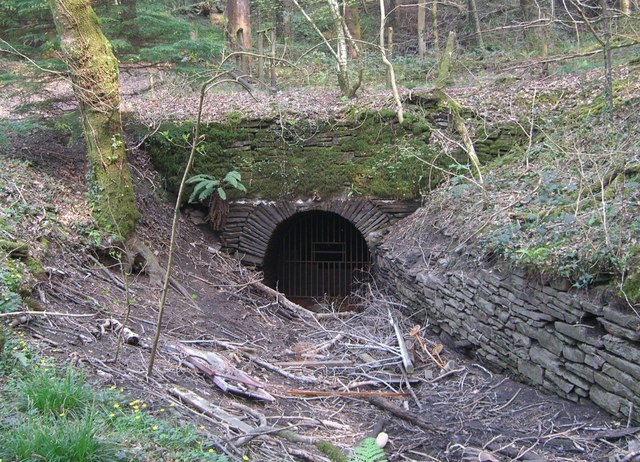
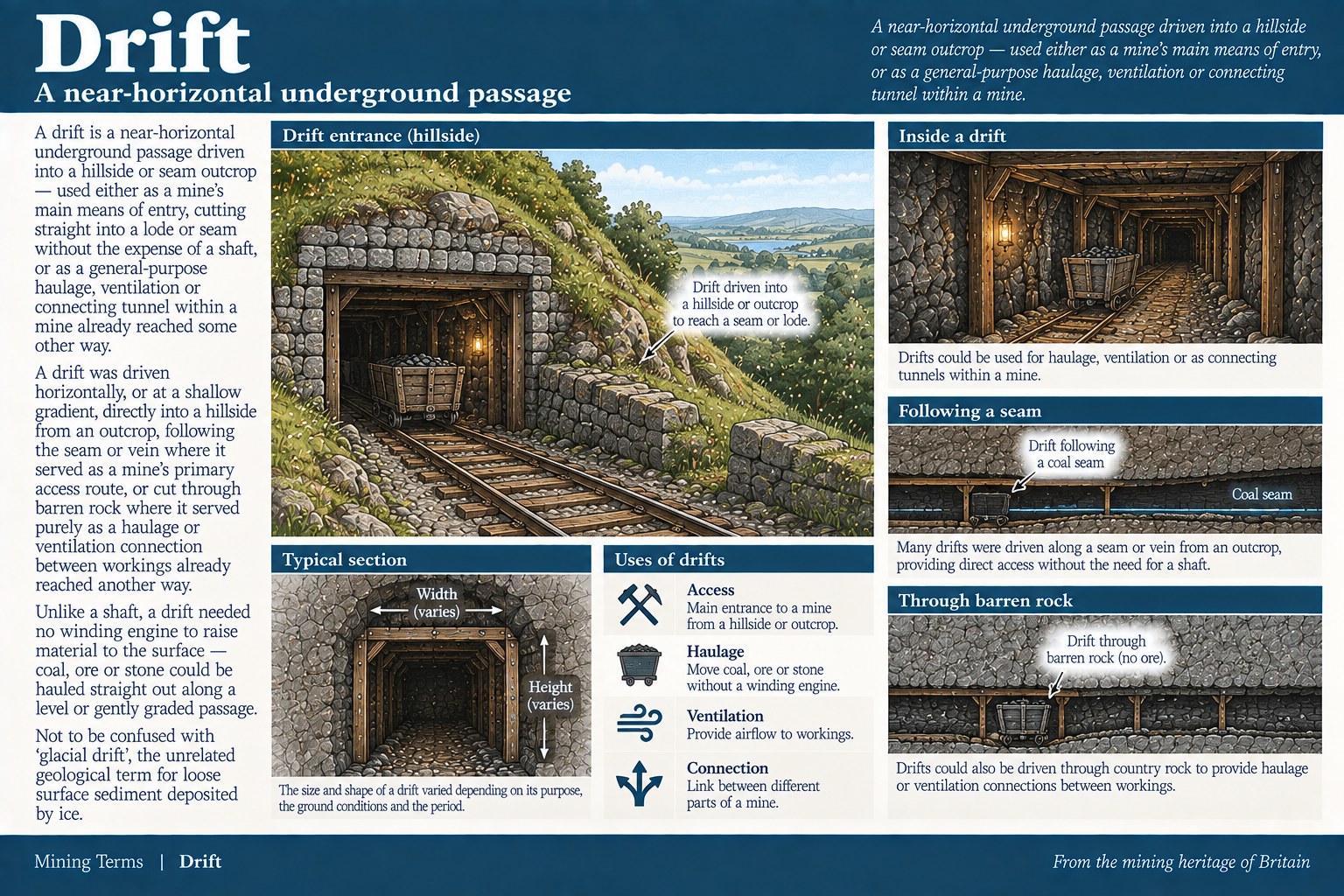
A near-horizontal underground passage driven into a hillside or seam outcrop — used either as a mine's main means of entry, cutting straight into a lode or seam without the expense of a shaft, or as a general-purpose haulage, ventilation or connecting tunnel within a mine already reached some other way. Not to be confused with 'glacial drift', the unrelated geological term for loose surface sediment deposited by ice.
Historical usage
Among the earliest forms of mine access in Britain, since a seam or vein outcropping on a hillside could be driven into directly, with no need to sink and equip a shaft first. Remained the standard entry method wherever the terrain allowed throughout the coal, metal and industrial-mineral industries — common across the steep valleys of the South Wales coalfield, in Staffordshire gypsum mining, and in the coastal jet workings of the North York Moors.
How it worked
A drift was driven horizontally, or at a shallow gradient, directly into a hillside from an outcrop, following the seam or vein where it served as a mine's primary access route, or cut through barren rock where it served purely as a haulage or ventilation connection between workings already reached another way. Unlike a shaft, a drift needed no winding engine to raise material to the surface — coal, ore or stone could be hauled straight out along a level or gently graded passage.
Why it was used
Driving a drift was cheaper and quicker than sinking a shaft, and, wherever a seam or lode actually outcropped on suitable ground, avoided the substantial capital cost of permanent winding machinery altogether.
Risks & limitations
A drift could only be used where the local topography — a hillside, a valley side, a seam genuinely reaching the surface — actually allowed a horizontal or shallow-graded route in; flatter-lying or deeper deposits still needed a shaft regardless of how many drifts served the shallower ground nearby.
Regional variation
Used across British coalfields and metal-mining districts alike; distinct from a Level, which specifically follows a lode, and from an Adit, which is specifically driven to drain a mine — a drift can serve either purpose, or simply general access and haulage, without either of those more specific implications.
Related terminology
Mines associated with this term
5 examples chosen from 278 linked records — the term page is not an index.
- Bedwas Navigation Colliery — Caerphilly (well documented example)
Named in this record’s geology: “…down to the Rhas Las or Black Vein, and thence by a cross-measure drift to the Hard Vein — the lowest coal then known in the Caerphilly…” - Blaenserchan Colliery — Torfaen (well documented example)
Named in this record’s history: “…changed again in 1977, when coal began reaching the surface via a drift at the Abertillery New Mine instead. Blaenserchan finally closed on…” - Bullcroft Colliery — South Yorkshire (well documented example)
Named twice in this record, first in the history: “…1968 Bullcroft was joined to Brodsworth Colliery by a 550-yard drift, with an 1,800-yard conveyor that allowed Bullcroft's coal to be…” - Eckington Mine — Derbyshire (well documented example)
Named 6 times in this record, first in the summary: “Eckington Mine was a drift mine on the eastern edge of Eckington in Derbyshire, seven miles…” - Eston Ironstone Mines — North Yorkshire (well documented example)
Named 9 times in this record, first in the summary: “…grew from a village to an iron town on the back of it. The last drift closed in September 1949.”
Disasters associated with this term
5 examples chosen from 44 linked records, most direct relationship first.
- Arkwright Town Methane Evacuation, 1988 (contextual relationship)
Named in this record’s contributing factors: “The pit had closed in April 1988 and its drifts were sealed, so the workings were no longer ventilated; older…” - Avonbraes mine explosion, 1841 (contextual relationship)
Named twice in this record, first in the summary: “…time on 16 March 1841 firedamp exploded in the Duke of Hamilton's drift mine in the Avon gorge near Quarter, killing six men and a boy inside,…” - Barrow Colliery shaft accident, 1874 (contextual relationship)
Named in this record’s narrative: “…new shafts to reach steam-coal seams that lay beneath the shallow drift workings already exploiting the Red Ash house-coal seam in the area.…” - Blaenclydach Colliery spake runaway, 1941 (contextual relationship)
The accident happened on the Abergorchy drift. - Brancepeth Colliery A Pit explosion, 1896 (contextual relationship)
Named in this record’s narrative: “…until nationalisation; it comprised three pits, A, B and C, and a drift. On 13 April 1896 an explosion of coal dust, ignited by shot firing,…”
Sources
- (secondary) Drift mining — Wikipedia
- (secondary) Drift | mining — Encyclopaedia Britannica
Record created: 24 August 2026 · Last researched: 24 August 2026