 MineArchive
Hopton Wood Quarries and Middleton Mine
| Also known as | Hopton Wood Stone Quarry, Middleton Mine, Middleton-by-Wirksworth limestone mine |
|---|---|
| Location | Hopton and Middleton-by-Wirksworth, Derbyshire — 53.0973, -1.5876 (exact) |
| Commodity | Limestone |
| Type | Quarry |
| Worked | From the 18th century–2005 (closure) |
| Operators | The Gell family (1700–1900), Hopton-Wood Stone Firms Ltd (1900–1959) |
Overview
England's premier decorative stone — a limestone so nearly pure it was sold as marble — cut for the Houses of Parliament, the Bank of England and Oscar Wilde's tomb, and then, after the Great War, into more than 120,000 war graves.
History
The stone was developed first by the Gell family and later by the Hopton-Wood Stone Firms Ltd. Wilson's Imperial Gazetteer of 1870-72 already noted that Hopton's building limestone was extensively quarried and had built Chatsworth House and Belvoir Castle. The firm held a large contract for stone flooring in the rebuilding of the Houses of Parliament, and the stone went into the Bank of England, the Tower of London, Westminster Abbey and Oscar Wilde's tomb. Its best known work came after the First World War: from 1920, in the depression, the quarry became a major contractor to the Imperial War Graves Commission, and more than 120,000 headstones were cut here and sent to cemeteries in France, Belgium and Britain. The Prince of Wales visited the masons' shed in February 1928. Work went underground in 1959 as Middleton Mine, which closed in 2005; surface quarrying ended the following year.
Geology
Hopton Wood stone is a Carboniferous limestone of remarkable purity — impurities have been put as low as 0.02 per cent — dense, fine and even enough to take a polish, which is why it was described as almost identical to marble and sold as England's premier decorative stone. That evenness is also what made it work as a war-grave stone: it carves crisply, weathers slowly, and can be produced identically by the hundred thousand.
Geological setting: Sedimentary Beds and Seams (well documented example)
Workings
Open quarrying on the hillside north of Hopton for most of its history, and then underground: work on a drift access began on 4 February 1959, and Middleton Mine grew into something like 26 miles of tunnels on three levels — the only underground limestone mine in the United Kingdom. Around 16 million tonnes were taken from the underground workings, at a peak of roughly 120,000 tonnes a year.
Closure
Middleton Mine closed in 2005 and quarrying finished in 2006. A reserve of the stone is kept at the National Stone Centre for restoration work on the buildings it was used in.
What remains
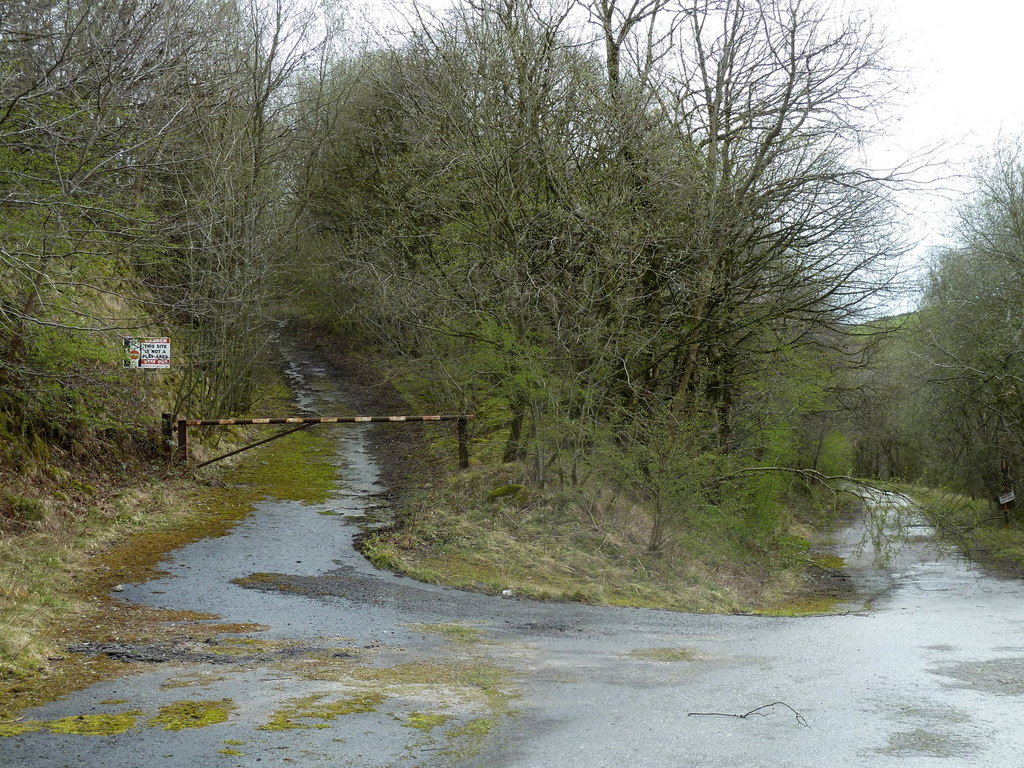
Disused. The old surface quarries at Hopton are wooded and their haulage roads still traceable; the underground mine is a very large void that has been used as a film location, including for Mission: Impossible and Lord of the Rings productions. It is well documented by explorers — reports run from a 2014 visit to the surface quarry through to a September 2023 underground report — and the workings are extensive and unlit.
The abandoned surface quarries and their tracks in woodland north of Hopton, and the mine entrances at Middleton.
Redevelopment
None as a mineral working; the underground space has found occasional use for filming.
Related mines
- Stancliffe Quarry — Another Derbyshire building-stone quarry whose product went to prestige work across the country.
Nearby mines
- Dovegang Mine — 0.6 miles (1.0 km) E
- Gang Mine — 0.6 miles (1.0 km) E
- Nether Ratchwood and Rantor Lead Mines — 0.6 miles (1.0 km) SE
- Bondog Hole Mine — 0.7 miles (1.1 km) W
- Via Gellia Lead Mines — 0.7 miles (1.1 km) NW
Straight-line distance, within 9 miles (15 km). Show on the map.
Recorded claims
Individual factual claims, each attached to the source(s) that support it below. Where sources disagree, both are kept.
- Hopton Wood stone is a remarkably pure limestone, impurities put as low as 0.02 per cent, described as almost identical to marble and as England's premier decorative stone. 1
- The stone was used in the Houses of Parliament, the Bank of England, the Tower of London, Westminster Abbey and Oscar Wilde's tomb, and earlier at Chatsworth House and Belvoir Castle. 1
- After the First World War the Imperial War Graves Commission contracted the quarry for headstones, and more than 120,000 were cut and sent to cemeteries in France, Belgium and Britain. 1
- Work on a drift access began on 4 February 1959; Middleton Mine grew to around 26 miles of tunnels on three levels and is the only underground limestone mine in the United Kingdom. 2,3
- About 16 million tonnes were extracted from the underground workings, at a peak of roughly 120,000 tonnes a year, before closure in 2005. 3
- Middleton Mine closed in 2005 and quarrying ceased in 2006; a reserve of the stone is held at the National Stone Centre for restoration work. 1
- A September 2023 exploration report photographs the underground workings, which remain extensive and unlit; the mine has also been used as a film location. 1,2
Photographs & further reading
The county historic environment record for the workings.
View sourceSources
- (secondary) Hopton Wood stone — Wikipedia
- (observational) Middleton Mine, September 2023 — 28DaysLater
- (observational) Hopton Wood Stone Quarry, April 2014 — 28DaysLater
Record created: 24 August 2026 · Last researched: 24 August 2026