 MineArchive
Carboniferous Limestone
| Also known as | Carboniferous Limestone Supergroup, Mountain Limestone, Dinantian limestone |
|---|---|
| Category | Prospecting & Exploration |
The thick grey marine limestone of the early Carboniferous that forms the Pennine dales, the Peak, the Mendips and much of North and South Wales, and holds the lead, zinc, fluorspar and barytes veins of the Pennine and Mendip orefields.
Historical usage
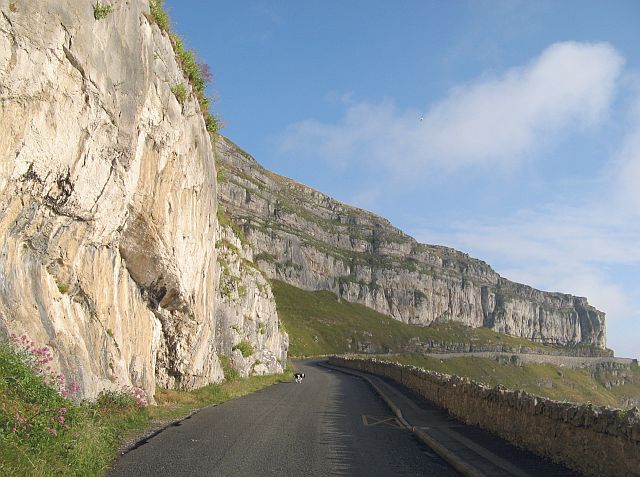
The Carboniferous Limestone was laid down in warm shallow tropical seas between about 359 and 330 million years ago, the Tournaisian and Visean ages that older books call the Dinantian, from the shells and skeletons of corals, crinoids and brachiopods set in carbonate mud; the rock is full of them. The British Geological Survey now treats the old name as obsolete and groups the rock as the Carboniferous Limestone Supergroup, one group in each province: the Peak Limestone Group about 800 metres thick in Derbyshire, the Great Scar Limestone Group as thick in northern England, the Clwyd Limestone Group up to 900 metres in North Wales, the Pembroke Limestone Group in the south. It rests on an unconformity above older rocks and is overlain by the dark mudstones of the Craven Group or the alternating limestones and shales of the Yoredale Group. For the mining history it is the host rock. In the Alston Block of the northern Pennines, where lead mining is recorded from the 12th century and the London Lead Company and the Beaumont concern dominated from the 17th to the 19th, the veins sit in the Carboniferous rocks and yielded at least four million tons of lead concentrates, with fluorspar, barytes and witherite taken from the same veins after lead collapsed; in the Mendips the lead, zinc and copper veins were deposited in the limestone by hot brines, at fifty to a hundred and fifty degrees, squeezed out of the sedimentary basins on either side; and on the Great Orme the copper that Bronze Age miners followed lies in the same rock.
How it worked
The limestone is bedded, jointed and soluble, and those three facts shape both its landscape and its mines. Water takes the joints and dissolves the rock, so the surface is a karst of pavements, shakeholes, dry valleys and gorges, with the drainage underground in caves; the hot mineralising fluids took the same joints and faults, and the veins they left are the rakes, with flats and pipes where the ore replaced the limestone bed itself. In the upper parts of a vein the air and water altered the sulphides: sphalerite became the calamine the brass-makers wanted, and iron carbonate became workable ironstone. The rock itself is worked wherever it crops out, for roadstone and aggregate above all, for lime where it is pure enough, as at Tunstead in the Peak and Horton in Ribblesdale, and for cement.
Why it was used
A miner in the Pennines, the Peak, the Mendips or Flintshire worked in Carboniferous Limestone whether he wanted lead, zinc, fluorspar, barytes, calamine, haematite or the stone itself. The archive's lead field records, its lime kilns and its show caves are all its records of this one rock.
Risks & limitations
The same solubility that made the veins made the water: a limestone mine drains the hills around it, and the great soughs of Derbyshire and the levels of the northern dales exist because the rock could not be kept dry otherwise. Caves met underground were a hazard and sometimes a windfall. The limestone is brittle and of little use as building stone except where nothing better exists.
Regional variation
Mountain Limestone in the older literature and on the old geological maps; Great Scar Limestone in the Dales; the Peak Limestone in Derbyshire, where the White Peak is named for it; the Carboniferous Limestone Series of the older textbooks. The limestones of the Scottish Midland Valley are of Carboniferous age but are not placed in the supergroup, and the Irish Carboniferous Limestone, famous at the Burren, is a different province again.
Related terminology
Barite, Calcite, Coal Measures, Copper, Fluorspar, Galena, Lead, Lime Kiln, Limestone, Quicklime, Show Cave, Witherite, Zinc
Mines associated with this term
5 examples chosen from 85 linked records — the term page is not an index.
- Charlestown Limeworks — Fife (well documented example)
Named in this record’s geology: “The works drew on the Carboniferous limestones of west Fife, quarried on the Earl of Elgin's own ground immediately…” - Ecton Copper Mines — Staffordshire (well documented example)
Named in this record’s geology: “…mineralisation where the River Manifold cuts through Lower Carboniferous limestone.” - Fremington Edge Quarry — North Yorkshire (well documented example)
Named in this record’s geology: “…form of silica — cryptocrystalline quartz — which occurs in the Carboniferous limestones of the northern Pennines as beds and nodular bands within the…” - Harpur Hill Quarry — Derbyshire (well documented example)
Named in this record’s geology: “The quarry works the Carboniferous limestone of the Derbyshire Peak, principally the Bee Low Limestones, burnt on…” - Hopton Wood Quarries and Middleton Mine — Derbyshire (well documented example)
Named in this record’s geology: “Hopton Wood stone is a Carboniferous limestone of remarkable purity — impurities have been put as low as 0.02 per…”
Sources
- (primary) BGS Lexicon of Named Rock Units: Carboniferous Limestone Supergroup — British Geological Survey
- (primary) Metalliferous and associated minerals, geology and man, Northern England — British Geological Survey (Earthwise)
- (primary) Zinc ore and mines: Foundations of the Mendips — British Geological Survey
- (secondary) Carboniferous Limestone — Wikipedia
Record created: 16 October 2026 · Last researched: 16 October 2026