 MineArchive
Witherite
| Category | Commodities |
|---|---|
| Commodity page | Witherite → |
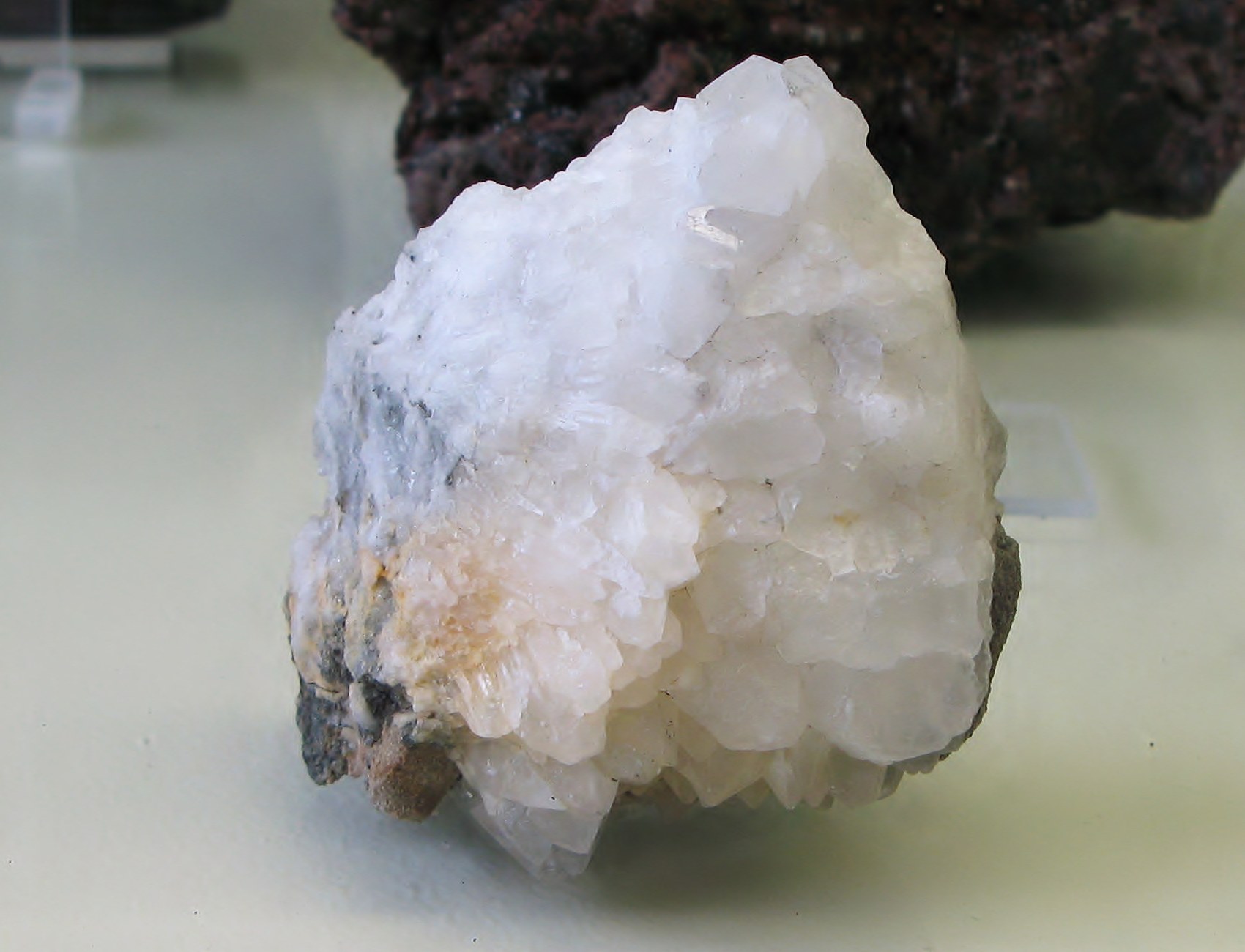
A barium carbonate mineral, a heavy white or colourless mineral mined almost nowhere else in the world in commercial quantity outside Settlingstones, Northumberland.
Historical usage
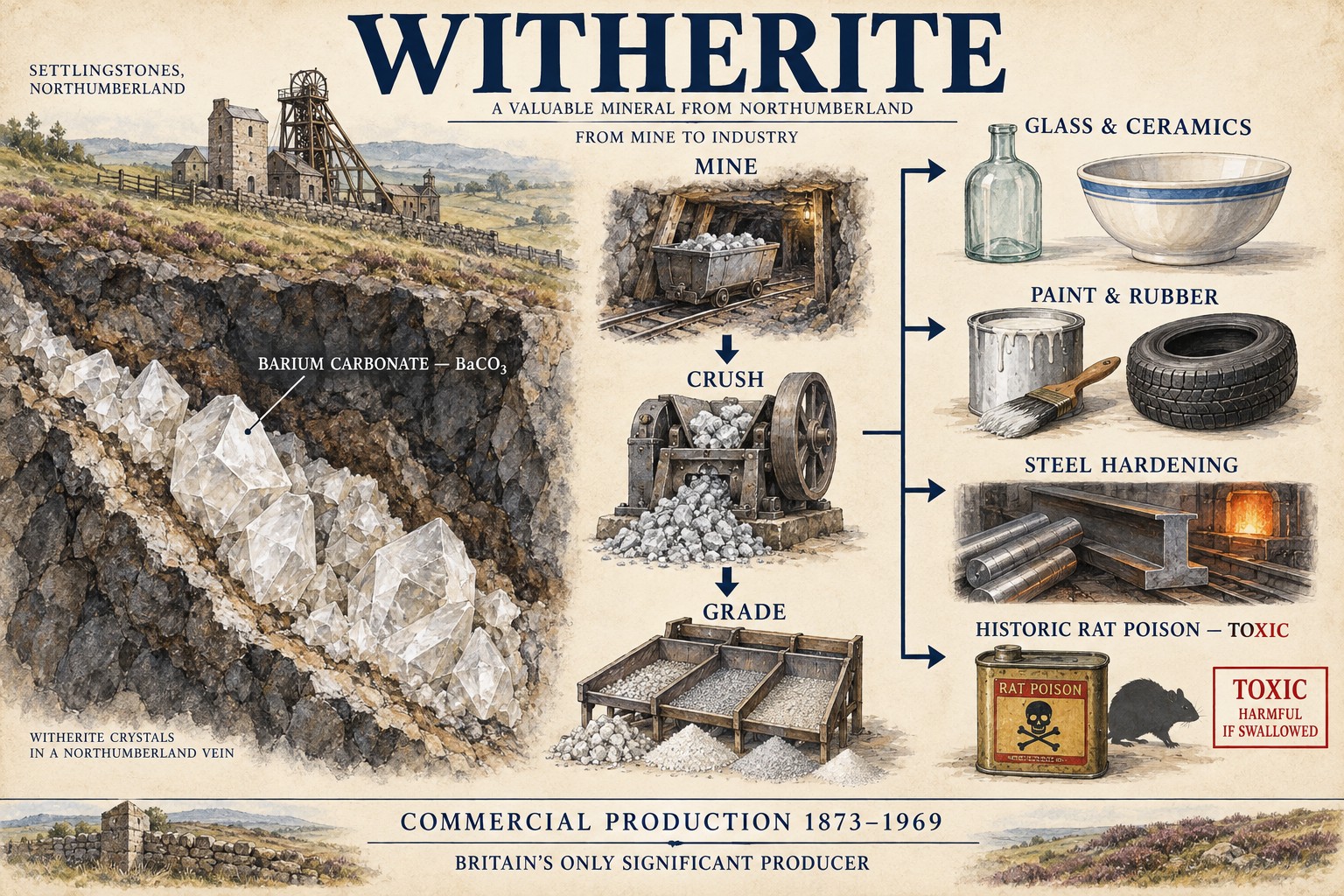
Witherite was already being noted for its toxicity soon after its discovery, and communities around Britain's few witherite veins — including Anglezarke in Lancashire — used it as rat poison long before it became an industrial mineral in its own right. Settlingstones in Northumberland became the world's only significant commercial witherite producer from 1873 to 1969.
How it worked
Mined and crushed like any barite-group mineral, then processed for use as a raw material in glass, ceramics, paints, rubber and — mixed into steel-making — as a hardening agent.
Why it was used
Its usefulness came directly from its toxicity as much as its chemistry: barium carbonate's lethal effect on rodents made it a valued rat poison, while industrially it found use wherever a cheap, reactive barium compound was needed — bricks, ceramics, glass and steel hardening among them.
Value over time
Witherite's value came from a single, narrow niche — as a cheap barium source for glass, ceramics and steel-hardening, and as rat poison — that never commanded dramatic price swings; demand simply tracked the fortunes of Settlingstones itself; once the mine closed in 1969, British commercial witherite production ended with it.
Hazards & challenges
Witherite is acutely toxic if ingested — the same property that made it valuable as rat poison made it dangerous to handle carelessly; in one notorious accident, 85 British soldiers were poisoned after flour was accidentally contaminated with barium carbonate intended for use as rodent poison. Barium ions block potassium channels in the body, causing muscular paralysis and cardiac disturbance, with symptoms typically appearing within hours of ingestion.
Risks & limitations
Almost no economically workable British witherite deposit existed outside Settlingstones, so the mineral's fortunes were entirely tied to one mine — once Settlingstones closed in 1969, British witherite production effectively ended rather than shifting to another domestic source.
Regional variation
Settlingstones, Northumberland was, for practical purposes, the entire story: no other British witherite deposit was ever worked at meaningful scale.
Related terminology
Mines associated with this term
5 examples chosen from 7 linked records — the term page is not an index.
- Lead Mines Clough — Lancashire (well documented example)
Named 5 times in this record, first in the summary: “…to 1837 and now recognised as the true type locality for the mineral witherite — a discovery that, according to a 2022 re-examination of the…” - Fallowfield Mine — Northumberland (well documented example)
A lead mine that ran out of lead and found something better in its own waste tips, becoming the first commercial witherite producer. - Hilton and Scordale Mines — Cumbria (well documented example)
Named twice in this record, first in the summary: “…Company for half a century and then reopened for the barytes and witherite its lead miners had left behind. It now sits inside an army firing…” - Nentsberry Haggs Mine — Cumbria (well documented example)
Named 3 times in this record, first in the summary: “A Nent Force Level-connected lead, zinc and witherite mine on Alston Moor, one of the last mines in the district still…” - Roddymoor Colliery — County Durham (well documented example)
Named twice in this record, first in the summary: “…coal were the main products, with fireclay raised from the 1920s and witherite — the barium carbonate mineral — appearing in the returns through…”
See every mine that worked witherite →
Sources
- (secondary) Mass barium carbonate poisoning with fatal outcome, lessons learned: a case series — PMC
- (secondary) Witherite — Wikipedia
Record created: 21 August 2026 · Last researched: 22 August 2026