 MineArchive
Barite
| Also known as | Barytes (the traditional British spelling, still in everyday UK mining use) |
|---|---|
| Category | Commodities |
| Commodity page | Barite → |
A dense, chemically inert mineral (barium sulphate, BaSO₄), long worked in Britain as a by-product of lead veins and, from the mid-20th century, increasingly for its own sake as the essential weighting agent in oil and gas drilling fluid.
Historical usage
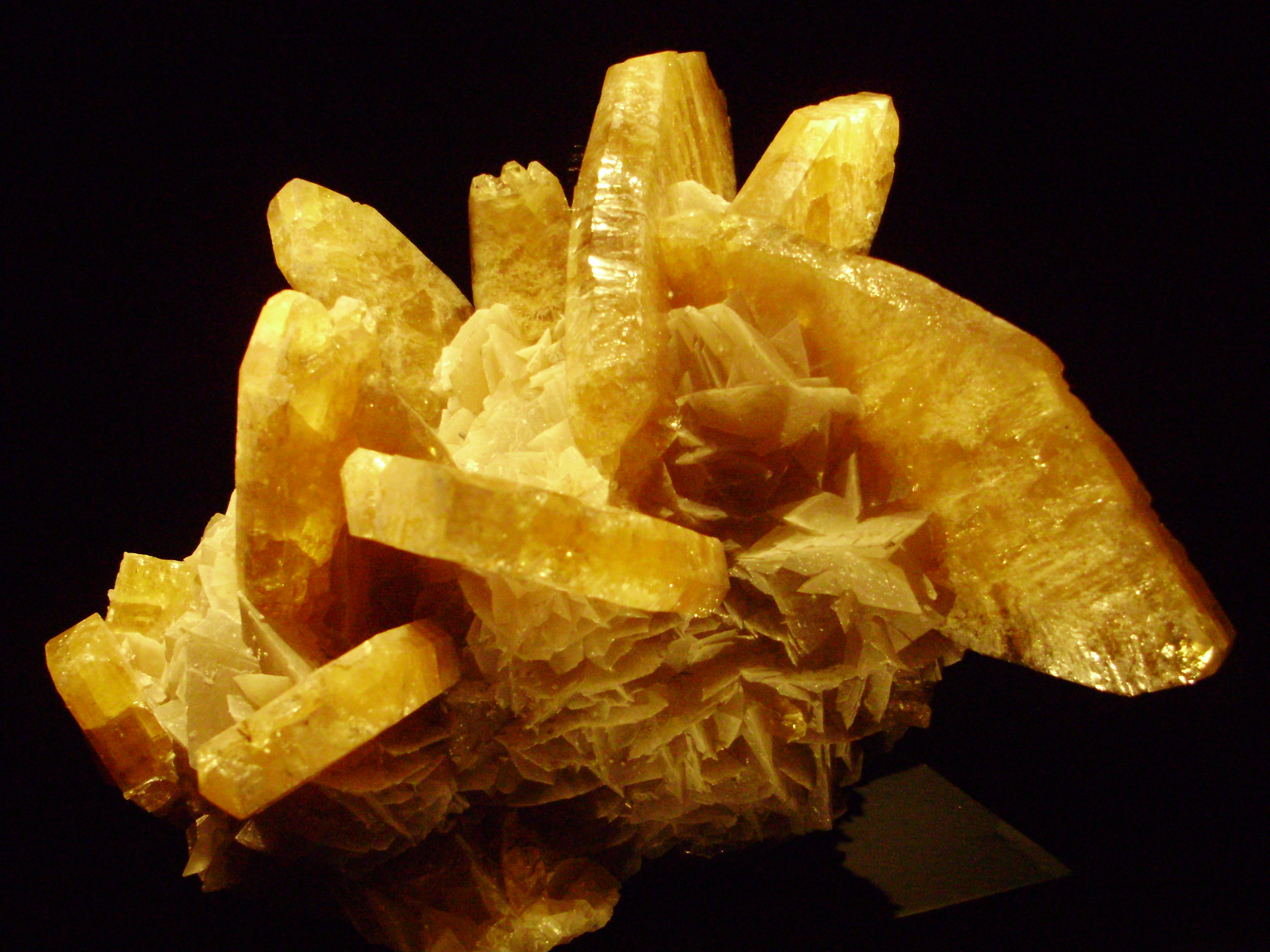
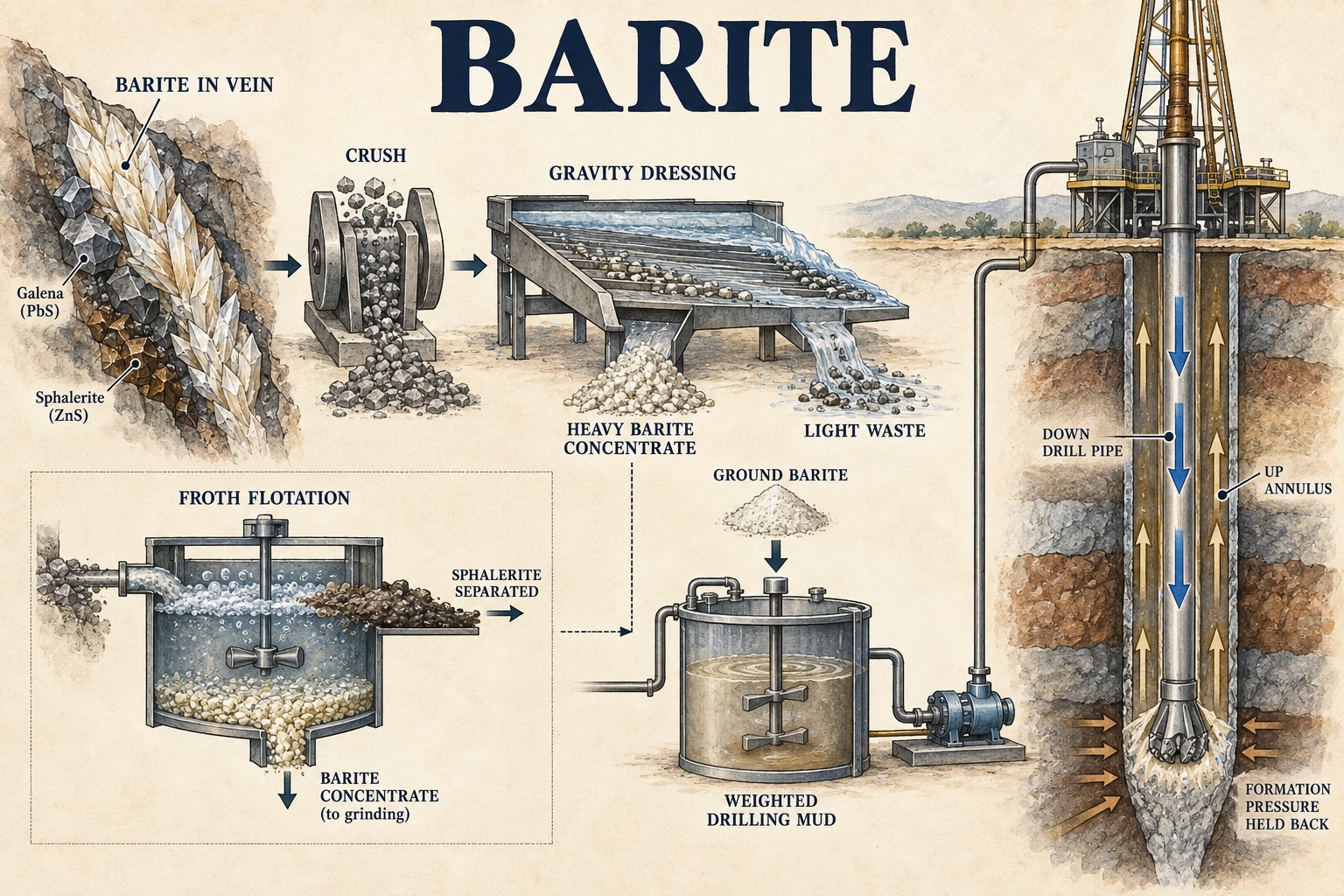
Barite was worked in Britain from the 18th century onward, almost always as a secondary product recovered alongside lead ore on the same veins — at Weardale, the North Pennines and the Peak District — with the ore separated from galena in the same crushing and gravity-dressing process. Muirshiel, a dedicated Renfrewshire barytes mine, was worked on and off for around 200 years and at its 1950s-60s peak supplied roughly a third of the UK's entire barytes output, reflecting a genuine shift toward barite as a target mineral in its own right rather than a lead-mining by-product. Force Crag in the Lake District similarly moved increasingly toward barytes production from the 1860s onward as its original lead and zinc lodes were worked out, installing flotation equipment in 1914 to separate barytes from zinc blende more effectively. Demand accelerated sharply during both World Wars, when barite became an essential material in munitions manufacture -- the Caldbeck Fells' Potts Gill mine, opened in 1844, saw its heaviest production during the Second World War for exactly that reason, and the North Pennines' Silverband Mine produced a remarkable 215,000 tons of dressed barite between 1939 and 1963.
How it worked
Barite was crushed and separated from waste rock and other sulphide minerals by gravity dressing, exploiting its unusually high density (roughly 4.5 times that of water) to concentrate it from lighter gangue; later operations like Force Crag added froth flotation to separate barytes more precisely from zinc blende occurring on the same veins.
Why it was used
Barite's very high density combined with its chemical inertness made it valuable wherever sheer weight without reactivity was needed — traditionally as a paint and paper filler and, since the mid-20th century, overwhelmingly as the standard weighting agent added to drilling mud, where it prevents high-pressure oil, gas or water from blowing back up a wellbore.
Value over time
For most of its British history barite was a modest by-product mineral, valued mainly for paint and paper filler use. Its economics were transformed in the 20th century as oil and gas drilling expanded worldwide: barite's role as a drilling-mud weighting agent came to account for the overwhelming majority of global demand, tying its price directly to the pace of oil and gas exploration rather than to construction or manufacturing activity as before — a shift visible at Muirshiel and Force Crag, both of which saw their most productive years once this market matured.
Hazards & challenges
Long-term exposure to barite dust causes baritosis, a benign pneumoconiosis in which barium sulphate particles accumulate in the lungs; unlike silicosis, baritosis causes little to no scarring or loss of lung function and the radiographic shadows it produces generally resolve once exposure ends — but barite ore worked alongside galena or fluorspar exposed miners to the more serious hazards of those minerals as well.
Risks & limitations
As a low-value bulk mineral, barite mining was only worthwhile where a decent tonnage occurred cheaply alongside an existing lead operation, or where a large dedicated deposit like Muirshiel's could be worked economically on its own; British barite production could never compete at scale with the much larger, lower-cost deposits developed elsewhere once transport costs fell.
Regional variation
The North Pennines and Peak District orefields for barite recovered alongside lead, Muirshiel (Renfrewshire, Scotland) as Britain's most productive dedicated barytes mine, and Force Crag in Cumbria for a mine that shifted its focus to barytes as its metal ores declined.
Related terminology
Barytocalcite, Gangue, Witherite
Mines associated with this term
5 examples chosen from 43 linked records — the term page is not an index.
- Muirshiel Barytes Mine — Renfrewshire (well documented example)
A dedicated Renfrewshire barytes mine that at its 1950s-60s peak supplied roughly a third of the UK's entire barytes output. - Auchencairn Mine — Dumfries and Galloway (well documented example)
Named 6 times in this record, first in the summary: “…times over two centuries for three different things — copper, then barytes, then copper again — each attempt ending the same way, in flooding…” - Bog Mine — Shropshire (well documented example)
Named 4 times in this record, first in the history: “…declined toward the end of the 19th century, the mine turned to barytes instead, worked on into the early 20th century; in 1917, with the…” - Bryntail Lead Mine — Powys (well documented example)
Named 8 times in this record, first in the summary: “A small lead and barytes mine on the Van Lode, now overshadowed — almost literally — by the…” - Burgham Mine — Shropshire (well documented example)
Named in this record’s summary: “A lead, zinc and barytes mine in the Stiperstones orefield of south-west Shropshire, also…”
See every mine that worked barite →
Sources
- (primary) BARYTES: Mineral Profile — British Geological Survey
- (secondary) Barite | Industrial Uses, Drilling Mud, Ore — Encyclopaedia Britannica
- (secondary) Baritosis — Wikipedia
- (secondary) Mineral Resource of the Month: Barite — EARTH Magazine
Record created: 22 August 2026 · Last researched: 22 August 2026