 MineArchive
Froth Flotation
| Also known as | Flotation (general usage), Flotation cell (used of the equipment) |
|---|---|
| Category | Ore Processing |
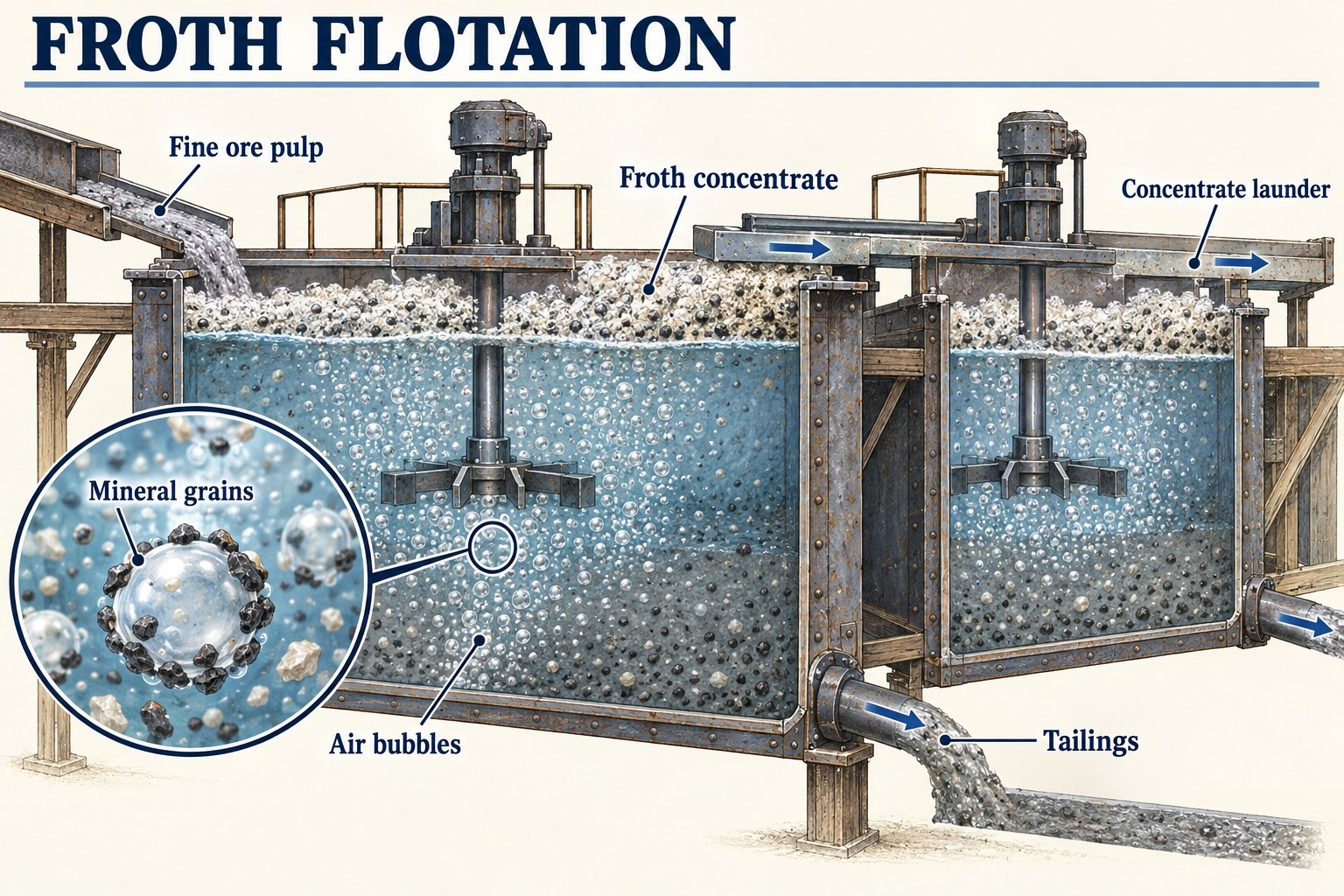
An ore-dressing process that separates minerals by chemistry rather than by weight: reagents make the wanted mineral water-repellent, air is beaten through the pulp, and the treated particles cling to the bubbles and rise as a froth that is skimmed off, while the rest sinks.
Historical usage
Flotation displaced the gravity dressing that had served British mining for centuries — the buddle, the jigger, the kieve — because gravity fails on finely ground ore and on sulphides whose density is close to the gangue. Its origins are partly Welsh: the Elmore brothers bought the Glasdir copper mine near Dolgellau in 1896 and installed the first industrial-scale flotation plant there in 1897, patenting it in 1898. Their process was bulk-oil flotation, not froth flotation — pulverised sulphides were agglomerated in oil and buoyed to the surface — and the distinction matters, because the froth process proper arrived later, through Potter and Delprat's acid work at Broken Hill from 1902 and above all Minerals Separation's 1905 patent, which established that air bubbles introduced by agitation, not chemically generated gas, did the work. Froth flotation became standard in American copper milling from about 1911 and spread through British mills over the following decades; Force Crag, Sygun and Glasdir itself are among the archive's mines where a flotation plant was installed.
How it worked
Ore is ground fine enough to liberate the mineral grains, then mixed with water into a pulp. Collectors — reagents that attach to the wanted mineral and leave a water-repellent surface on it — are added, along with frothers to make a stable bubble film and, where needed, depressants to keep unwanted minerals wettable. Air is drawn or blown into the agitated pulp in a bank of cells; the treated particles fasten to the bubbles, ride to the surface, and are skimmed as concentrate, while the tailings pass on to the next cell or to the dump.
Why it was used
It recovers what gravity cannot. Flotation works on particles far too fine for a buddle to hold, separates minerals of similar density, and — because different reagents can be used in sequence — allows a complex ore to be split into separate saleable concentrates, lead in one, zinc in another. For 20th-century mines working lower-grade ground than their predecessors, it was often the difference between an ore body and a waste heap.
Risks & limitations
The process depends on a chemistry that has to be maintained: pH, reagent dose and grind size all shift with the ore, and a mill can lose a concentrate to a change the operators cannot immediately see. It also produces very fine tailings mixed with reagent, which behave badly in a tailings dam and are the source of much of the water-quality trouble that outlives a 20th-century mine.
Regional variation
British flotation history is disproportionately Welsh and Cornish at the start — Glasdir for the Elmores' oil process, and later Cornish and Lake District mills for froth flotation proper — but the technique is international by nature, and its British adoption largely followed practice worked out at Broken Hill and in the American copper camps.
Related terminology
Buddle, Dressing Floor, Heavy Media Separation, Jigger, Kieve, Tailings, Vanning
Mines associated with this term
5 examples chosen from 12 linked records — the term page is not an index.
- Nantymwyn Mine — Carmarthenshire (well documented example)
Named twice in this record, first in the history: “…in 1915, 1923 and 1930–32, before it closed for good in 1932. A flotation mill built around 1929 by the Sulphide Corporation used chemical…” - Auchencairn Mine — Dumfries and Galloway (well documented example)
A flotation plant was installed in the 1950s to concentrate copper; the venture closed in 1961. - Force Crag Mine — Cumbria (well documented example)
Named 3 times in this record, first in the history: “…rebuilt in its present form in 1908–9 at around 900 feet elevation; flotation equipment installed in 1914 allowed effective separation of blende…” - Glapwell Colliery — Derbyshire (well documented example)
Named in this record’s history: “…at Newstead, and the combined financial commitment forced the flotation of a new company merging Staveley and Sheepbridge interests, which…” - Glasdir Mine — Gwynedd (well documented example)
The Elmore brothers installed the first industrial-scale flotation plant here in 1897 — a bulk-oil process, the direct ancestor of froth flotation.
Sources
- (secondary) Glasdir Mine — Graces Guide to British Industrial History
- (secondary) History of Flotation Patents — 911 Metallurgist
- (secondary) To Float or Sink: A Brief History of Flotation Milling — Mining History Journal (Dawn Bunyak)
Record created: 25 August 2026 · Last researched: 25 August 2026