 MineArchive
Heavy Media Separation
| Category | Ore Processing |
|---|
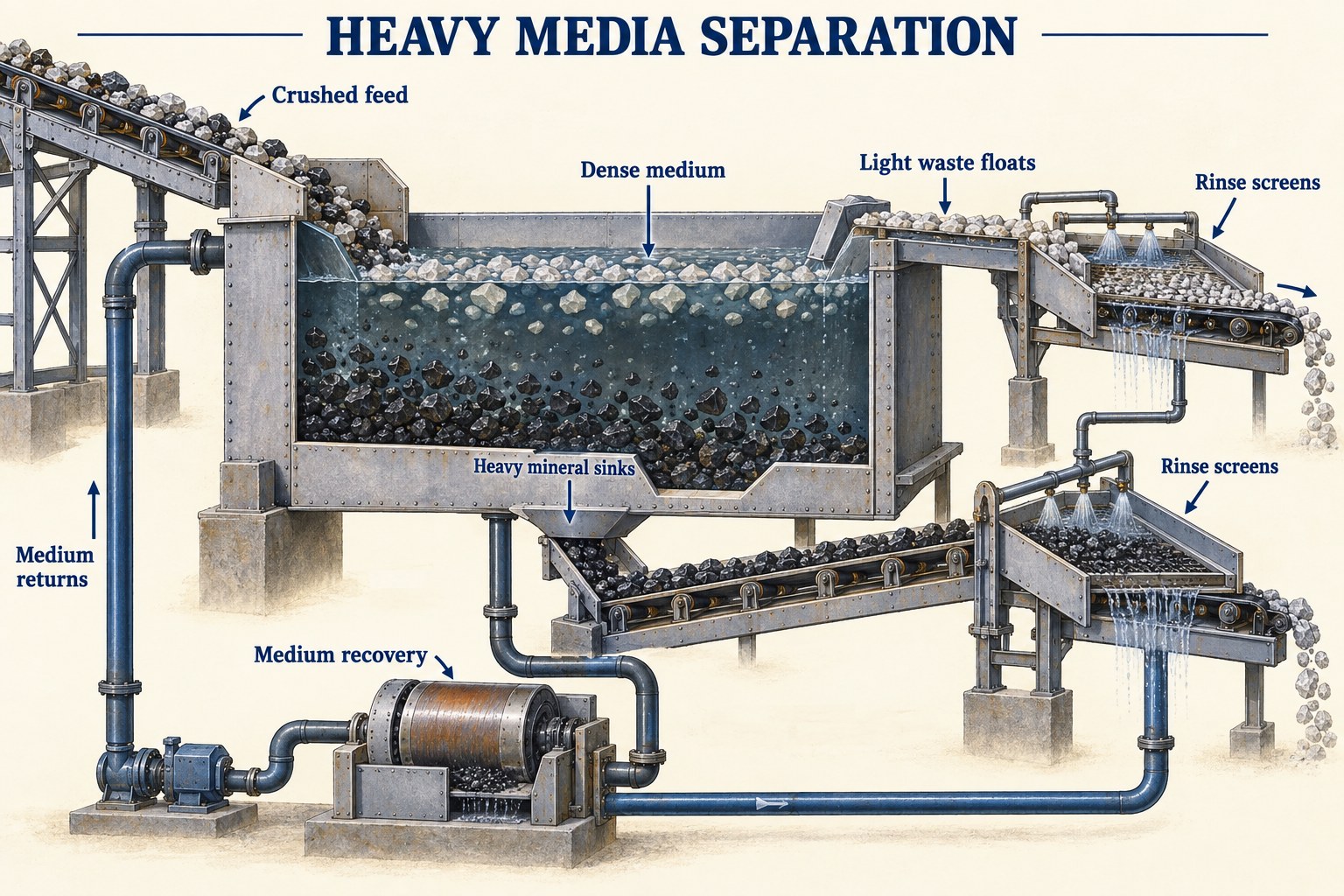
An ore-dressing technique that separates minerals by density rather than by size or surface chemistry, by suspending crushed ore in a fluid — a 'dense medium' — whose effective density sits between that of the wanted mineral and the surrounding waste rock, so the heavier material sinks and the lighter material floats.
Historical usage
Developed as an industrial process from the 1930s-40s — the dense medium cyclone itself was first patented in the 1940s — and grew rapidly in popularity from the 1950s to 1970s, during which it replaced older jigging plants at many coal, iron and other ore-processing sites. A Wemco heavy-media-separation plant was installed in 1960 at the Weardale Lead Company's Boltsburn Mill, Rookhope, replacing the jigs previously used there to separate galena and fluorspar concentrates.
How it worked
Crushed ore was fed into a bath or cyclone of dense medium — typically very fine ferrosilicon and/or magnetite powder suspended in water, chosen partly because both are magnetic and so can be recovered and recirculated — held at a controlled density between that of the valuable mineral and the surrounding waste rock. Heavier, mineral-rich particles sank and were drawn off, while lighter waste rock floated and was skimmed away; medium clinging to both products was then washed off on drainage screens, recovered magnetically, and returned to the circuit.
Why it was used
Unlike jigging, which relies on pulses of rising water and hindered settling and works less predictably as particle size varies, heavy media separation maintained a genuinely uniform density throughout the bath, giving cleaner, more consistent separation and yields close to the theoretical maximum obtainable from a given ore's density difference — a real efficiency gain that saw it replace jigs at many older plants from the 1950s onward.
Risks & limitations
Effective mainly on relatively coarse material, roughly 28-mesh up to a few inches; an accumulation of fine slimes and contamination in the dense medium degrades its density and viscosity and reduces separating efficiency, so continuous cleaning and magnetic recovery of the medium is essential. The plant itself — cyclones or vessels, drainage and washing screens, magnetic separators, a thickener — is markedly more complex and costlier to install than the jigs it typically replaced, even where cheaper to run.
Related terminology
Mines associated with this term
Included only where MineArchive's own research gives a reasonable evidential basis — not every mine where this might plausibly apply.
- Brightling and Mountfield Gypsum Mines — East Sussex (well documented example)
Named in this record’s closure notes: “…when: the fullest account puts it in the early 1990s, after a heavy media separation plant had for some years allowed anhydrite-contaminated ground to be…”
Sources
- (secondary) BRITISH MINING No.5: Weardale — Northern Mine Research Society
- (secondary) Heavy Media Separation Process — 911Metallurgist
Record created: 26 August 2026 · Last researched: 26 August 2026