 MineArchive
Jigger
| Category | Ore Processing |
|---|
A gravity-based ore-dressing machine that separates crushed ore from waste rock by pulsating water through a perforated screen — a specific piece of dressing-floor equipment, distinct from the buddle or the kieve, used at the stage where crushed material still needed sorting by density before sale.
Historical usage
Jigging has been used in ore dressing for close to two centuries, with hand-jigging first practised in Cornwall before English miners carried the technique to other mining districts. By the 19th century, purpose-built jigger houses were a standard feature of a well-equipped dressing floor at larger metal mines across Britain, standing alongside the buddles, crushers and stone-breakers that made up the rest of a mine's surface processing plant.
How it worked
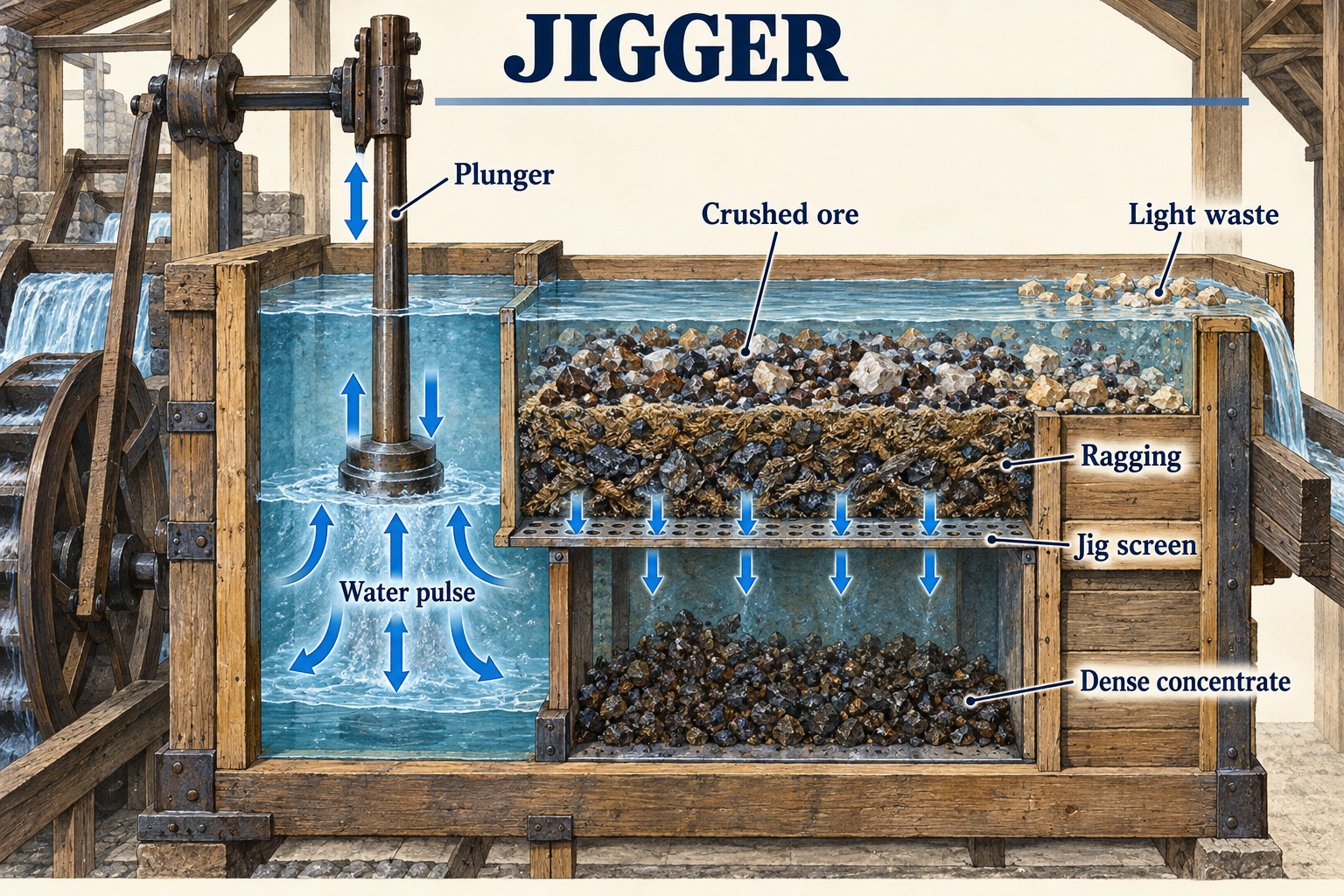
Crushed ore and water were fed into an open tank holding a jig screen — a perforated horizontal surface topped with a bed of coarse, heavy particles called ragging. A plunger, worked by hand or by machinery, pulsed water up and down through the bed, and as the ore moved across it, the densest particles — the valuable ore mineral — worked their way down through the ragging and screen to settle as concentrate at the bottom, while lighter waste rock stayed higher up and was washed away.
Why it was used
A jigger could treat large quantities of crushed ore quickly, was simple to build and operate compared with more elaborate dressing machinery, and worked reliably across a range of ore types and conditions — a straightforward, effective way to concentrate ore by density once crushing alone was no longer enough to separate it cleanly from waste.
Risks & limitations
Jigging worked well only where there was a real, exploitable difference in density between the target mineral and the surrounding waste rock; ore with only a marginal density contrast, or waste that closely resembled the ore in size and weight, was much harder to separate cleanly this way, and mines often ran jiggers alongside buddles and other dressing methods to catch what jigging alone missed.
Related terminology
Cornish Rolls, Froth Flotation, Heavy Media Separation
Mines associated with this term
5 examples chosen from 9 linked records — the term page is not an index.
- Glencraig Colliery — Fife (well documented example)
Named in this record’s history: “…in 1966. The case that keeps the pit's name alive began on the Mine Jigger Brae, a main haulage road, where a repairer named English was…” - Aberdaunant Mine — Powys (well documented example)
Named twice in this record, first in the workings: “…rock-cut in places -- from the Nant Gwestyn, driving rock crushers, jiggers and buddles; visible workings include several adits, an engine…” - Cwm Elan Mine — Powys (well documented example)
The mine's own recorded history explicitly describes Collom's patent jigger tables installed in the 1873 mill. - Greenburn Mine — Cumbria (well documented example)
Named in this record’s surface remains: “…house and wheelpit, a crushing mill, crusher and stamp houses, a jigger house, buddle houses, a slime tank, two acid precipitation tanks,…” - Killhope Lead Mine — County Durham (well documented example)
The mine's own recorded surface remains explicitly name a surviving jigger house.
Disasters associated with this term
Included only where MineArchive's own research gives a reasonable evidential basis, with the nature of the relationship stated — not every disaster where this term might plausibly apply.
- Cronton Colliery explosion (contextual relationship)
Named in this record’s narrative: “…(30), Walter Pye (42), James O'Neil (40) and John Harrison (36); jigger George Richard Jones (23); haulage hand John W. Travis (24);…” - Glencraig Colliery Haulage Accident 1933 (contextual relationship)
Named in this record’s cause: “English was repairing an airway off the Mine Jigger Brae, a main haulage road, when between 1:30 and 2pm the haulage…” - Whiston Colliery explosion, 1878 (contextual relationship)
Named in this record’s narrative: “…went down to build a stopping while sand was brought to them up the jigger brow. As the first boxes of sand arrived, using full boxes of coal…”
Sources
Record created: 22 August 2026 · Last researched: 22 August 2026