 MineArchive
Cornish Rolls
| Also known as | Rolls (Everyday shorthand on the dressing floor), Crushing rolls (General engineering usage), Roll crusher (Modern usage), Copper crusher (Cornish) |
|---|---|
| Dialect | Cornish |
| Category | Ore Processing |
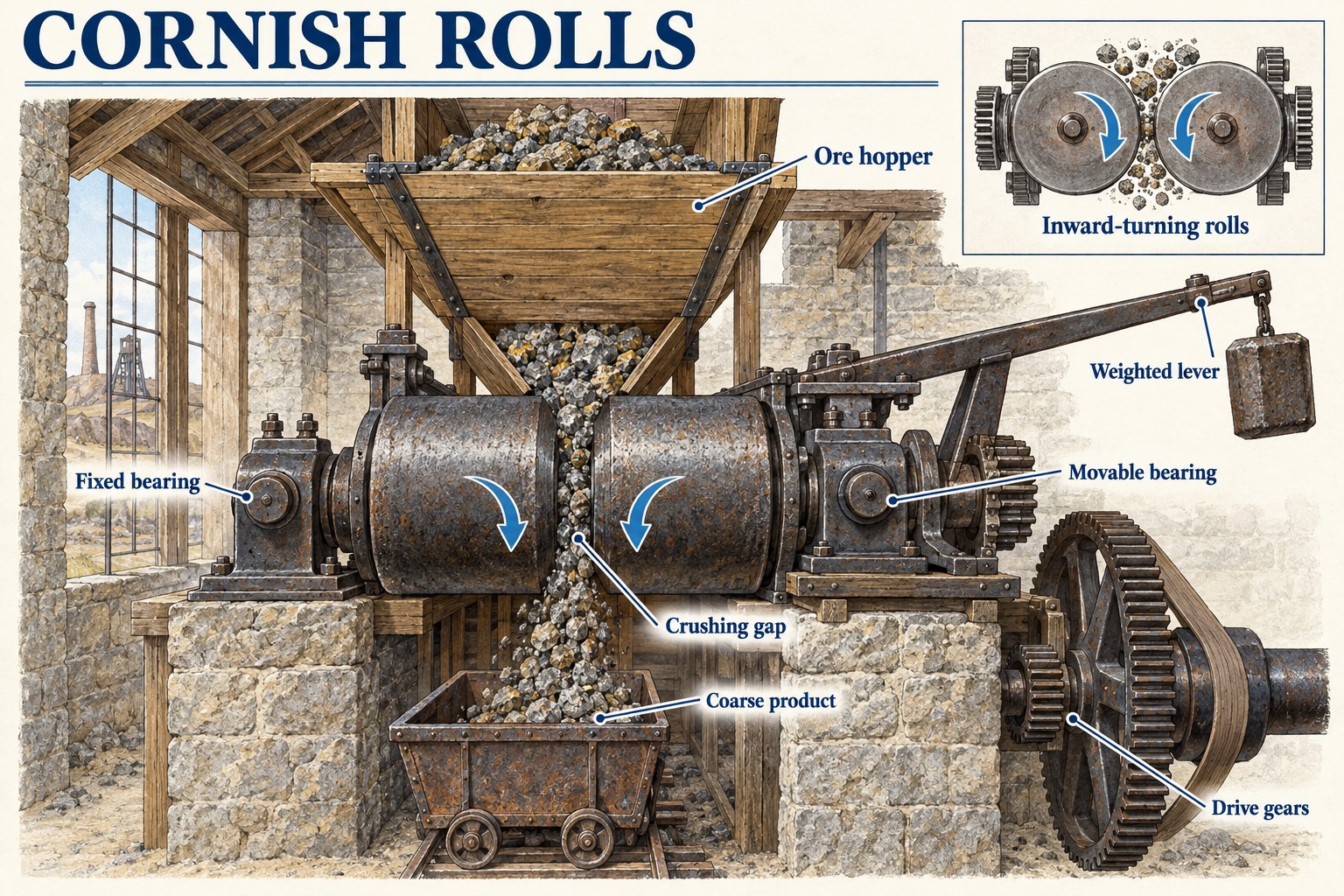
A pair of heavy iron rollers, geared to turn inwards against each other, between which ore was crushed. Ore fed from a hopper above passed through the gap and came out reduced to a coarse gravel; a weighted arm held the rolls at the right pressure and let them spring apart on anything too hard to break.
Historical usage
Crushing rolls were introduced to Cornish and Devon copper dressing in the early nineteenth century, John Taylor's installation at Wheal Friendship in 1796 being among the first. They became standard equipment on copper dressing floors and were used at metal mines well beyond Cornwall — the manganese mine at the Lecht in the Grampians crushed its ore between a pair of Cornish rolls driven by a waterwheel almost eight metres across, then re-crushed anything still too coarse before washing and drying it.
How it worked
Two cylindrical rolls are mounted on parallel horizontal axles and geared to counter-rotate, drawing material down into the nip between them. One bearing is fixed and the other held against a weighted lever or spring, so that the gap can open if an unbreakable lump goes through instead of wrecking the machine. Setting the gap sets the product size. Rolls crush by pressure between two surfaces rather than by impact, so what comes out is comparatively uniform, and material fine enough already passes straight through untouched.
Why it was used
The point of rolls is what they do not do. Stamps crush by dropping weighted heads, and on a soft, brittle mineral they overshoot — producing too much fine slime that then escapes the dressing floor with the wastewater. Copper ore in particular breaks down too readily under stamps, so a great deal of value was lost that way. Rolls reduce the ore to the size actually wanted and no further, which is why they took over copper crushing while stamps stayed in use for tin and for low-grade or otherwise difficult ores.
Risks & limitations
Rolls have limited capacity and only a modest reduction ratio, so they suit intermediate crushing rather than either the first breaking of run-of-mine rock or the final fine grinding. The roll surfaces wear and have to be re-dressed or replaced. Like all unguarded nineteenth-century mill machinery, an in-running nip between two powered rollers at waist height on a crowded dressing floor was a serious hazard to the people feeding it.
Regional variation
Called 'Cornish rolls' or simply 'the rolls' in south-west England, and 'crushing rolls' or 'roll crushers' in general engineering usage. A separate building housing them at a mine is a crusher house.
Related terminology
Buddle, Copper, Dressing Floor, Jigger, Stamps, Waterwheel
Mines associated with this term
5 examples chosen from 10 linked records — the term page is not an index.
- Pandora Mine — Conwy (well documented example)
Named in this record’s history: “…aerial ropeway. Completed in 1900 and equipped with stone-breakers, Cornish rolls, trommels, jigs and Wilfley tables, and powered by a hydroelectric…” - Bedwellty Pits — Blaenau Gwent (well documented example)
Named in this record’s workings: “The colliery is recorded in the Welsh disaster rolls under the name Bedwellty Pits; no account of its shafts, seams or…” - Creggan Silver-Lead Mines — County Armagh (well documented example)
Named in this record’s workings: “…under Captain Samuel Bailey. Ore was dressed at the surface using a Cornish rolls crusher before being carted by road to the port of Dundalk, around…” - Cwm Elan Mine — Powys (well documented example)
The 1873 mill was fitted with crushing rolls alongside a Blake's stonebreaker, round buddles and a battery of Collom's patent jiggers — rolls doing the intermediate crushing between the stonebreaker and the separating plant, which is exactly the place they occupy in a dressing sequence. - Dunston Colliery — Tyne and Wear (well documented example)
Named in this record’s history: “…Quarter at 67 were left unworked because of bands, troubles and post rolls. The pit raised 500 tons a day with 476 men and boys. On 24 May 1893…”
Disasters associated with this term
Included only where MineArchive's own research gives a reasonable evidential basis, with the nature of the relationship stated — not every disaster where this term might plausibly apply.
- Merthyr Vale Colliery arch collapse, 1875 (contextual relationship)
Named in this record’s narrative: “…1875. On 29 October that year an arch fell on the carpenters William Rolls, 43, and James Jones, 45, killing both and injuring a third man.”
Sources
- (secondary) A Cornish mining glossary — Cornish Mining World Heritage Site (UNESCO)
- (secondary) Dressing the Ore — Cornish Mining World Heritage Site
Record created: 25 August 2026 · Last researched: 25 August 2026