 MineArchive
Buddle
| Also known as | Buddling, Round buddle |
|---|---|
| Category | Ore Processing |
A shallow, usually circular pit in which crushed ore was washed and mechanically stirred so that heavier mineral settled out from lighter waste by gravity.
Historical usage
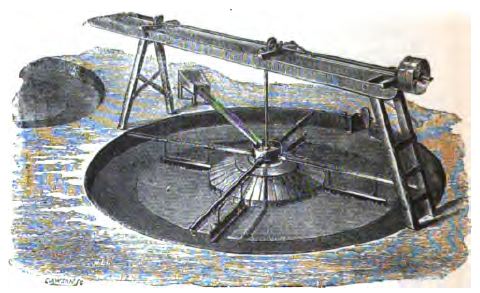
Buddling developed mainly in Cornwall for concentrating tin ore, and spread from there to lead, zinc and copper dressing floors across Britain through the 18th and 19th centuries; most surviving examples are the circular, mechanically-raked Victorian design. Part of its appeal was that a mine could build one for itself: Davies, writing in 1902, put the round buddle's long popularity down to 'the great simplicity of its construction, which permitted its being made out of the odds and ends of machinery usually to be found on a mine', with only the cast-iron heads, shafting, bevel wheels and driving pulleys bought in. By the end of the century it was standard equipment rather than a local Cornish habit, described in the general engineering handbooks alongside jiggers, vanners and shaking tables.
How it worked
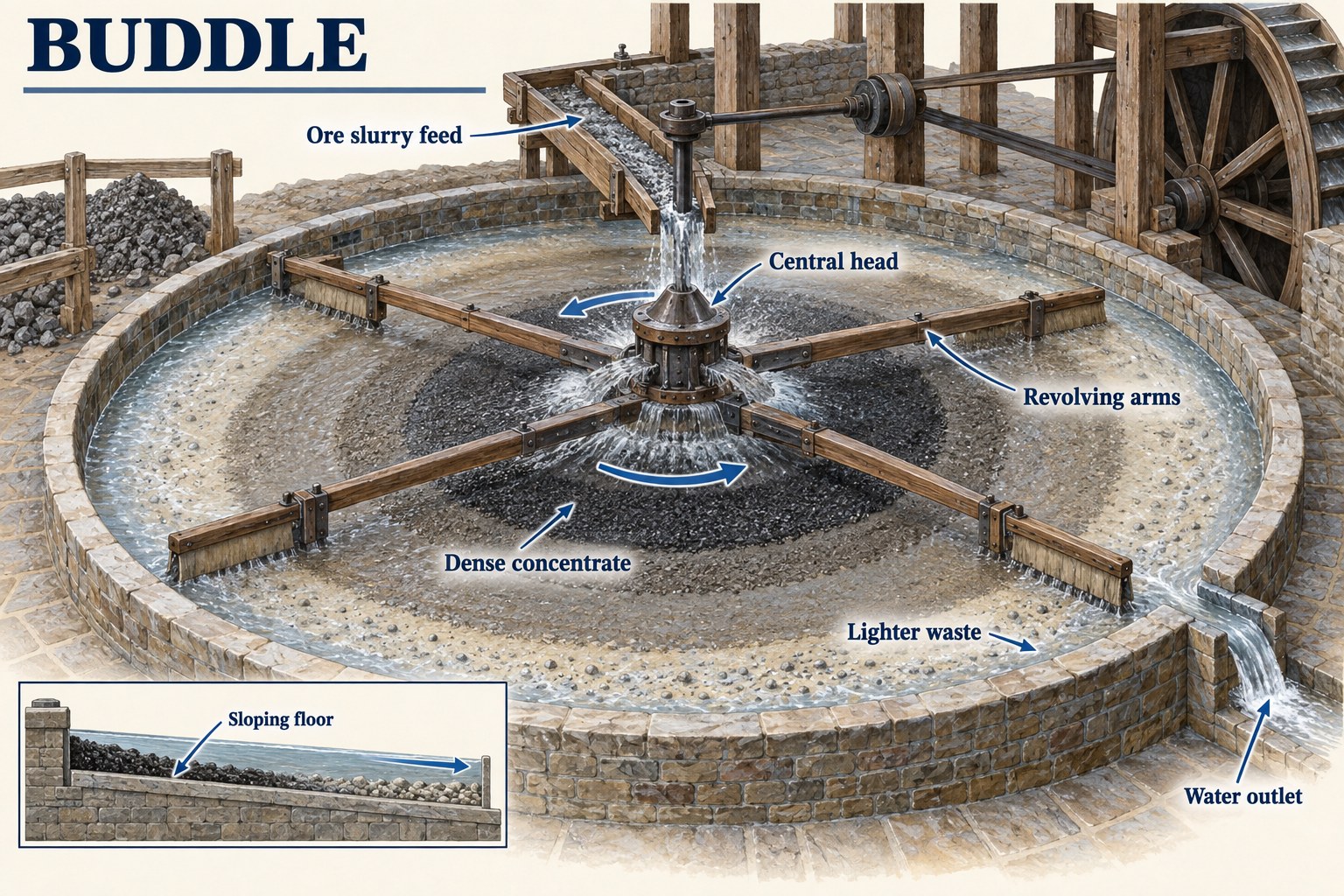
Crushed ore in suspension, typically fed from the stamps, was run into the buddle and spread across its sloping floor. Rotating brushes or rakes, often driven by a waterwheel, kept the mixture gently stirred while a steady flow of water washed the lighter waste material outward and away, leaving the denser, valuable ore to settle near the centre or inlet, where it could be shovelled out.
The Victorian round buddle was a shallow circular pit dug into the ground, 14 to 22 feet across and a foot to eighteen inches deep, its sides of stone or brick set in mortar and its floor — planed board, or cement laid on concrete — falling outward at about 1 in 30. In the middle stood a fixed head four to eight feet across, and above it a revolving head carrying four arms. Slime water ran in from a launder onto the revolving head, which spread it in an even film over the fixed head; the film fell over the edge and flowed outward across the sloping floor, dropping what it carried in order of density — the richest ore first, close to the head, the poorest out at the rim. Boards on the four arms, hung with cloth or brushes, swept round at three to six revolutions a minute to smooth each layer as it formed and stop the deposit cutting itself into gutters. Waste water left through a small sluice in the circumference whose door was pierced with a vertical line of holes, plugged one after another from the bottom as the bed of mineral thickened.
A run took about ten hours, until the deposit stood as high as the centre cone. The machine was then stopped, a groove cut from the cone out to the rim, and samples washed on a vanning shovel to judge where the divisions fell; rings were marked on the surface and the bed lifted in three concentric portions, the head, the middle and the tail. On Lock's figures the head — the innermost third — held about 70 per cent of all the metal that had gone into the buddle, the middle nearly 20 per cent, and the tail only a trace.
Why it was used
Buddling used gravity and a controlled flow of water to do the separating work, needing little beyond the pit itself, a water supply and (commonly) a small amount of water-wheel power — a comparatively cheap, low-technology way to concentrate ore before smelting. It was the machine for the material nothing else could hold: the slimes, the finest fraction from the stamps, too small to jig and easily lost altogether. Successive buddling could take lead waste down to no more than 4 per cent lead and raise the concentrate to 50 or 60 per cent, and about 42 per cent zinc where blende was present, before the heads went on to a dolly tub for final cleaning.
Risks & limitations
Buddling was labour-intensive to load, tend and clear, needed a reliable water supply, and its gravity-based separation was relatively crude compared to what followed it: from the late 19th century, buddles were progressively superseded by American-invented mechanical concentrators — first the Frue vanner, later the Wilfley shaking table — which achieved better recovery with less manual handling.
Davies set out the objections plainly in 1902. No clean product came off a buddle straight away: the heads had to be reworked in a second buddle and the middles run again and again until the waste was poor enough to throw, so the same mineral was handled several times over, 'always a costly proceeding'. And the machine was a batch process in an age moving to continuous ones — once full it had to be stopped and stand idle until it was dug out, so a mill needed several to keep up. Even a small mill wanted three or four; a large one working lead with blende in it needed sixteen to twenty. The vanner and the shaking table ran continuously and beat it on both counts.
Regional variation
Round buddles of the kind common in Cornwall and the Pennines were one of several related gravity-dressing devices; a related, freestanding, all-wooden Cornish variant used on tailings was known as a round frame. The ordinary round buddle is properly a convex or centre-head buddle, its middle standing higher than its rim; Borlase's concave buddle inverted the arrangement, feeding at the circumference and running inward, and Lock's plates set both beside the propeller-knife, Munday's and Linkenbach patterns then in use. The poorer the slimes, the wider the pit: the practice was to concentrate first in a small buddle and re-treat what it made in a larger one.
Related terminology
Cornish Rolls, Froth Flotation, Launder
Mines associated with this term
5 examples chosen from 39 linked records — the term page is not an index.
- Killhope Lead Mine — County Durham (surviving physical example)
Killhope's restored site includes a surviving buddle house among its ore-dressing structures. - Snake Mine — Derbyshire (well documented example)
Named 3 times in this record, first in the history: “…100 feet by 70 feet, containing the main shaft, a ruined coe, an ore buddle, a climbing shaft and the centre stone of a horse-gin -- were…” - Aberdaunant Mine — Powys (well documented example)
Named twice in this record, first in the workings: “…places -- from the Nant Gwestyn, driving rock crushers, jiggers and buddles; visible workings include several adits, an engine shaft, an ore…” - Blackmoor Rake — Somerset (well documented example)
Named twice in this record, first in the history: “…smelting until 1878, when falling lead prices ended it; dressing and buddling of remaining ore continued until the site was finally abandoned in…” - Caradon Hill Medieval and Post-Medieval Mines — Cornwall (well documented example)
Named twice in this record, first in the history: “…(1886) and a substantial ore-processing works containing at least 21 round buddles -- but despite this investment, output stayed poor and the mine…”
Sources
- (primary) Machinery for Metalliferous Mines: a practical treatise for mining engineers, metallurgists and managers of mines — E. Henry Davies, Crosby Lockwood & Son, 1902
- (primary) Mining and Ore-dressing Machinery: a comprehensive treatise dealing with the modern practice of winning both metalliferous and non-metalliferous minerals — C. G. Warnford Lock, E. & F. N. Spon, 1890
- (secondary) Buddle pit — Wikipedia
Record created: 20 August 2026 · Last researched: 20 August 2026