 MineArchive
Vanning
| Dialect | Cornish |
|---|---|
| Category | Ore Processing |
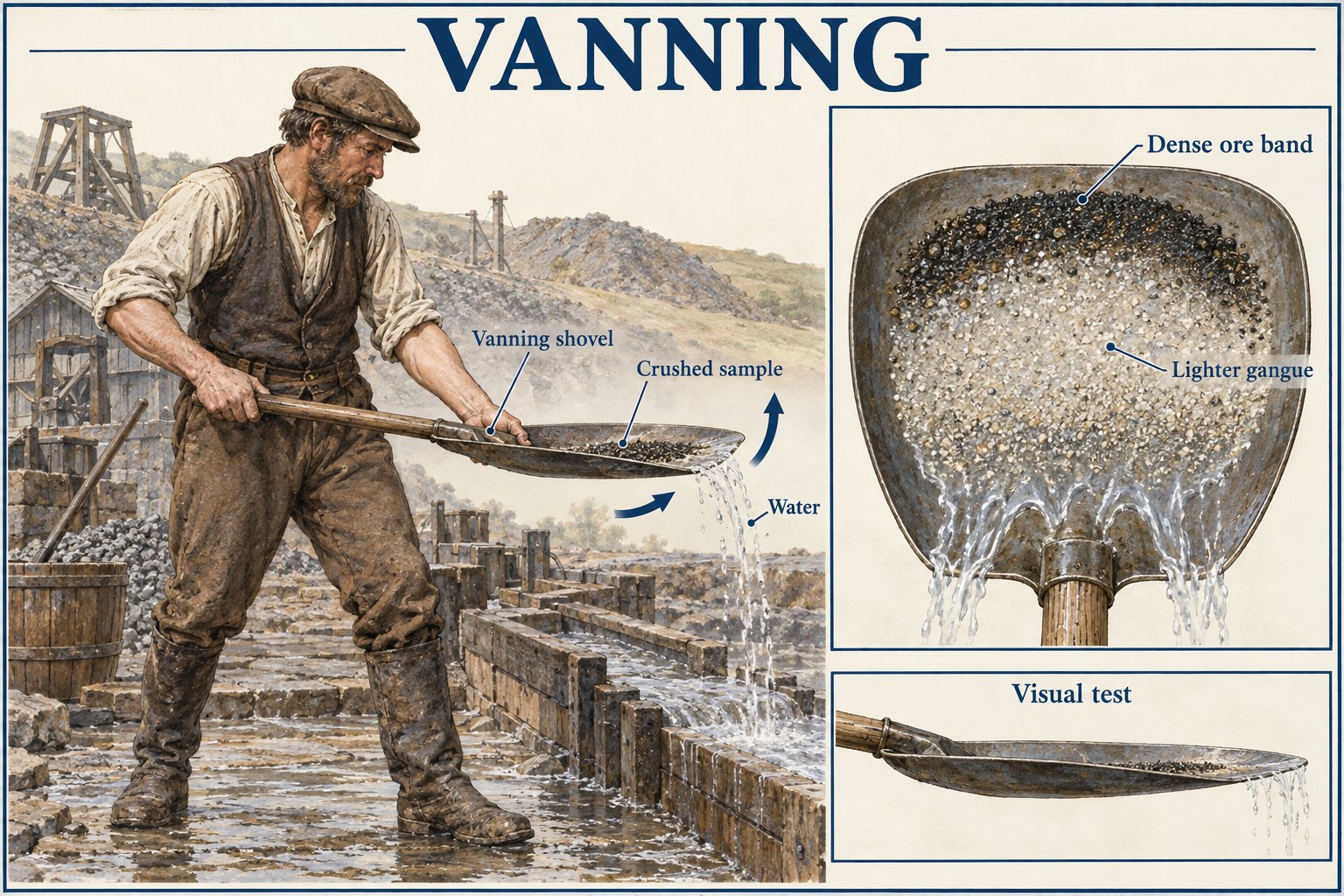
A hand-testing technique for judging the quality of crushed or partly-dressed ore, in which a small sample is washed and flicked on a shovel to separate heavy ore from lighter waste by eye.
Historical usage
Vanning was developed in western England and was the standard method Cornish tin mines used to assay ore for its 'black tin' (cassiterite) content, remaining in use at at least one major Cornish tin mine and a mine-waste reprocessing firm as late as 1985.
How it worked
A small sample of finely crushed ore was mixed with water on the blade of a shovel — known as a vanning shovel — and given a series of sharp upward flicks; the denser ore particles were thrown up through the water and settled into a distinct crescent-shaped band at the top of the sample, with the lighter waste (gangue) remaining below, letting an experienced vanner judge the ore's richness by eye on the spot.
Why it was used
Vanning gave a quick, cheap, on-the-spot estimate of ore quality without needing a laboratory assay, letting a mine judge in real time whether ore reaching the dressing floor was worth continuing to process, or whether working conditions needed adjusting.
Risks & limitations
Vanning depended entirely on the skill and experience of the person doing it, giving a useful visual estimate rather than a precise, repeatable figure — in the 19th century, the same basic principle was mechanised and scaled up industrially in devices such as the Frue vanner.
Related terminology
Black Tin and White Tin, Froth Flotation
Mines associated with this term
Included only where MineArchive's own research gives a reasonable evidential basis — not every mine where this might plausibly apply.
- Ventonwyn Mine — Cornwall (well documented example)
Named in this record’s history: “…a man holding a Cornish pump bucket, the sample taker with his vanning shovel, two blacksmiths with hammers, the engine driver with his oil…”
Sources
- (secondary) Assaying Tin Ore — 911 Metallurgist
- (secondary) Vanning — Wikipedia
Record created: 21 August 2026 · Last researched: 21 August 2026