 MineArchive
Black Tin and White Tin
| Also known as | Black Tin (The dressed ore concentrate stage specifically.), White Tin (The smelted metal stage specifically.), Cassiterite (The tin oxide mineral itself, of which dressed 'black tin' is the concentrate) |
|---|---|
| Category | Ore Processing |
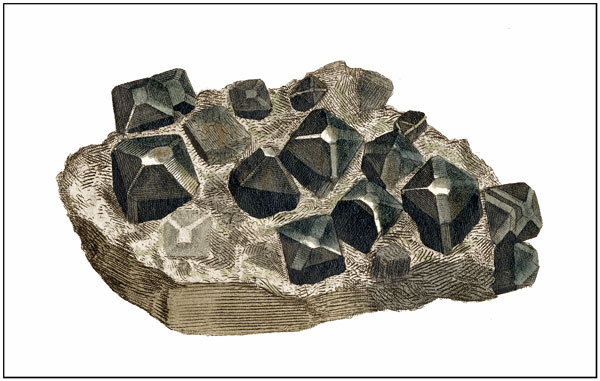
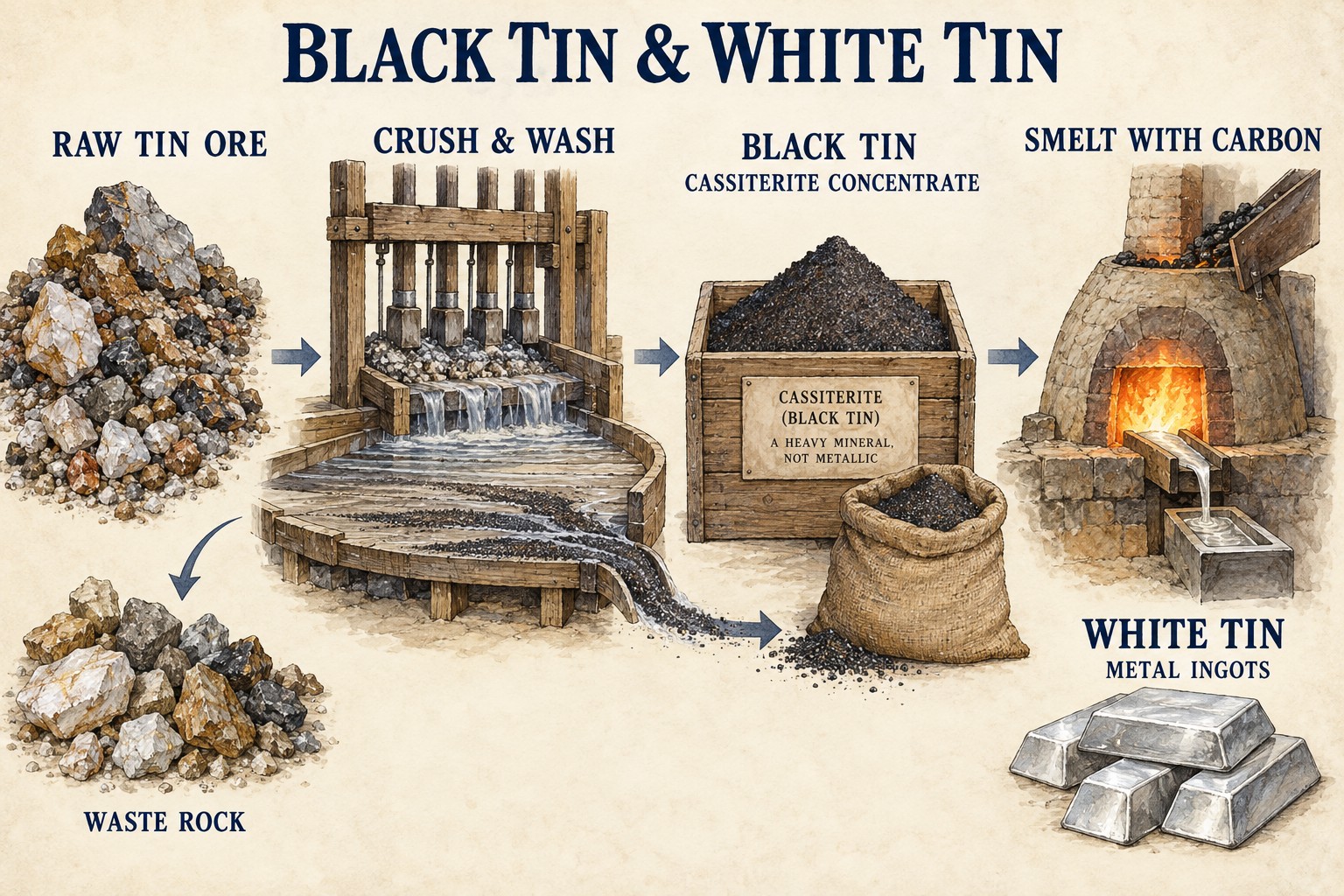
The two stages tin ore passed through on its way to market: 'black tin' was dressed cassiterite concentrate, still an oxide and dark in colour, ready to sell to a smelter; 'white tin' was the pure, silvery metal produced once that concentrate had actually been smelted. The distinction runs through almost every Cornish and Devon tin mine's production figures.
Historical usage
Both terms were standard trade vocabulary throughout the Cornish and Devon tin industry from at least the medieval stannary period onward, and smelters were historically known as 'white tinners' to distinguish their trade from that of the miners and ore-dressers who produced black tin. Mines reported their output in tons of black tin sold, not tons of ore raised, since black tin — already crushed, washed and concentrated — was the actual saleable commodity a mine produced; the finished white metal was normally the smelter's product, not the mine's.
How it worked
Raw ore straight from underground was almost worthless — mostly waste rock with only a small proportion of actual cassiterite. Crushing (originally by stamps) and washing on dressing floors and buddles concentrated this down into black tin: a heavy, dark, sand-like concentrate of cassiterite, still chemically an oxide (tin bonded to oxygen) and still containing impurities such as arsenic, iron and wolfram that had to be removed before the metal itself was any use. Smelting black tin at high temperature with a source of carbon (originally charcoal, later coal) stripped away the oxygen, leaving pure metallic white tin behind, cast into ingots.
Why it was used
Selling black tin rather than raw ore let a mine capture as much value as possible from its own dressing floors before handing the material on to a specialist smelter, without needing to run a smelting works of its own — smelting required a different kind of furnace, fuel supply and skill set from dressing, and in Cornwall's case, coal that had to be imported since the county has no coalfield of its own.
Risks & limitations
Black tin's value depended entirely on how thoroughly it had been dressed — poorly concentrated black tin, still carrying too much waste rock or too many impurities, fetched a lower price and could be rejected outright by a smelter. Grades fell over a mine's working life as the richest, easiest-to-dress ground was worked out first: Dolcoath's own recorded yield, for example, fell from 80lb of black tin per ton of rock in 1896 to just 30lb by 1915.
Related terminology
Mines associated with this term
5 examples chosen from 39 linked records — the term page is not an index.
- Geevor Tin Mine — Cornwall (well documented example)
The mine's own recorded history explicitly reports around 50,000 tons of black tin produced over its working life. - Wheal Hermon — Cornwall (well documented example)
Named in this record’s geology: “…prospecting adit in the valley floor was driven on the Riblows Lode. Cassiterite, the tin ore, and fluorite are recorded from the mine.” - Eylesbarrow Mine — Devon (well documented example)
Named 3 times in this record, first in the history: “…and the Birch Tor and Vitifer mines. By 1820 it was sending black tin to Cornwall for smelting, but in 1822 the mine took the unusual…” - Golden Dagger Mine — Devon (well documented example)
Intermittent working between 1882 and 1914 produced around 220 tons of black tin — the dressed ore before smelting, not the metal. - Wheal Vor — Cornwall (well documented example)
The mine's own recorded history explicitly reports production in both black tin (840 tons in 1865-66) and white tin (200 tons a month at peak), the clearest paired example on the site.
Sources
- (secondary) Black tin — Wikipedia
- (secondary) Dressing the Ore — Cornish Mining World Heritage Site
- (secondary) White tin — Wikipedia
Record created: 22 August 2026 · Last researched: 22 August 2026