 MineArchive
Arsenic
| Category | Commodities |
|---|---|
| Commodity page | Arsenic → |
A highly toxic semi-metal (As), recovered in Cornwall almost entirely as a by-product of roasting tin and copper ore, and refined for use as a pesticide, pigment and industrial chemical.
Historical usage
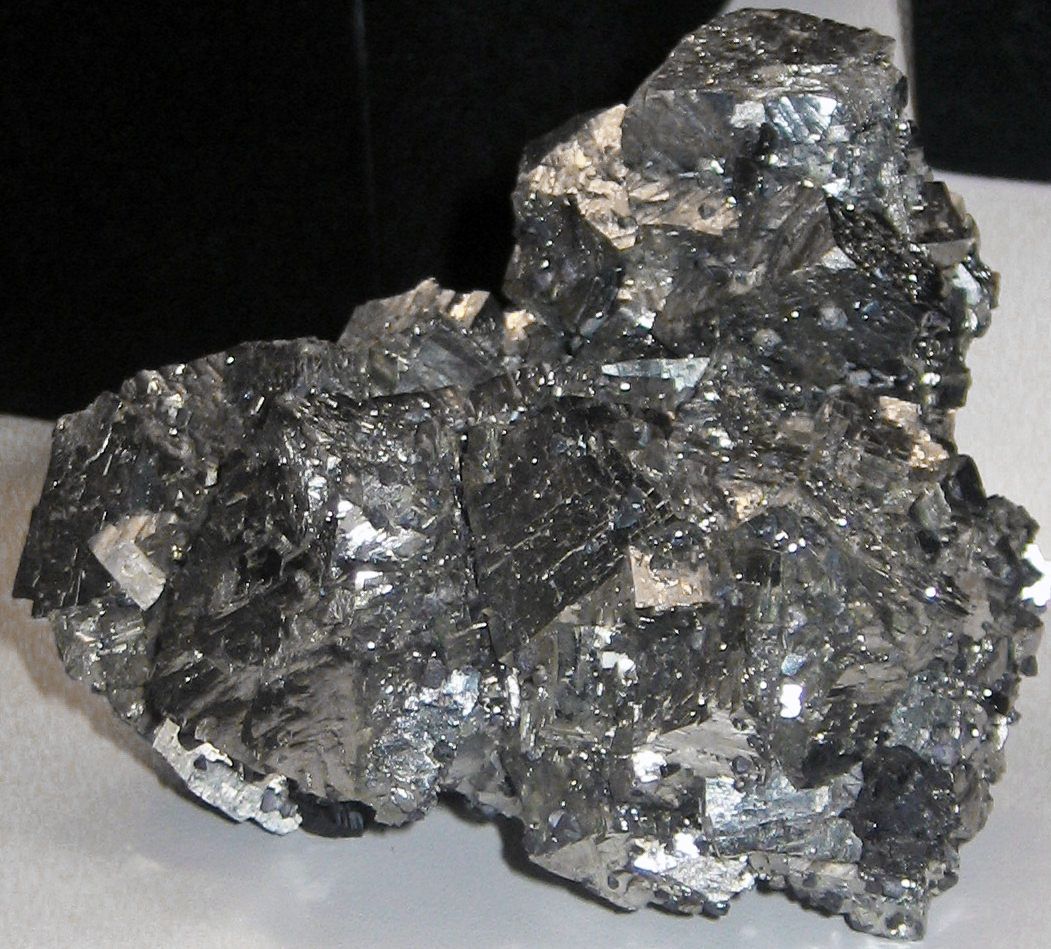
Arsenic occurs naturally alongside Cornish and Devon tin and copper ores, chiefly as the mineral arsenopyrite, and was originally just a contaminant vented to the atmosphere while roasting ore for its tin. Once markets for arsenic itself — pigments, pesticides, glass decolourising — developed in the early 1800s, mines began recovering it deliberately in purpose-built calciners. By the 1870s a handful of Cornish and Devon mines produced over half the world's arsenic; Devon Great Consols alone, the largest producer, refined some 3,000 tons of arsenic a year at its peak.
How it worked
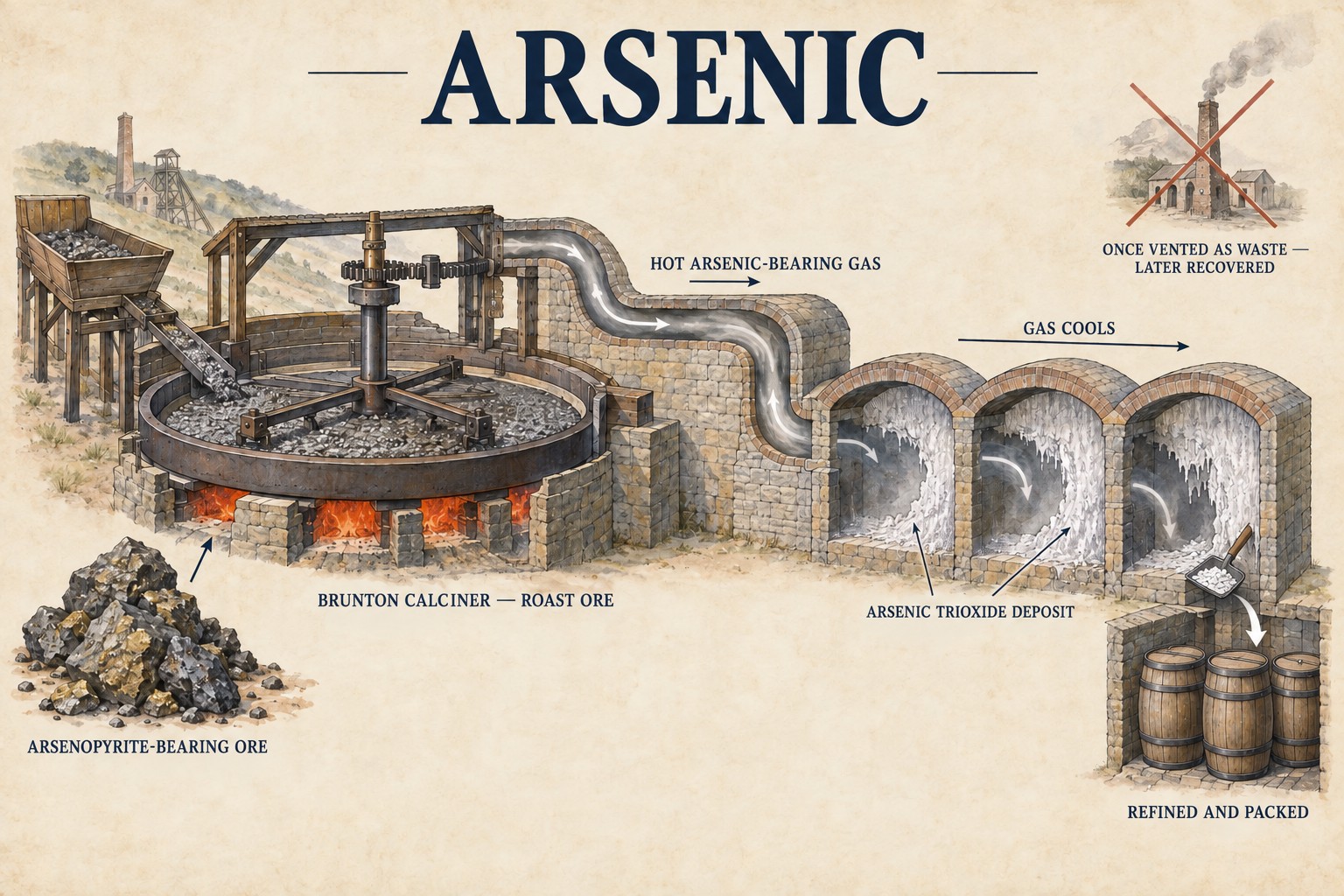
Arsenopyrite-bearing ore was roasted at around 600°C in a Brunton calciner, driving off arsenic and sulphur as gas along with the tin being recovered; the gases were drawn through long, winding flues and arched condensing chambers, where the cooling arsenic deposited as a grey-white crust of refined arsenic trioxide on the chamber walls, later scraped out, re-refined and packed for sale.
Why it was used
Arsenic's toxicity was exactly what made it commercially valuable — as a pesticide, rat poison and sheep-dip it killed pests reliably and cheaply, while its use as a glass decolouriser and pigment depended on unrelated chemical properties; Lancashire's cotton industry, using arsenic-based dyes and pigments, was Cornwall's principal customer.
Value over time
Arsenic was, in effect, a waste stream that Victorian industry turned into one of Cornwall's most valuable exports: worthless contamination before the 1800s, it became profitable enough that Devon Great Consols could refine 3,000 tons a year by the industry's peak. That value collapsed just as quickly once its principal use — agricultural and household pesticides — was progressively restricted through the 20th century on safety grounds, and Cornish arsenic production was effectively phased out by the early 1900s as tin mining itself also declined.
Hazards & challenges
Arsenic is acutely and cumulatively toxic, and Cornwall's calciner workers — often women and girls tending the Brunton calciners — worked with minimal protection, sometimes no more than cotton wool wads in the nostrils and a cloth over the mouth against the arsenic-laden fumes and dust. The legacy is still measurable today: soil around former calciner sites in Cornwall records some of the highest arsenic concentrations found anywhere in the world, up to around 2,500 parts per million, a direct record of just how much toxic material passed through these sites and how little of it was contained.
Risks & limitations
Because arsenic was almost always a by-product rather than a mine's primary target, its production tracked the fortunes of the tin and copper industry that generated it rather than following an independent market of its own — when Cornish tin mining declined, arsenic output declined with it regardless of arsenic's own market conditions.
Regional variation
Cornwall and west Devon were overwhelmingly the centre of British arsenic production, a direct consequence of the region's tin and copper lodes running through arsenopyrite-bearing rock; arsenic recovery on this scale was not significant anywhere else in Britain.
Related terminology
Mines associated with this term
5 examples chosen from 32 linked records — the term page is not an index.
- Botallack Mine — Cornwall (well documented example)
Named 3 times in this record, first in the history: “…14,500 tonnes of tin, 20,000 tonnes of copper and 1,500 tonnes of arsenic, alongside smaller quantities of cobalt, lead and silver; the…” - Carrock Fell Mine — Cumbria (well documented example)
Named in this record’s history: “…were roasted in a half-ton hand-raked furnace to drive off arsenic. The workforce peaked at around 100 before falling to 25 by late…” - Wheal Busy — Cornwall (well documented example)
Named 6 times in this record, first in the summary: “…It ended its working life a century and a half later roasting arsenic, and the Brunton calciner that did it still stands to roof level.” - Bedford United Mine — Devon (well documented example)
After 1890 the workings continued above adit into the 1920s chiefly for arsenic, with smaller amounts of tin and wolfram. - Devon Great Consols — Devon (well documented example)
The largest arsenic producer in the world at its peak, refining around 3,000 tons of arsenic a year.
See every mine that worked arsenic →
Disasters associated with this term
Included only where MineArchive's own research gives a reasonable evidential basis, with the nature of the relationship stated — not every disaster where this term might plausibly apply.
- Wheal Jane acid mine water discharge, 1992 (contextual relationship)
The impounded water had turned acidic enough (pH 3.1) to strip arsenic and other metals out of the abandoned workings long before the collapse released 50,000 m³ of it into the Carnon River.
Sources
- (primary) Geochemical assessment of arsenic toxicity in mine site along the proposed Mineral Tramway Project, Camborne, Cornwall — Geochemistry: Exploration, Environment, Analysis
- (secondary) 12: Minor Metals — 12.1 Arsenic — National Association of Mining History Organisations
- (secondary) Extracting Arsenic — Cornish Mining World Heritage Site
- (secondary) Poison Panic & the History of Arsenic — Historic UK
Record created: 20 August 2026 · Last researched: 20 August 2026