 MineArchive
Cobalt
| Category | Commodities |
|---|---|
| Commodity page | Cobalt → |
A hard, ferromagnetic metal (Co), worked in Britain on only a small, short-lived scale, chiefly for the intense blue pigment its compounds produce in glass and ceramics.
Historical usage
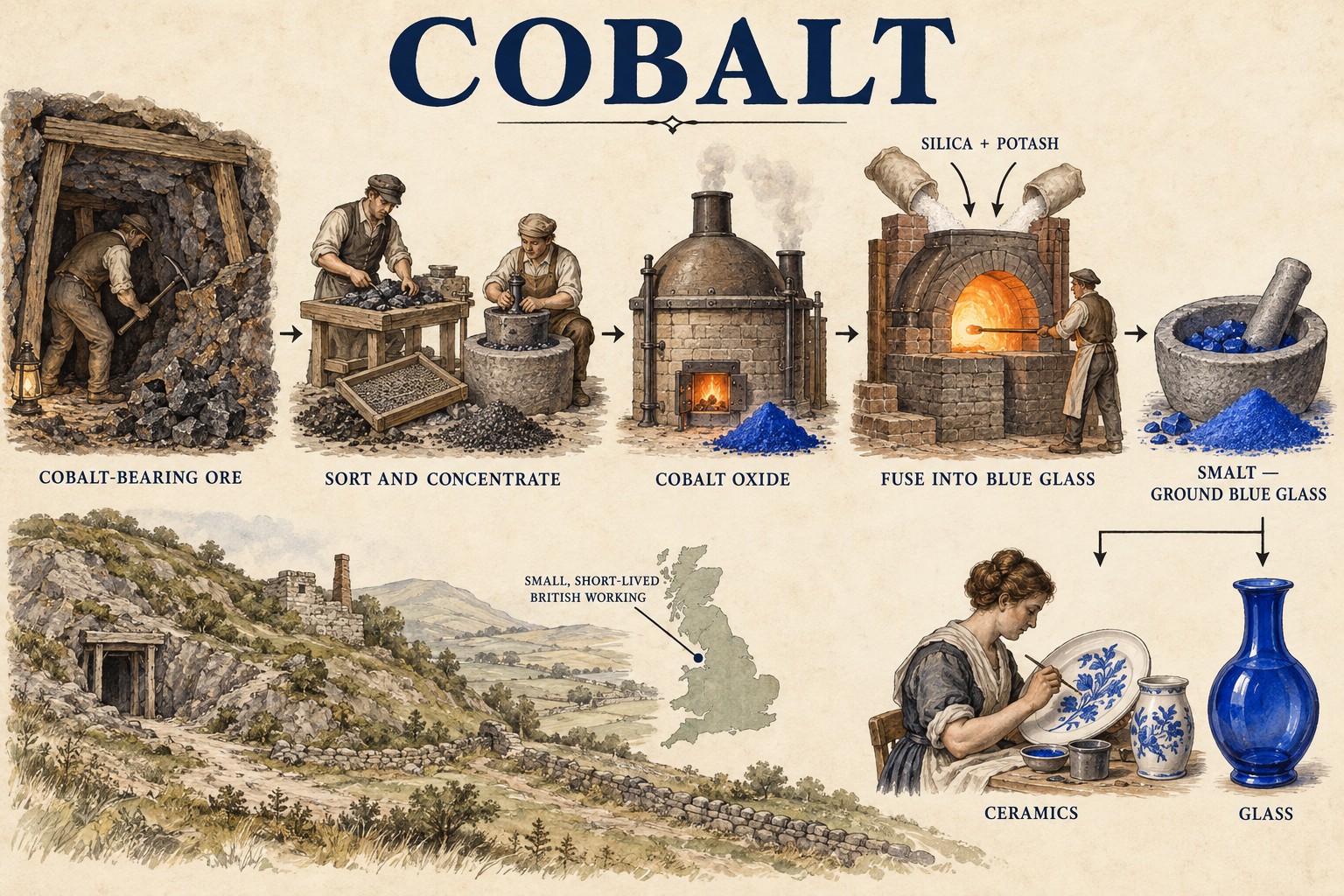
Cobalt ore was worked at Alderley Edge in Cheshire on a real but brief scale in the early 19th century: landowner Sir John Thomas Stanley, anticipating a lucrative market once Napoleonic-era trade disruption cut off continental cobalt supplies, leased out cobalt extraction rights from 1808. The mines were abandoned again in 1817 once normal imports resumed and the brief window of British cobalt's competitiveness closed.
How it worked
Cobalt-bearing ore (asbolite and related minerals) was separated from waste rock and concentrated, then sent for processing into blue cobalt oxide, which was in turn manufactured into zaffre and smalt — pulverised cobalt oxide fused with silica and potash glass — the actual pigment sold on to potteries, glassmakers and papermakers.
Why it was used
Cobalt compounds produce an exceptionally strong, stable blue colour that other available pigments could not match, making it the standard blue for fine pottery, glass and painting for centuries even at relatively small production volumes; modern demand instead rests on wholly different properties — cobalt's role in high-performance battery cathodes and in superalloys that keep their strength at the extreme temperatures inside jet and rocket engines.
Value over time
Alderley Edge's cobalt mines are a clean example of a market opening and closing almost as fast as it appeared: workable only because Napoleonic-era trade disruption temporarily cut Britain off from cheaper continental cobalt, the mines lost their entire commercial rationale the moment normal trade resumed in 1817, after less than a decade. Cobalt's value today follows an equally volatile pattern for different reasons: prices collapsed to multi-year lows in 2023 on oversupply, then reversed dramatically in 2025 when the Democratic Republic of Congo — source of roughly three-quarters of world supply — imposed an export ban, sending prices up by around 180% within about a year, the same kind of supply-shock volatility now separately driving tungsten's price surge on this site.
Hazards & challenges
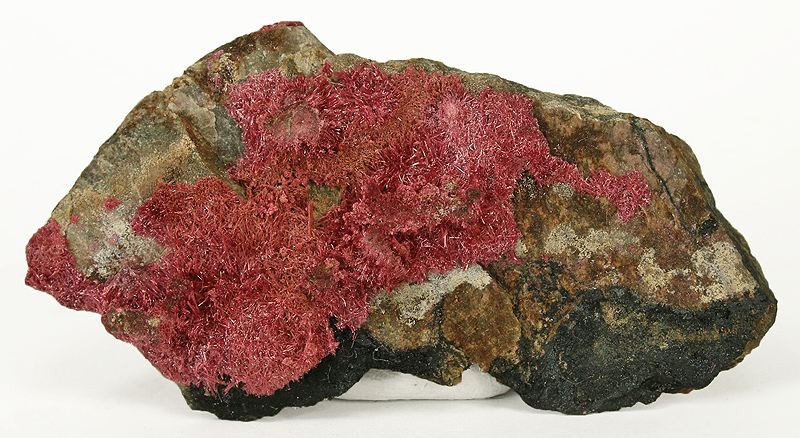
Cobalt is now recognised as a probable human carcinogen (IARC Group 2B), and chronic exposure by inhalation causes respiratory irritation, wheezing, reduced lung function and fibrosis, alongside effects on the heart and thyroid; cobalt ore also very often occurs alongside arsenic-bearing minerals — cobalt's own 'bloom' mineral, erythrite, is chemically a cobalt arsenate — so historic cobalt workers, like arsenic and tin miners nearby, faced real arsenic exposure risk on top of cobalt's own toxicity.
Risks & limitations
British cobalt mining has only ever been viable in short opportunistic windows when normal import supply was disrupted, since domestic deposits like Alderley Edge's are small relative to the major world sources — a pattern of dependency on a handful of dominant foreign suppliers (Saxony and Norway historically, the Democratic Republic of Congo today) that has never really changed.
Regional variation
Alderley Edge in Cheshire is the only significant British cobalt-mining site; unlike lead, tin or coal, cobalt was never worked at meaningful scale anywhere else in the country.
Related terminology
Mines associated with this term
5 examples chosen from 8 linked records — the term page is not an index.
- Botallack Mine — Cornwall (well documented example)
Named in this record’s history: “…copper and 1,500 tonnes of arsenic, alongside smaller quantities of cobalt, lead and silver; the mineral botallackite, a copper chloride, was…” - Alderley Edge Mines — Cheshire (well documented example)
The only significant British cobalt-mining site, worked briefly from 1808 to 1817 during Napoleonic-era trade disruption. - Alva Silver Mine (Silver Glen) — Clackmannanshire (well documented example)
The silver deposit carried cobalt ore alongside it, later worked intermittently and sold to porcelain manufacturers — a second commodity out of the same vein. - Clive Mine — Shropshire (well documented example)
Named in this record’s workings: “…hand-worked sections that still show candle-soot marks. Copper, cobalt, manganese and iron minerals stain the vein walls in distinctive…” - Cobalt Mine — Cheshire (well documented example)
Named twice in this record, first in the geology: “…at Alderley Edge, part of a wider series of unconnected shallow cobalt workings from Saddlebole to Finlow Wood.”
See every mine that worked cobalt →
Sources
- (primary) Toxicological Profile for Cobalt — US National Center for Biotechnology Information
- (secondary) Abandoned cobalt mine rediscovered with 'time capsule' of artefacts — HeritageDaily
- (secondary) Cobalt Market Update: Q3 2025 Review — Prices Surge on DRC Export Controls — Investing News Network
- (secondary) Pigments through the Ages — Cobalt blue — WebExhibits
- (secondary) The cobalt time capsule of Alderley Edge — Minor Metals Trade Association
Record created: 20 August 2026 · Last researched: 20 August 2026