 MineArchive
Tungsten
| Category | Commodities |
|---|---|
| Commodity page | Tungsten → |
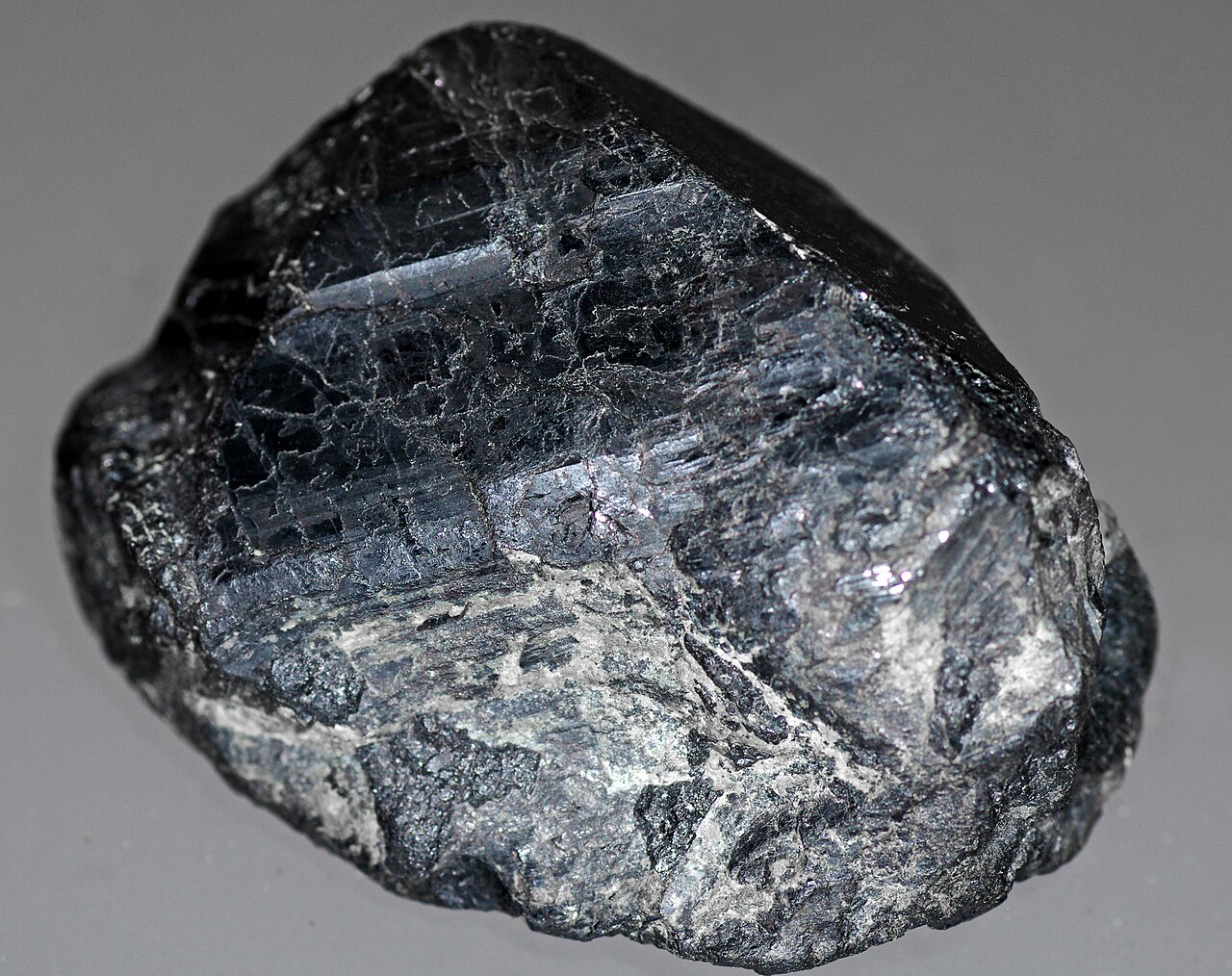
A very dense, extremely high-melting-point metal (W), worked chiefly from the mineral wolframite, prized above all for hardening steel.
Historical usage
Tungsten metal was first isolated in 1783 by the Spanish chemists Juan José and Fausto Elhuyar, from wolframite ore. Its major industrial use only began around 1900, when metallurgists found that adding tungsten to steel made it far harder and more heat-resistant; tungsten high-speed steel, exhibited at the 1900 Paris World Exhibition, transformed cutting-tool manufacturing. In both world wars it became a strategically critical material — Germany's tungsten-steel cutting tools gave it a real manufacturing edge in the First World War, much of the ore then coming from Cornish mines, and Portugal's wolframite deposits at Panasqueira made it a pressured neutral supplier to both sides in the Second.
How it worked
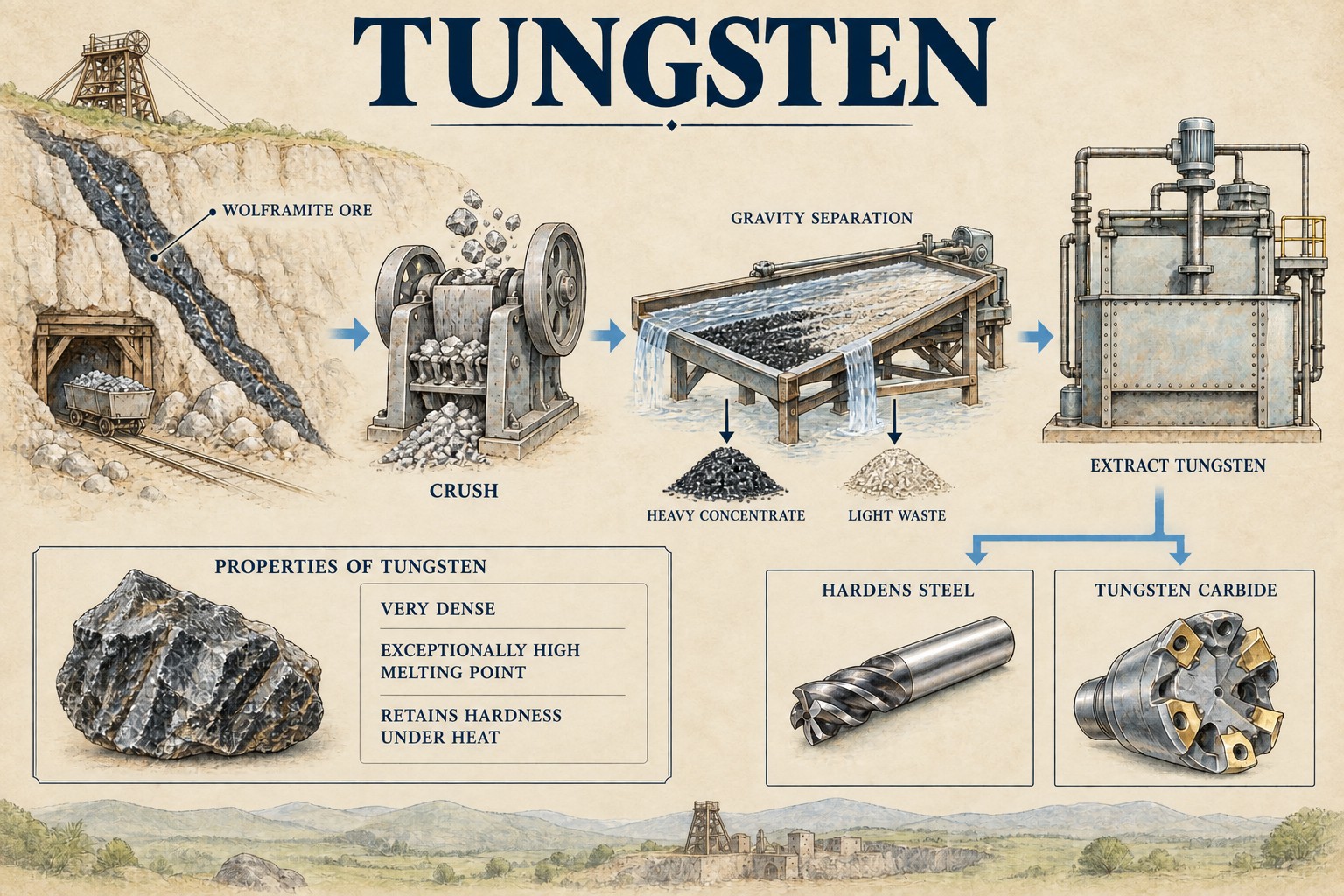
Wolframite ore is crushed and concentrated, historically by gravity separation given the mineral's high density, then chemically processed to extract tungsten. From the 1920s, tungsten carbide — cemented tungsten particles in a metal binder, patented by Osram Studiengesellschaft in Berlin in 1923 — gave cutting tools a hardness close to diamond.
Why it was used
Tungsten has the highest melting point of any metal and is exceptionally hard and dense, properties that translate directly into cutting tools, drill bits and armour-piercing ammunition that keep their edge and integrity under conditions that would deform or melt ordinary steel.
Value over time
Tungsten's value has always tracked its status as a strategic, supply-constrained material rather than behaving like an ordinary commodity: wartime demand repeatedly made it a matter of national urgency rather than simple economics. That pattern is playing out again now — tungsten prices rose roughly 622% between January 2025 and April 2026 alone, hitting a 12-year high, as China (which supplies over 80% of world output) tightened export controls; it is exactly this price surge that is driving the current restart of Hemerdon Mine in Devon, previously uneconomic to reopen.
Hazards & challenges
Tungsten metal itself is not especially toxic, so wolframite mining's main historic hazard was the generic one shared with most hard-rock mining: fine silica dust from crushing and milling a very hard, dense ore, causing silicosis with prolonged exposure. Wolframite veins, including at Hemerdon, also commonly occur alongside tin and, in some districts, arsenic-bearing minerals, adding the same arsenic dust and fume exposure risk documented at Cornish and Devon tin mines more broadly.
Risks & limitations
Even rich tungsten deposits tend to be low-grade relative to the ore volume needed — Chinese ore grades have fallen from 0.42% tungsten in 2004 to just 0.28% by 2024 — meaning large volumes of rock must be processed for a comparatively small yield, an economic problem that price spikes can offset but low prices make quickly uneconomic.
Regional variation
China dominates world tungsten production today, but historically Britain (chiefly Cornwall and Devon) and Portugal were significant producers, particularly during both world wars when supply from potentially hostile sources was itself a strategic risk — precisely the concern now driving renewed British interest in domestic tungsten supply.
Related terminology
Mines associated with this term
5 examples chosen from 15 linked records — the term page is not an index.
- Carrock Fell Mine — Cumbria (well documented example)
A primary tungsten (wolframite) producer in the Lake District. - Wheal Fortune — Cornwall (well documented example)
Named twice in this record, first in the summary: “A tin, copper, zinc, tungsten and arsenic mine straddling the Breage and Sithney parish boundary…” - Carn Brea Mine — Cornwall (well documented example)
Named 3 times in this record, first in the history: “…after amalgamation continued to include substantial arsenic and tungsten production — 3,142 tons of arsenic and 390 tons of tungsten in 1906,…” - Devon Great Consols — Devon (well documented example)
Named twice in this record, first in the history: “…60-year life; smaller-scale 20th-century rework extracted tin and tungsten from the dumps, continuing sporadically as late as the 1970s, with…” - Devon United Mine — Devon (well documented example)
Named in this record’s geology: “…a granite. The same calcareous feldspars are the likely reason the tungsten here came up as scheelite rather than wolframite.”
See every mine that worked tungsten →
Sources
- (secondary) DUST TO DUST: Silicosis cases expose government complacency on deadly engineered stone — Hazards magazine
- (secondary) Infographic: The History of Tungsten, the Strongest Natural Metal on Earth — Visual Capitalist
- (secondary) The history of tungsten, the strongest natural metal on earth — MINING.COM
- (secondary) Tungsten prices hit 12-year high as China tightens export controls — MINING.COM
- (secondary) Tungsten | Properties & Uses — Almonty Industries
- (secondary) Why Tungsten Prices Soared 622% Since 2025 — Visual Capitalist
Record created: 20 August 2026 · Last researched: 20 August 2026