 MineArchive
Silicosis
| Category | Ventilation & Mine Gases |
|---|
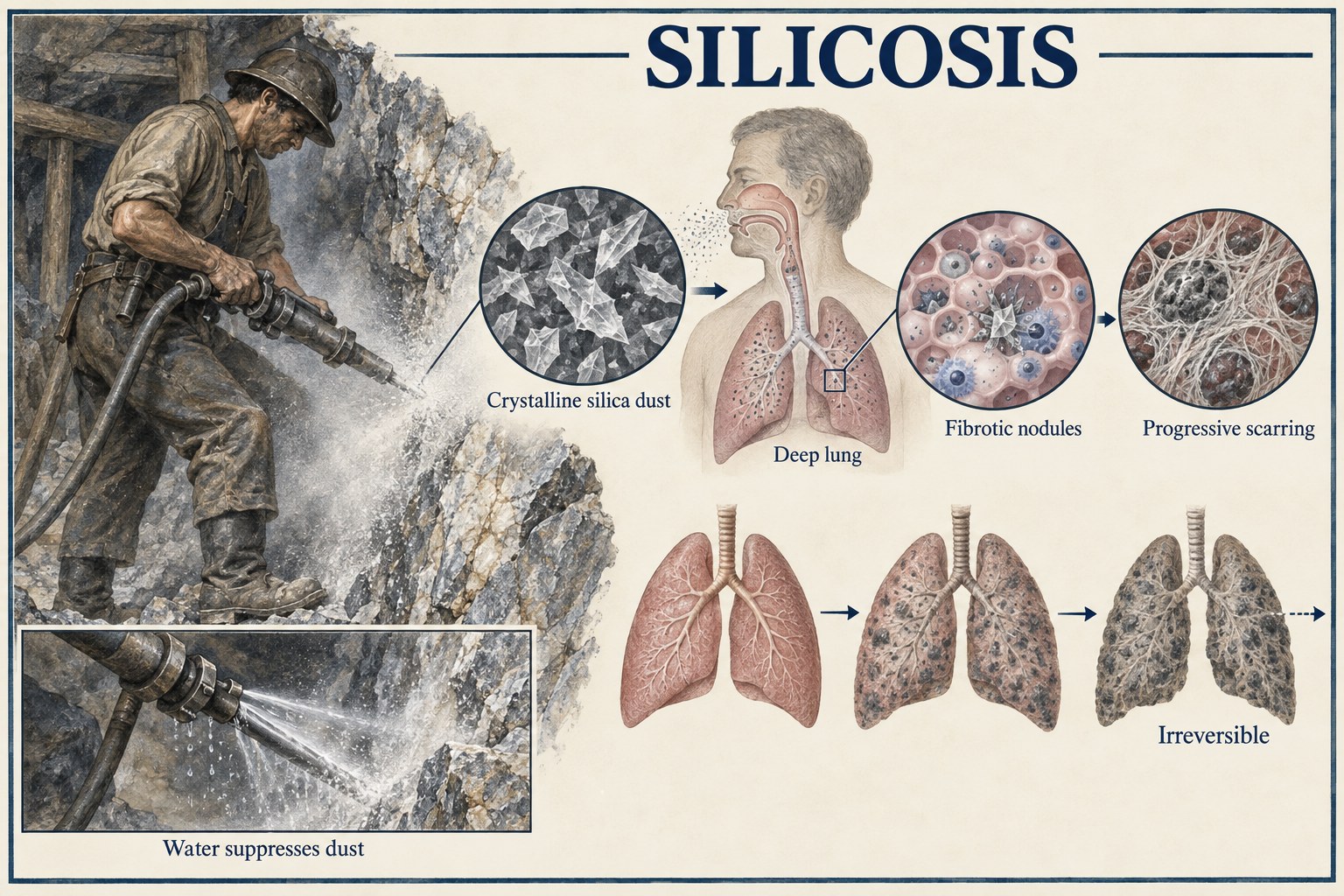
A progressive, incurable lung disease caused by inhaling fine crystalline silica dust — generated wherever miners drilled, blasted or crushed quartz-bearing rock — and one of the deadliest occupational hazards in British hard-rock and coal mining history, known to miners themselves for generations as "miners' phthisis" or "miners' consumption" long before it had a formal medical name.
Historical usage
High death rates from lung disease among Cornish tin and copper miners had been noted for generations, but the true cause went unproven until the British government's Haldane Commission, led by the physiologist John Scott Haldane, investigated Cornish miners' health in 1900-02 and reported in 1904 that fine silica dust, not damp or bad air as many had assumed, was the principal culprit. The problem worsened sharply from the 1890s as compressed-air rock drills — nicknamed "widow-makers" by the men who used them — mechanised drilling and threw far more dust into the air than hand-boring ever had, driving a marked rise in deaths among miners as young as 25 to 45. At Greenside Mine in the Lake District, unusually high rates of the disease were recorded and attributed at the time to exactly this cause. Statutory compensation followed only slowly: coalminers became eligible for silicosis compensation from 1928, and a dedicated Coalmining Industry (Pneumoconiosis) Compensation Scheme followed in 1943 after further Medical Research Council investigation.
How it worked
Fine silica particles, small enough to be drawn deep into the lungs, become permanently lodged in lung tissue once inhaled; the body's own attempt to wall the particles off with scar tissue is what progressively destroys the lung's capacity to take in oxygen, a process that continues even after dust exposure ends and for which there remains no cure.
Why it was used
Correctly identifying dust, rather than damp underground air, as the true cause mattered enormously, because it pointed toward a genuine remedy — wetting rock before and during drilling to keep dust out of the air — rather than the ventilation-focused measures that had done little to slow the death toll through the 19th century.
Risks & limitations
Silicosis is irreversible and has no treatment beyond managing its symptoms, and it also sharply increases a miner's vulnerability to tuberculosis, a combination that made "miners' phthisis" a virtual death sentence for many Cornish and Derbyshire hard-rock miners before dust-suppression measures became standard.
Regional variation
Any mining that generated fine rock dust carried some risk, but the hazard was most acute in hard-rock metal mining through quartz-bearing ground — Cornwall's tin and copper mines above all — with coal mining's related dust diseases, chiefly coalworkers' pneumoconiosis, recognised and compensated somewhat later and via a separate scheme.
Related terminology
Mines associated with this term
Included only where MineArchive's own research gives a reasonable evidential basis — not every mine where this might plausibly apply.
- Arn Gill Mine — North Yorkshire (well documented example)
Named in this record’s history: “…per cent of local workings suffering from extremely impure air, with silicosis (miners' asthma), caused by poor ventilation, explosive fumes and…” - Dipton Colliery — County Durham (well documented example)
Named in this record’s history: “…1911, a driller who died in 1936 of tuberculosis brought on by silicosis, and an onsetter who fell 200 feet to the shaft bottom in 1937 after…” - Greenside Mine — Cumbria (well documented example)
Reports noted unusually high rates of pneumoconiosis (miners' phthisis) among Greenside's workforce, attributed at the time to silica dust.
Sources
- (primary) Hard Rock Miners' Phthisis in 19th and Early 20th Century Britain: From Diagnosis to Compensation — eScholarship / University of California
- (primary) “A Mere Matter of Rock”: Organized Labour, Scientific Evidence and British Government Schemes for Compensation of Silicosis and Pneumoconiosis among Coalminers, 1926–1940 — PMC / NIH
- (secondary) Silicosis history: from antiquity to the anthropocene — Frontiers in Public Health
Record created: 22 August 2026 · Last researched: 22 August 2026