 MineArchive
Coal Workers' Pneumoconiosis
| Category | Ventilation & Mine Gases |
|---|
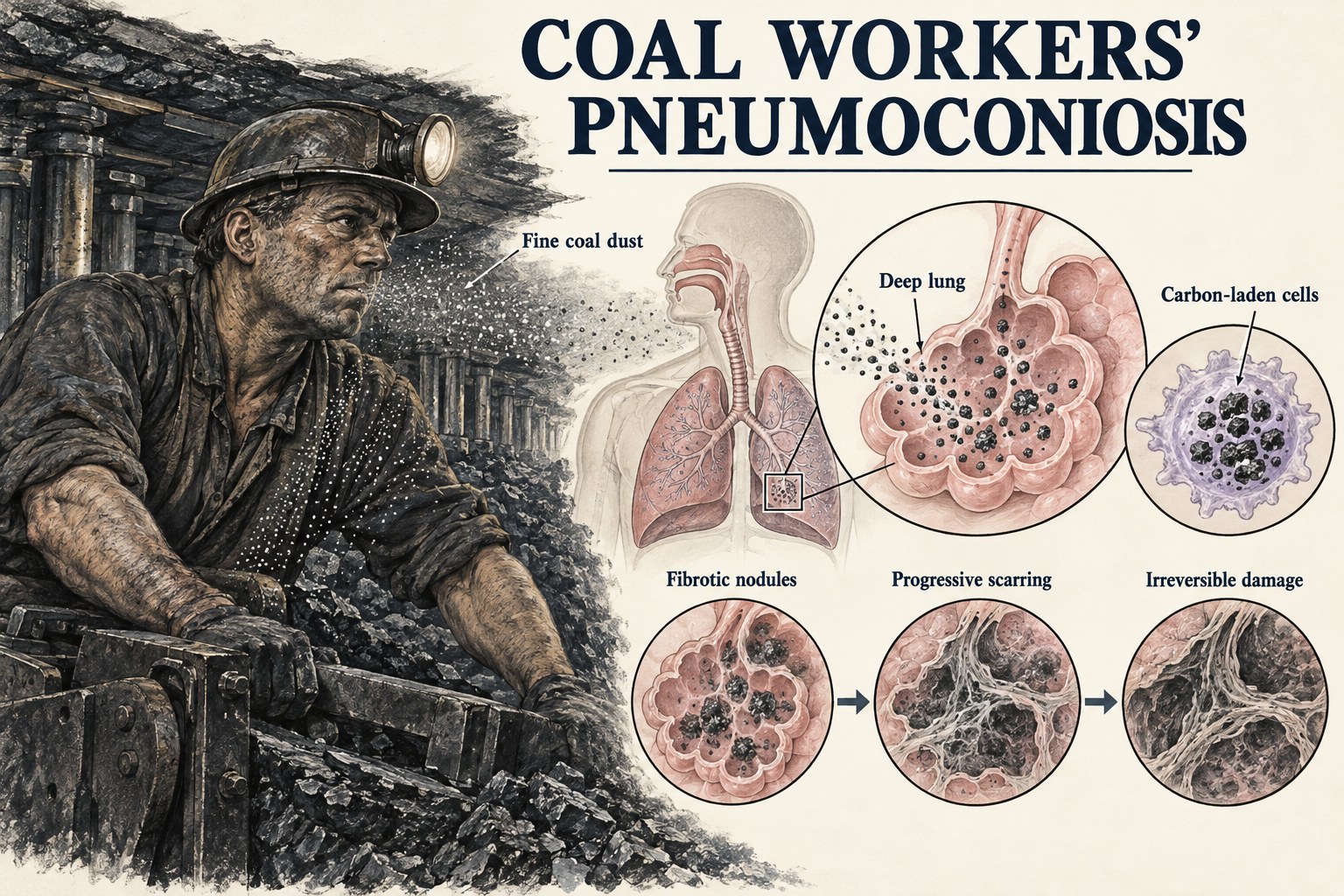
A chronic, incurable lung disease caused by years spent breathing in fine coal dust, leaving scarred, blackened lung tissue — distinct from silicosis, which is caused by quartz and other rock dust, though the two conditions frequently occurred together and were, for decades, compensated in Britain as if they were a single disease.
Historical usage
Scottish physicians produced some of the earliest clinical descriptions linking coal mining to chronic lung disease in the 19th century, but formal recognition and compensation lagged for decades: coalminers only became eligible for silicosis compensation in 1928, and many with pneumoconiosis specifically — as opposed to silicosis — were refused, since it was not, technically, the disease the scheme covered. Between 1933 and 1948, some 17,000 miners in Wales alone left underground work because of pneumoconiosis or silicosis.
How it worked
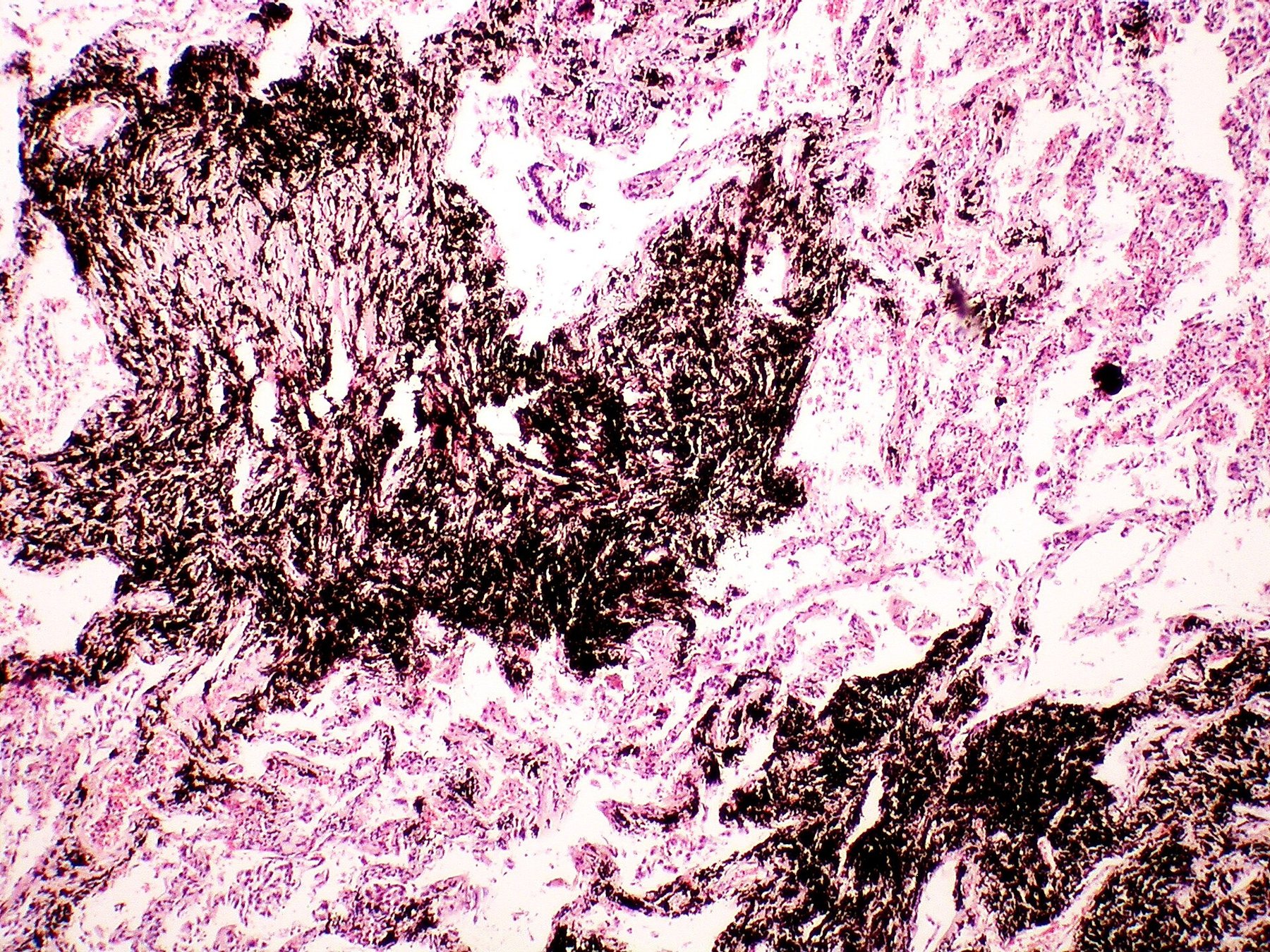
Fine coal dust inhaled over years of underground work lodges permanently in the lungs, where it triggers inflammation and progressive scarring (fibrosis); the disease continues to worsen even after dust exposure ends, and no treatment can reverse the damage already done. What the disease actually leaves behind is visible in the tissue: pigmented fibrotic nodules formed where carbon and silica were deposited together, set in lung blackened throughout by carbon carried in macrophages. Where silica is present alongside the coal the condition is distinguished as anthracosilicosis, and the nodules are the reason the damage is permanent — scar tissue does not clear.
Risks & limitations
A 1943 UK compensation scheme, prompted by Medical Research Council investigation, finally allowed payment for pneumoconiosis as well as silicosis — but only for miners who had worked in the industry between 1934 and 1942, excluding those already disabled before that window. The National Coal Board's Pneumoconiosis Field Research, begun in 1952, eventually recommended a maximum dust concentration in coalface return air, with new British dust standards coming into force in 1969. Coal workers' pneumoconiosis remains a notifiable industrial disease in the UK today.
Related terminology
Shearer, Silicosis, Stone Dusting
Sources
- (secondary) 'A Mere Matter of Rock': Organized Labour, Scientific Evidence and British Government Schemes for Compensation of Silicosis and Pneumoconiosis among Coalminers, 1926-1940 — PubMed Central (academic)
- (secondary) Black lung disease — Wikipedia
- (secondary) Coal workers' pneumoconiosis: anthracosilicosis, pathology image series — Yale Rosen, Wikimedia Commons
- (secondary) New Dust Standards for British Coal Mines — Nature
- (secondary) The Deadly Dust – Industrial Disease in the Coalfield — Glamorgan Archives

Record created: 25 August 2026 · Last researched: 9 September 2026