 MineArchive
Stone Dusting
| Category | Ventilation & Mine Gases |
|---|
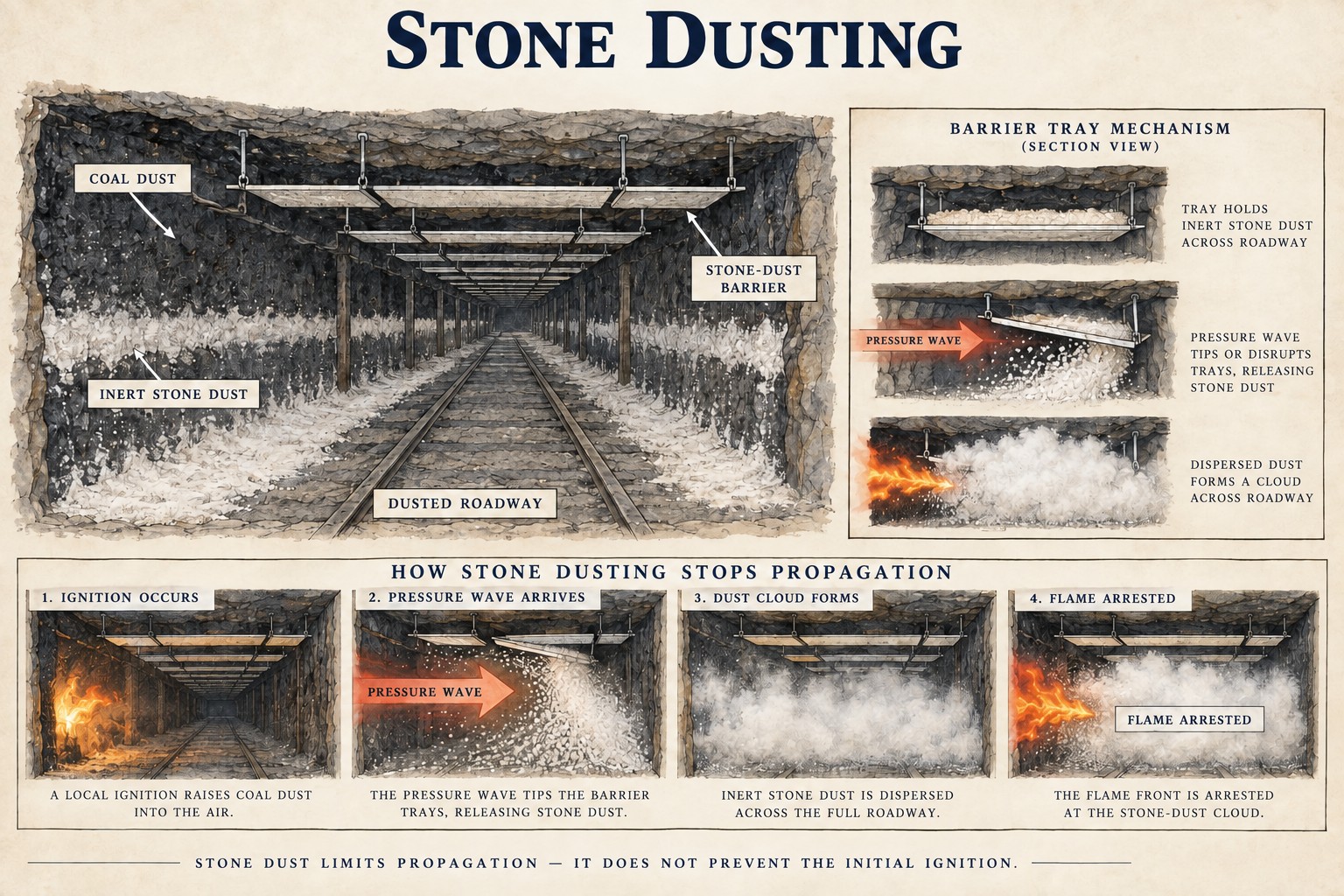
The practice of spreading inert limestone or other stone dust across mine roadways and workings, so that even where firedamp ignites, fine coal dust stirred up by the blast cannot itself sustain or carry the explosion further through the mine.
Historical usage
Investigations into major early-20th-century British colliery explosions — including the inquiry that followed the 1913 Senghenydd disaster, Britain's worst coal-mining accident — increasingly identified airborne coal dust itself, not just firedamp, as a propagating agent capable of turning a local ignition into a mine-wide explosion, and recommended systematic stone dusting in response.
How it worked
Regularly applied stone dust dilutes the combustible coal dust lying in mine roadways below the concentration needed to sustain a flame front; the inert dust also absorbs heat from any explosion that does occur, either extinguishing the reaction outright or sharply reducing its intensity. Later systems formalised this into stone-dust barriers — trays, bags or tanks of dust suspended across roadways at intervals, positioned to be thrown into the air and dispersed by the pressure wave of an approaching explosion, rather than relying solely on dust already settled on surfaces.
Why it was used
Firedamp explosions alone were often survivable in scale; the same explosions became vastly more destructive once they threw up and ignited the fine coal dust that had settled throughout a mine's roadways over normal working. Neutralising that dust with an inert substitute was the direct response to that realisation.
Risks & limitations
Stone dust that becomes wet and then dries can cake, making it far less effective at dispersing into the air fast enough to suppress an oncoming explosion — a limitation still being addressed in modern rock-dusting standards. The practice also does nothing to prevent the initial ignition, only to stop it propagating.
Related terminology
Coal Workers' Pneumoconiosis, Firedamp
Disasters associated with this term
5 examples chosen from 6 linked records, most direct relationship first.
- Eden Colliery explosion, 1927 (contributing factor)
The old Busty roadways leading to the drift predated the stone-dusting regulations and were untreated; the inspector warned of the danger. - Blackwell A Winning Colliery explosion, 1895 (contextual relationship)
The roads were damped only with water barrels; the dust that carried the explosion lay on the roof, sides and in the cracks of the roadway. - Graig Colliery explosion, 1925 (contextual relationship)
Named in this record’s investigation: “The inquest raised concerns about whether proper stone-dusting and tests for gas had been carried out.” - Minnie Pit Explosion, 1918 (contextual relationship)
The jury and the inspector called for the treatment of coal dust and research into making it inert. - Pretoria Pit Disaster (contextual relationship)
Pretoria was worked before stone dusting was required: the pit relied on watering roadways twice a week, and the disaster became a standard argument for the inert-dust practice that replaced it.
Sources
- (secondary) Coal Mines Act 1911 — Wikipedia
- (secondary) How Does Limestone Rock Dust Prevent Coal Dust Explosions in Coal Mines? — US National Institute for Occupational Safety and Health (NIOSH)
- (secondary) Senghenydd colliery disaster — Grokipedia
- (secondary) The Use of Stone Dust to Control Coal Dust Explosions — US Mine Safety and Health Administration (MSHA)
Record created: 25 August 2026 · Last researched: 25 August 2026