 MineArchive
Pretoria Pit Disaster
At about 7.50 on the morning of Wednesday 21 December 1910, an explosion tore through the workings of the Hulton Colliery Company’s Bank Pit No. 3 at Over Hulton, near Westhoughton — the pit universally known as the Pretoria Pit. Of the 344 men and boys underground in the affected districts, only three came out alive, and one of those died the following day. The final toll of 344 dead makes it the worst mining accident in Lancashire’s history and the third worst in Britain, after the Oaks Colliery explosion of 1866 and Senghenydd in 1913.
| Date | 21 December 1910 |
|---|---|
| Mine | Pretoria Pit (Hulton Colliery Bank Pit) |
| Region | Greater Manchester |
| Primary type | Explosion |
| Associated types | Fire, Rescue |
| Fatalities | 344 (The figure of 344 is the one carried by the memorials and by every modern account. Contemporary reckoning varied slightly at the margins depending on whether a man killed in the Arley mine and one who died fighting a surface fire were counted in; the NMRS account, following the inspectors, gives approximately 345.) |
| Context | During active mining (The last working day before the Christmas holiday; the day shift had just gone down.) |
Cause
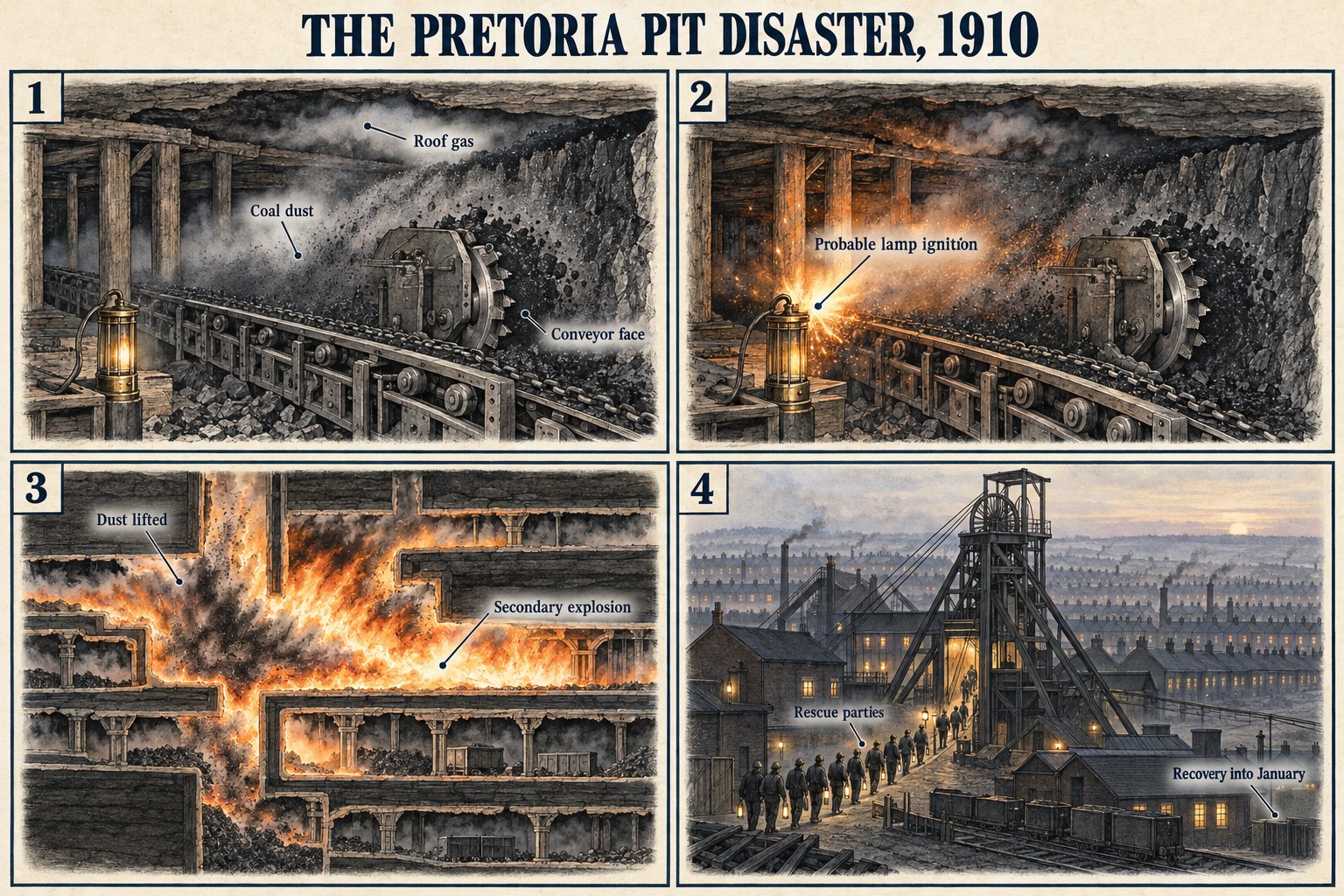
The coroner’s jury found that an accidental ignition of coal dust and gas occurred at the conveyor face in the North Plodder district, "in some manner unknown to the jury but probably from a defective or overheated safety lamp". Whatever lit it, the initial ignition raised and fired the coal dust lying through the roadways, and it was that secondary dust explosion — not the first flash of gas — that carried through the pit and killed almost everyone in its path.
Contributing factors
Three things were named against the colliery. Machine cutting produced far more fine coal dust than hand-holing, and the twice-weekly watering of the roadways through spray nozzles on the water mains was not enough to keep it damp. Ventilation was inefficient: in some districts only about half the air the four Sirocco fans produced actually reached the faces. And gas was known to be present — a roof fall the previous day is thought to have released an accumulation into the workings.
What happened
About 900 men and boys came on for the day shift, and 344 of them descended the No. 3 shaft to work in the Plodder, Yard and Three-Quarters mines. The explosion came at 7.50 a.m. It was felt at the surface and heard for miles. The Yard mine took the worst of it: of roughly 145 men who had gone in there, two were eventually brought out alive.
The two survivors from the Yard mine were Joseph Staveley and William Davenport, found by the rescue parties. Two others were brought up alive from elsewhere in the workings; one died almost immediately and one the following day. A further man was killed in the Arley mine, and William Turton died fighting a fire that broke out at the surface.
Rescue & recovery
Rescue parties went down within the hour and worked in relays for weeks. The bodies were not all recovered until January 1911. Because the disaster fell four days before Christmas, and because whole streets in Westhoughton had sent men down the same shaft, the recovery was conducted in front of a town that had lost a large share of its working men at once. The Mayor of Bolton opened an immediate relief effort, paying five shillings a week to men thrown out of work and making provision for dependants.
Investigation & inquiry
The coroner’s inquest ran to twenty-one sittings. It identified three contributing factors — probable ignition by a defective lamp, an accumulation of coal dust from mechanical cutting, and the resulting secondary dust explosion — and returned a verdict of accidental death. A formal inquiry under the Coal Mines Regulation Acts followed the same ground.
Legal & regulatory aftermath
Compensation reached the families through three channels: the Workmen’s Compensation Act 1906, private insurance, and the relief societies. A disaster relief fund raised £145,000 — an enormous sum for 1911. It was still paying out sixty years later: John Baxter received the final payments in 1973, and the fund was wound up in 1975.
Changes to practice & legislation
The Miners’ Federation used the disaster to press for statutory safety reform, and Pretoria became one of the standard citations in the long argument over coal dust that ran through the Coal Mines Act 1911 and the stone-dusting requirements that followed it. The pit’s reliance on watering roadways twice a week, rather than on inert stone dust, was exactly the practice that the next generation of regulation replaced.
Memorials & commemoration
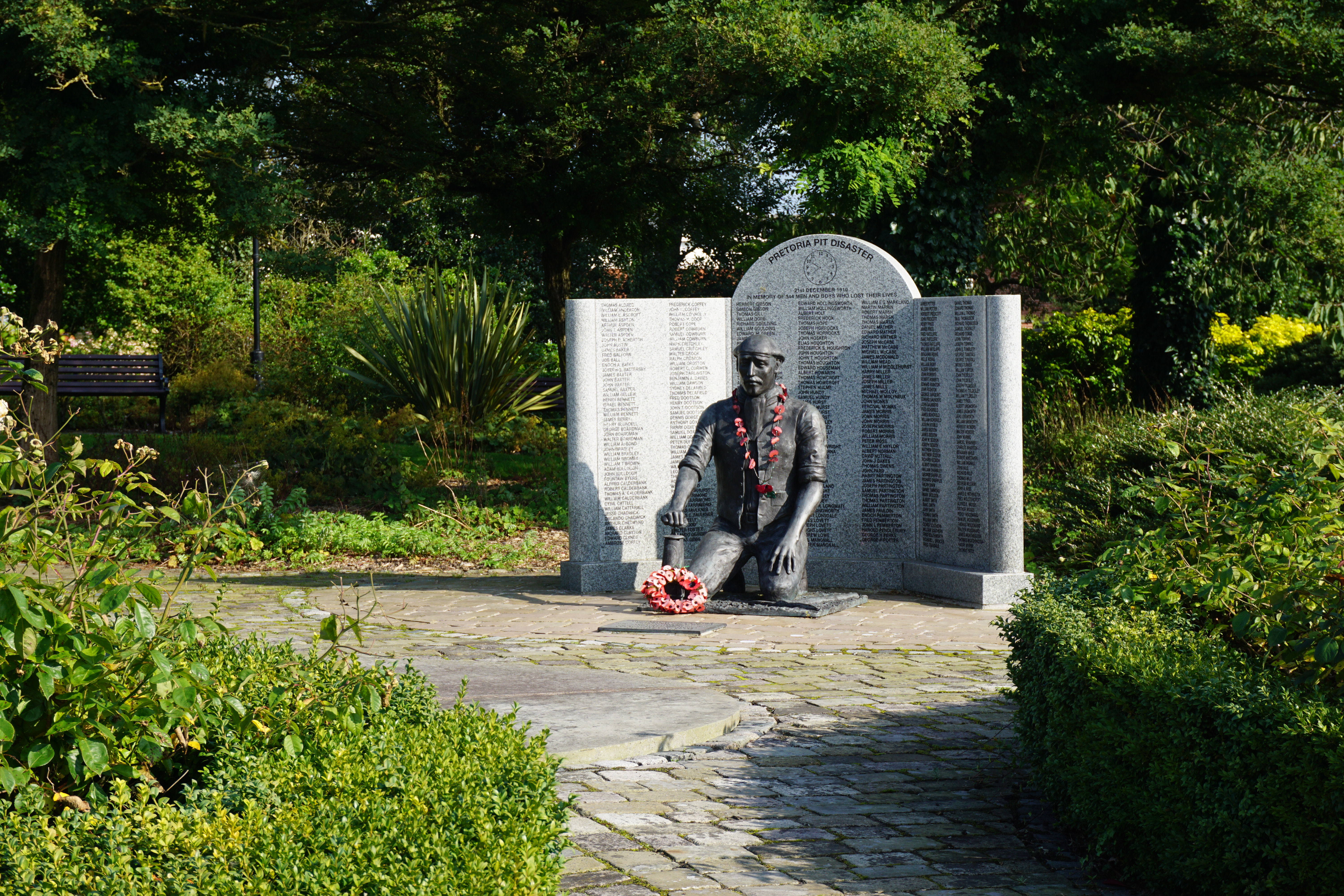
A memorial was raised in Westhoughton cemetery in 1910, over the graves of many of the dead, and is now Grade II listed. A second memorial was erected on Broadway in 2010, and a bronze figure of a miner by Jane Robbins was unveiled opposite Westhoughton parish church on 19 December 2010, two days short of the centenary.
What's uncertain
Points where sources disagree or the record could not be settled; both accounts are kept. All open questions in the archive.
- The NMRS account, following the inspectors’ recovery figures, gives approximately 345 deaths once a man killed in the Arley mine and one who died fighting a surface fire are included. (disputed) 2
- Wikipedia’s account places the explosion in the Plodder mine and attributes it to an accumulation of gas released by a roof collapse the previous day. (disputed) 1
Recorded claims
Individual factual claims, each attached to the source(s) that support it below. Where sources disagree, both are kept.
- A total of 344 men and boys died — the worst mining accident in Lancashire and the third worst in British history. 1,2
- The NMRS account, following the inspectors’ recovery figures, gives approximately 345 deaths once a man killed in the Arley mine and one who died fighting a surface fire are included. (disputed) 2
- The jury found an accidental ignition of coal dust and gas at the North Plodder conveyor face, "in some manner unknown to the jury but probably from a defective or overheated safety lamp". 2
- Wikipedia’s account places the explosion in the Plodder mine and attributes it to an accumulation of gas released by a roof collapse the previous day. (disputed) 1
- Only two men came out of the Yard mine alive — Joseph Staveley and William Davenport. Of four brought to the surface alive in total, one died immediately and one the next day. 1,2
- The relief fund raised £145,000; the last payment was made to John Baxter in 1973 and the fund was dissolved in 1975. 1
- The coroner’s inquest sat twenty-one times before reaching its verdict. 2
Related terminology
Mining terms this disaster is structurally linked to, with the nature of the relationship.
- Coal Mines Act 1911 (contextual relationship)
One of the disasters immediately preceding the Act, which was passing through Parliament when 344 men and boys died here in December 1910. - Firedamp (direct cause)
An ignition of gas at the conveyor face was the initiating event, before the coal dust took it through the rest of the pit. - Roof Fall (contextual relationship)
Named in this record’s contributing factors: “…actually reached the faces. And gas was known to be present — a roof fall the previous day is thought to have released an accumulation into…” - Safety Lamp (direct cause)
The inquest named a defective or overheated safety lamp as the probable ignition source — the device carried specifically to prevent this outcome. - Stone Dusting (contextual relationship)
Pretoria was worked before stone dusting was required: the pit relied on watering roadways twice a week, and the disaster became a standard argument for the inert-dust practice that replaced it.
Photographs & further reading
This page doesn't try to reproduce everything — these are the best original sources found for this disaster.
Transcribed gravestone inscriptions for the men and boys buried at Westhoughton, giving ages and family relationships that the casualty lists alone do not.
View sourceThe town’s own account, including the centenary memorial and the annual commemoration.
View sourceSources
- (secondary) Pretoria Pit disaster — Wikipedia
- (secondary) Hulton Colliery Explosion, Atherton, 1910 — Northern Mine Research Society
- (secondary) The Pretoria Pit Disaster — transcribed contemporary accounts — Lancashire Online Parish Clerk Project
Record created: 26 August 2026 · Last researched: 26 August 2026