 MineArchive
Pretoria Pit (Hulton Colliery Bank Pit)
| Also known as | Hulton Colliery Bank Pit No. 3, Hulton Colliery Bank Pit No. 4, Hulton Colliery |
|---|---|
| Location | Over Hulton, Westhoughton, Greater Manchester — 53.5364, -2.4869 (approximate) |
| Commodity | Coal |
| Type | Coal |
| Worked | 1900–01–14 April 1934 |
| Maximum depth | 434 yards (about 397 m) to the Arley seam |
| Operators | Hulton Colliery Company (1900–1934) |
Overview
Pretoria Pit was the Nos. 3 and 4 shafts of the Hulton Colliery Company’s Bank Pit at Over Hulton, on the western edge of the Lancashire coalfield. Sunk in 1900–01 and named for the South African town captured that summer, it was the largest colliery in the Westhoughton area, working five seams at depths between 146 and 434 yards. On the morning of 21 December 1910 an explosion of gas and coal dust killed 344 men and boys — the worst mining accident in Lancashire’s history and, at the time, the second worst in England (see Disasters, below). The pit worked on for another twenty-three years and closed on 14 April 1934.
History
The Hulton Colliery Company worked a group of four collieries with seven coal-drawing shafts around Over Hulton and Chequerbent, together raising roughly 2,400 tons a day and employing about 2,400 people above and below ground by 1910. The Bank Pit’s Nos. 3 and 4 shafts — universally known as the Pretoria Pit — were sunk in 1900–01, each 18 feet in diameter and standing 75 yards apart. No. 4 was the downcast shaft and No. 3 the upcast.
The pit was mechanised by the standards of its day: coal was cut by machine and carried out of the North Plodder district on a conveyor face, and the men worked Wolf safety lamps burning naphtha rather than naked lights. It was that combination — machine-cut coal producing fine dust, an ignition source that the inquest jury could not identify with certainty, and ventilation that delivered only about half the air the fans produced to some of the workings — that made the 1910 explosion as destructive as it was.
After the disaster the pit was reopened and worked on into the 1930s. It closed permanently on 14 April 1934.
Geology
The colliery worked the Middle Coal Measures of the Lancashire coalfield, a thick sequence of sandstones, mudstones and coal seams laid down in Carboniferous coastal swamp and delta conditions. Five seams were reached from the Nos. 3 and 4 shafts — in descending order the Trencherbone (3 ft 6 in), Plodder (2 ft), Yard (3 ft 11 in), Three-Quarter (1 ft 5 in to 1 ft 6 in) and Arley (2 ft 11 in) — at depths from 146 to 434 yards. The measures dipped southward at roughly 1 in 5.5, steep enough that each seam was reached at a markedly different depth on either side of the take.
Geological setting: Sedimentary Beds and Seams (well documented example)
Workings
Ventilation came from four underground Sirocco fans, three exhausting and one forcing. The inspectors’ later analysis found that in some districts only about half the air the fans produced actually reached the working faces, the rest short-circuiting through the returns. Coal dust was suppressed by running water mains with spray nozzles through the roadways twice a week — a practice that was normal for 1910 and demonstrably not enough. Ten abandonment plans for the Bank (Pretoria) Nos. 3 and 4 shafts are catalogued at the British Geological Survey’s Keyworth store.
Closure
The Pretoria Pit closed permanently on 14 April 1934, twenty-three years after the disaster and in the middle of the interwar contraction that took most of the western Lancashire coalfield with it.
What remains
Nothing of the colliery survives above ground. The pit site and its spoil grounds were worked over by opencast coaling and then landscaped; the ground east of Westhoughton is now open country. The disaster, rather than the pit, is what is marked on the ground.
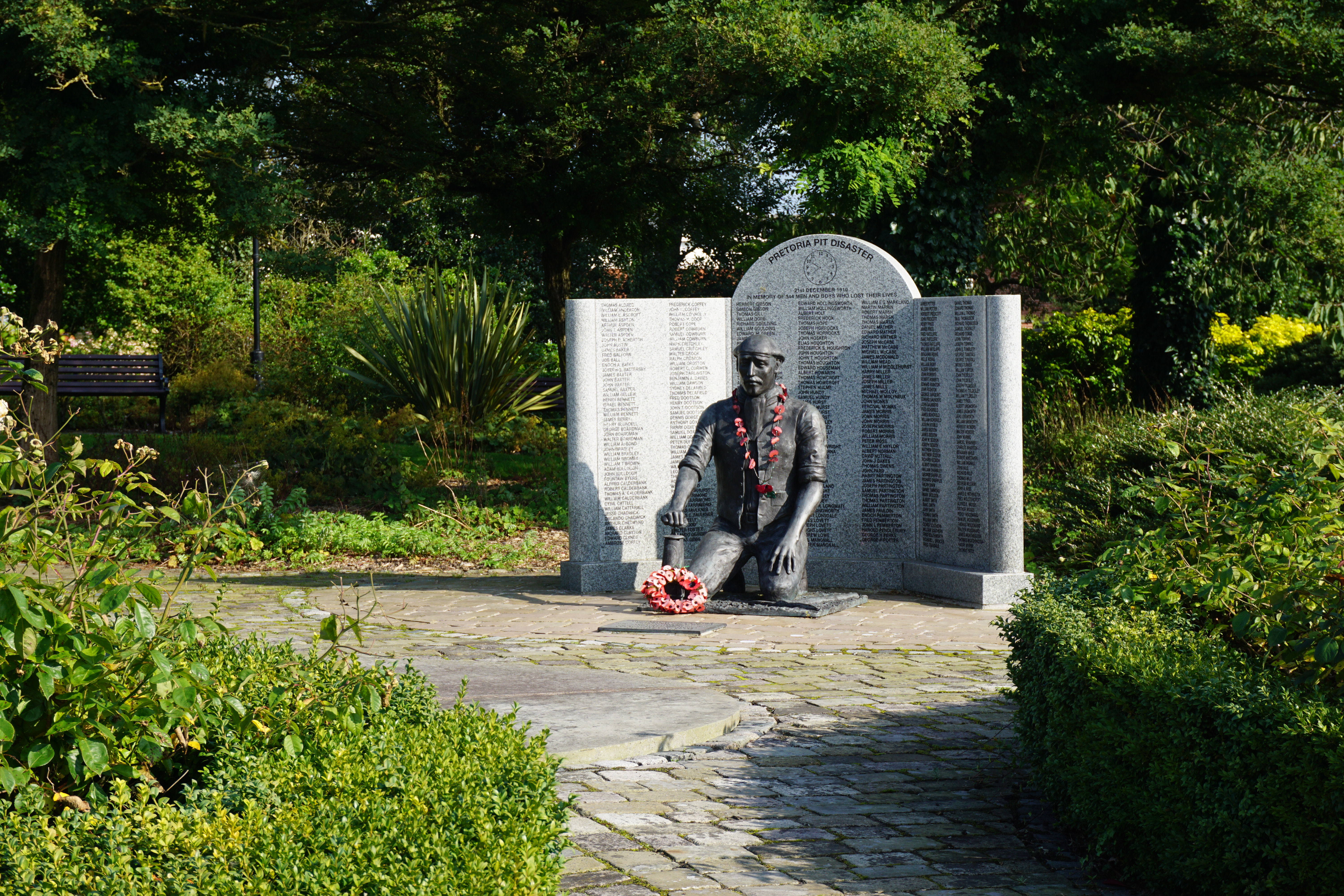
The colliery buildings and headgear are gone. What remains are memorials: a Grade II listed monument erected in 1910 in Westhoughton cemetery over the graves of many of the dead, a second memorial put up on Broadway in 2010, and a bronze figure of a miner by the sculptor Jane Robbins, unveiled opposite Westhoughton parish church on 19 December 2010 for the centenary.
Related mines
- Cronton Colliery — Cronton was sunk by the Hulton Colliery Company -- the same company behind Pretoria Pit (Hulton Colliery).
Nearby mines
- Gibfield Colliery — 0.9 miles (1.5 km) SW
- Peelwood Colliery — 1.1 miles (1.8 km) SE
- Chanters Colliery — 1.3 miles (2.0 km) S
- Shakerley Colliery — 1.4 miles (2.3 km) SE
- Combermere Colliery — 1.6 miles (2.6 km) SE
Straight-line distance, within 9 miles (15 km). Show on the map.
Disasters & major incidents
-
Pretoria Pit Disaster
21 December 1910 · Explosion · 344 fatalities
At about 7.50 on the morning of Wednesday 21 December 1910, an explosion tore through the workings of the Hulton Colliery Company’s Bank Pit No. 3 at Over Hulton, near Westhoughton — the pit universally known as the Pretoria Pit. Of the 344 men and boys underground in the affected districts, only three came out alive, and one of those died the following day. The final toll of 344 dead makes it the worst mining accident in Lancashire’s history and the third worst in Britain, after the Oaks Colliery explosion of 1866 and Senghenydd in 1913.
Recorded claims
Individual factual claims, each attached to the source(s) that support it below. Where sources disagree, both are kept.
- Nos. 3 and 4 shafts were sunk in 1900–01, each 18 feet in diameter and 75 yards apart, No. 4 serving as downcast and No. 3 as upcast. 1
- Five seams were worked from the two shafts at depths between 146 and 434 yards: Trencherbone, Plodder, Yard, Three-Quarter and Arley. 1
- The Hulton Colliery Company employed about 2,400 people above and below ground across its four collieries in 1910. 2,1
- The colliery closed permanently on 14 April 1934. 2
- Four underground Sirocco fans ventilated the workings — three exhausting, one forcing — but in some districts only about half the air produced reached the faces. 1
- Ten abandonment plans for the Bank (Pretoria) Nos. 3 and 4 shafts are catalogued in the BGS mine plans collection at Keyworth. 3
Photographs & further reading
Transcribed contemporary newspaper coverage and a full list of the dead, compiled by the Lancashire Online Parish Clerk project.
View sourceThe catalogue records for the ten abandonment plans held at Keyworth. No scans are published, but the entries themselves confirm what survives and where.
View sourceSources
- (secondary) Hulton Colliery Explosion, Atherton, 1910 — Northern Mine Research Society
- (secondary) Pretoria Pit disaster — Wikipedia
- (primary) BGS mine plans catalogue: HULTON, BANK (ATHERTON) (PRETORIA) NOS.3, 4 — British Geological Survey
Record created: 26 August 2026 · Last researched: 26 August 2026