 MineArchive
Coal Mines Act 1911
| Category | Law & Custom |
|---|
The Act that consolidated and rewrote British coal-mining law, and the statute under which every colliery in the country was run for the next forty-five years. It received royal assent on 16 December 1911, came into force on 1 July 1912, and applied not only to coal but to mines of stratified ironstone, shale and fireclay. It was repealed on 1 January 1957, when the Mines and Quarries Act 1954 replaced it.
Historical usage
It grew out of the Royal Commission on Mines of 1906-11, itself set up after the Courrières disaster in France killed around 1,100 miners in 1906, and it was drafted and passed against a run of catastrophes at home: 136 men died at the Wellington Pit, Whitehaven, in May 1910, and 344 at the Pretoria Pit near Bolton that December, a year before the Bill completed its passage. The Act took the general rules of the Coal Mines Regulation Act 1887 as its base and added the Commission's recommendations on top.
How it worked
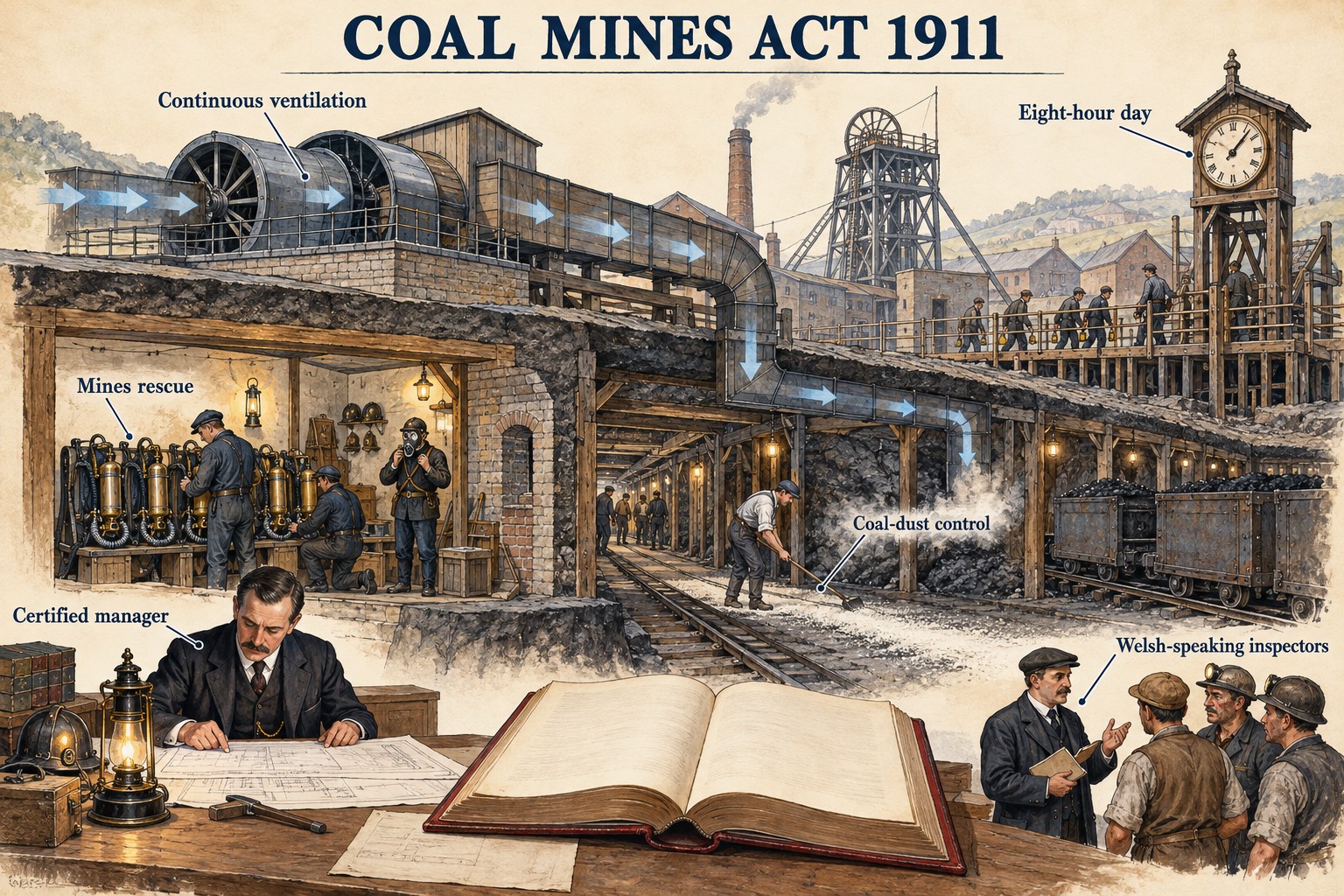
It put one certificated manager in charge of each mine, personally responsible for its control and direction and required to supervise it daily, with a Mining Qualifications Board issuing the certificates of competency. It made rescue provision compulsory for the first time, requiring a station within reach of any colliery above a threshold size — see Mines Rescue Station for how that system was actually built. On ventilation it required fans to run continuously while men were at the face, reversible fans, and measured air currents, and it obliged owners to guard against coal-dust explosions. It also set an eight-hour day underground, though winding time was excluded from the count; barred boys under 14 from working underground and under-16s from night work at the surface; regulated the keeping of pit ponies; and, at section 97(1), provided for Welsh-speaking inspectors in Wales.
Why it was used
Before 1911 the law had accumulated as a series of amending Acts on the 1887 Regulation Act, and the duties of an owner, an agent and a manager were correspondingly tangled. Putting management accountability, ventilation, dust and rescue into one statute meant an inspector could point at a single named person for a single named failure — which is precisely what happened two years later.
Risks & limitations
Its weakness was enforcement, and Senghenydd proved it. When an explosion at the Universal Colliery killed 440 men and boys in October 1913, the inquiry found multiple breaches of the new Act. The manager, Edward Shaw, faced seventeen charges and was convicted on eight, fined £24 in total — £5 of it for the accumulation of coal dust, the offence most likely to have caused the explosion. The owners, the Lewis Merthyr Coal Company, faced four charges and were convicted on one, for failing to fit reversible ventilation fans, and fined £10 with costs. The Merthyr Pioneer reduced the arithmetic to a headline: miners' lives at 1s 1¼d each.
Regional variation
The Act applied across Great Britain. Its one explicitly regional provision was section 97(1), which provided for Welsh-speaking inspectors in Wales — a recognition that a safety regime enforced through conversation with working miners had to be enforced in the language those miners actually spoke.
Related terminology
Colliery, Emergency Escapeway, HM Chief Inspector of Mines, Mines Rescue Station, National Coal Board
Mines associated with this term
Included only where MineArchive's own research gives a reasonable evidential basis — not every mine where this might plausibly apply.
- Meiklehill Colliery — East Dunbartonshire (well documented example)
Named in this record’s history: “…injured him fatally. Matches were prohibited in that pit by the Coal Mines Act 1911 and he knew it. Sheriff-Substitute Kippen at Dumbarton found the…” - Woodilee Colliery — East Dunbartonshire (well documented example)
Named in this record’s history: “…explosion that followed. Matches were prohibited in that pit by the Coal Mines Act 1911 and Robertson knew it. The Sheriff-Substitute at Dumbarton found the…”
Disasters associated with this term
5 examples chosen from 14 linked records, most direct relationship first.
- Clifton Colliery explosion, 1914 (contextual relationship)
Named in this record’s narrative: “…inspect after the Friday, a serious breach of section 64 (1) of the Coal Mines Act 1911, that the fan had been stopped from 6.30 a.m. to 6.30 p.m. on the…” - Glyncorrwg Colliery Explosion (contextual relationship)
Named in this record’s investigation: “A formal investigation was held under Section 82 of the Coal Mines Act 1911, and T. A. Jones O.B.E., H.M. Divisional Inspector of Mines,…” - Grassmoor Colliery Explosion, 1933 (contextual relationship)
Named in this record’s investigation: “…be held by the Chief Inspector of Mines under section 83 of the Coal Mines Act 1911. Members pressed him on whether the lamps in use had been oil or…” - Ingham Colliery explosion, 1947 (contextual relationship)
Named in this record’s narrative: “…though the two were worked as separate mines under Section 25 of the Coal Mines Act 1911. Two shafts went to the Black Bed at 277 yards, with an inset at 188…” - Loveston Colliery Inrush (contextual relationship)
Named in this record’s aftermath: “…from old workings was already compulsory under Section 68 of the Coal Mines Act 1911, and said he was considering what further measures could be taken to…”
Sources
- (primary) Coal Mines Act 1911 (1 & 2 Geo. 5 c. 50) — legislation.gov.uk (The National Archives)
- (secondary) 'Miners' lives at 5½p each': the Government Enquiry into the 1913 Senghenydd mine disaster — Amgueddfa Cymru – Museum Wales
- (secondary) Coal Mines Act 1911 — Wikipedia
Record created: 26 August 2026 · Last researched: 26 August 2026