 MineArchive
Emergency Escapeway
| Category | Ground Conditions & Hazards |
|---|
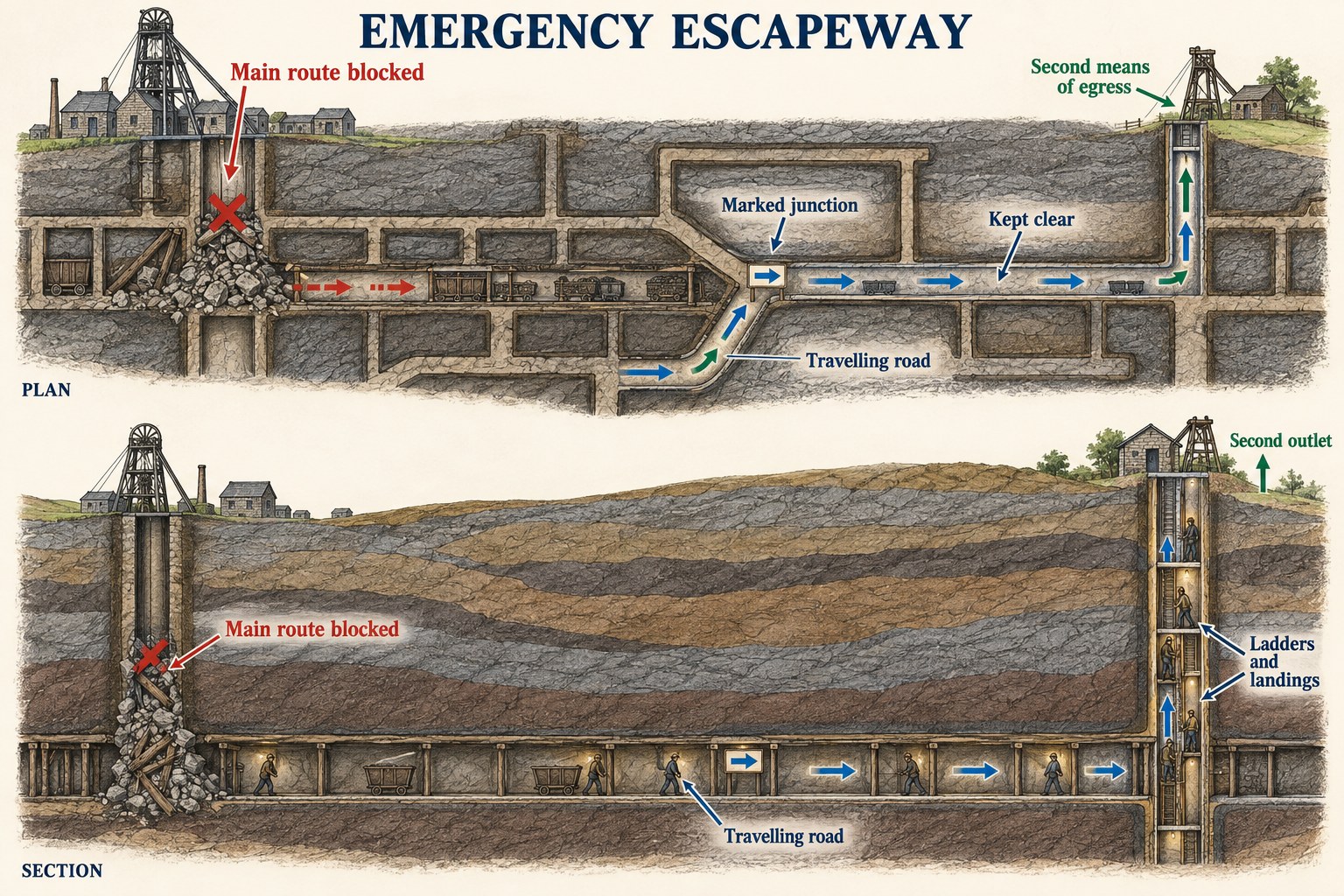
A designated secondary route out of a mine -- a second shaft or outlet, kept clear and marked -- required by law so that men below ground had a way out if the main shaft or haulage road became blocked or unsafe.
Historical usage
The requirement exists because of a specific disaster: on 16 January 1862, 204 men and boys died at New Hartley Colliery's Hester Pit (see Hartley Colliery) when the cast-iron beam of the pit's pumping engine broke and fell down the mine's single shaft, completely blocking the only way in or out and sealing every man below ground with no alternative escape. The inquest jury's own recommendation -- that every working colliery should have at least a second shaft or outlet, to give the men a means of escape should any obstruction take place -- was written into law within months, in an Act of Parliament passed on 7 August 1862 requiring all new mines to have two shafts and every existing mine to sink a second one by the end of 1864. That requirement was carried forward and elaborated through the Coal Mines Regulation Acts of 1872 and 1887 and the Coal Mines Act 1911, and survives in detailed form in the Mines and Quarries Act 1954: Section 22 makes it unlawful to employ anyone below ground in a coal, ironstone, shale or fireclay mine without two shafts or outlets giving alternative means of ingress and egress, separated by at least 45 feet for shafts sunk after 1 January 1865; Section 24 requires every junction along an escape route to be clearly marked with the shaft or outlet it leads to; and no more than nine people may work in a single place served by only one exit.
How it worked
The 1862 Act is worth reading for how precisely it defines the thing. It forbade any owner to employ a person underground unless there were, in communication with every seam then at work, at least two shafts or outlets 'separated by natural strata of not less than ten feet in breadth', by which distinct means of ingress and egress were available to the men employed. The ten feet of solid ground is the heart of it: two compartments of one shaft, divided only by a brattice, had satisfied the letter of earlier practice and would not satisfy this. The Act also allowed the second outlet to belong to a neighbouring mine, so long as the men had the use of it, which is why adjoining collieries were so often connected underground; it exempted new workings driven to prove minerals, and workings made purely to connect two shafts, so long as no more than twenty people were employed at a time; and it gave the owner of an existing mine a right of appeal to arbitration if the nature of the mine, or its near exhaustion, made a second shaft unreasonable. Existing mines had until 1 January 1865 to comply.
In practice the escapeway was a travelling road kept passable on foot and, where it rose through a shaft, laddered the whole way, with the ladders in stages and landings between them. The Coal Mines Act 1911 and the regulations under it carried the principle forward into the modern industry: escape routes marked, inspected and kept clear, and in the 20th century self-rescuers carried on the belt so that a man had breathable air for the walk out.
Why it was used
A mine with only one way in or out has, by definition, no way out at all if that one route fails -- exactly what Hartley proved at the cost of 204 lives.
Risks & limitations
A legally-compliant second shaft or outlet was no guarantee of survival on its own: it had to be genuinely kept clear, correctly marked, and actually reachable from every working place, and mining disasters after 1862 still occurred where an escape route existed on paper but proved impractical, blocked, or too far from the men who needed it in an emergency.
Regional variation
The word escapeway is a modern one; the 19th-century sources call the thing itself a second shaft or second outlet, and Barrowman's 1886 Scottish glossary gives escape-pit, 'a shaft used as a second outlet'. The Durham Mining Museum's glossary uses the statutory wording that outlasted them both, second means of egress: the alternative roadways from the working areas that would be used if an emergency arose. Metal mines, which more often had adits driven from a hillside, frequently had a second way out by accident of geography long before any statute required one.
Related terminology
Disasters associated with this term
Included only where MineArchive's own research gives a reasonable evidential basis, with the nature of the relationship stated — not every disaster where this term might plausibly apply.
- Greenrigg Colliery pithead fire (rescue/recovery concept)
The connecting passage into Southrigg's workings served as the escape route. - Hartley Colliery disaster, 1862 (contextual relationship)
This disaster's single blocked shaft directly caused the legal requirement for a second means of escape at every mine, enacted within months of the disaster.
Sources
- (primary) Coal Mines Act 1862 (25 & 26 Vict. cap. 79) — Durham Mining Museum
- (primary) Glossary of Mining and Geordie Words — Durham Mining Museum
- (primary) Provisions for securing safe Ingress and Egress — Mines and Quarries Act 1954 — legislation.gov.uk
- (secondary) Hartley Colliery disaster — Wikipedia
- (secondary) Pit Terminology — Healey Hero
Record created: 29 August 2026 · Last researched: 11 September 2026