 MineArchive
Hartley Colliery disaster, 1862
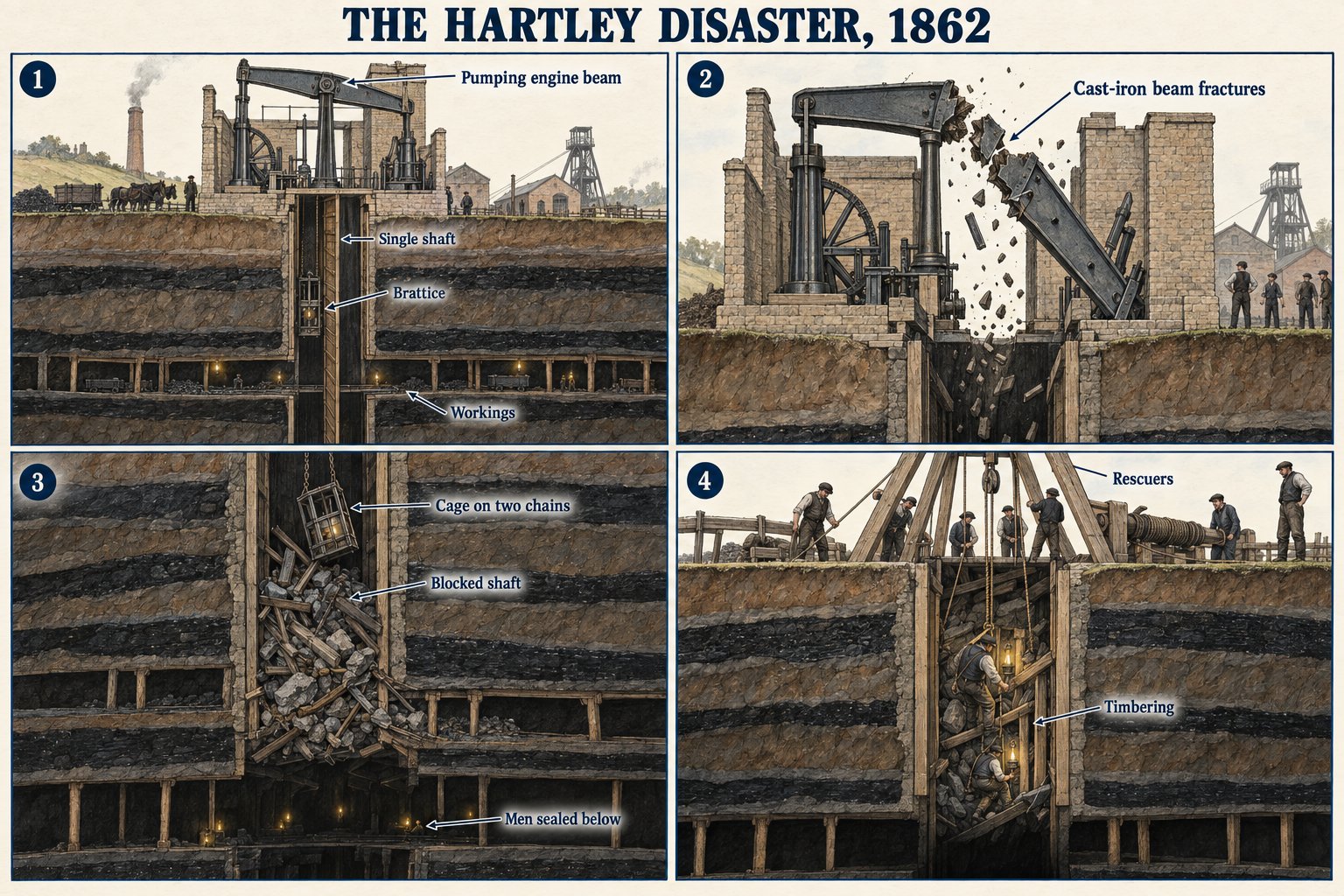
The cast-iron beam of New Hartley Colliery's pumping engine fractured and fell down the mine's single shaft during a shift changeover, blocking the only way in or out and sealing 204 men and boys underground, all of whom died of suffocation over the following days despite a sustained rescue effort. The disaster's central lesson — that a mine with only one shaft has no way out if that shaft fails — led directly to a change in the law within months.
| Date | 16 January 1862 |
|---|---|
| Mine | Hartley Colliery (Hester Pit) |
| Region | Northumberland |
| Primary type | Winding / Shaft Accident |
| Associated types | Entrapment, Gas / Asphyxiation |
| Fatalities | 204 (All 204 men and boys underground at the time of the collapse died; four further men fell during the initial collapse but these are generally counted within the total.) |
| Context | During active mining |
Cause
The 300-horsepower beam engine's cast-iron beam fractured under shock loading and fell down the shaft, destroying the ventilation brattice, snapping two of the cage's four support chains, and bringing down roughly 30 yards of debris that completely blocked the shaft.
Contributing factors
The inquest heard expert evidence that the beam's casting had inherent design weaknesses — excessive metal concentration around its central boss, and a hexagonal fixing hole oriented with its points top and bottom, both concentrating stress — and that the wedges securing the beam to its gudgeon pin had been driven with excessive force. All three pump stages used heavier bucket pumps rather than plunger pumps, increasing the load on the beam, and the shaft-bottom sump had reportedly not been cleaned for at least four years. A separate incident a month earlier, when hydraulic jacks failed during maintenance and let the beam drop three inches, is thought likely to have started a micro-fracture in the casting that later failed catastrophically.
What happened
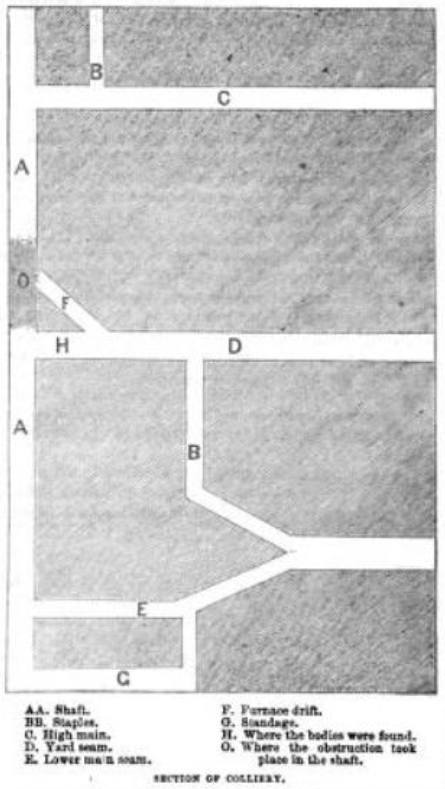
At 10:30am on 16 January 1862, during a shift changeover, the engine beam broke and fell down the shaft, and the resulting collapse of debris sealed the mine below the Yard and High Main seams. Four men fell during the initial collapse; under-viewer Joseph Humble organised the earliest rescue efforts, and three survivors were brought up from the damaged cage before the shaft blocked completely. Rescuers spent days cutting through the debris and rock falls, hampered by a geological 'trouble' (fault) requiring extensive timbering, before finally breaking through to the trapped miners' location — by which time all had died of suffocation as the sealed workings filled with gases including carbon monoxide.
Rescue & recovery
Master sinker William Coulson, who had supervised the original 1845-46 sinking of the shaft and happened to be passing through Hartley railway station as the disaster unfolded, took charge of the rescue effort. His team worked for several days through the blockage and a geological fault, breaking through to the furnace drift, where a discovery of disturbed tools showed the trapped miners had themselves tried and failed to dig their way out. All 204 bodies were eventually recovered.
Investigation & inquiry
The inquest, held over several sessions between 21 January and 6 February 1862, examined the beam's design and maintenance history in detail and returned a verdict of accidental death, with a jury rider calling for every working colliery to have at least a second shaft or outlet, and for colliery engine beams to be made of malleable rather than brittle cast metal.
Legal & regulatory aftermath
£83,000 was raised through a public relief fund for the 467 dependants left by the disaster, with the surplus later used to help found early miners' insurance societies against death and injury; William Coulson received a gold medal for leading the rescue, and his sinkers were given silver medals and extra pay.
Changes to practice & legislation
Parliament passed the Act to Amend the Law Relating to Coal Mines on 7 August 1862, within seven months of the disaster, requiring all new collieries to have at least two shafts or outlets and existing collieries to provide a second means of escape by the end of 1864 — the direct origin of the modern requirement for two ways out of every mine.
Memorials & commemoration
A memorial to the 204 victims stands in Earsdon churchyard, Northumberland, and the disaster is separately commemorated at the site of the former colliery.
Recorded claims
Individual factual claims, each attached to the source(s) that support it below. Where sources disagree, both are kept.
- The relief fund raised £83,000 for the disaster's 467 dependants, and its surplus later helped fund some of the earliest miners' insurance societies against death and occupational injury.
Related terminology
Mining terms this disaster is structurally linked to, with the nature of the relationship.
- Beam Engine (direct cause)
The pumping engine's cast-iron beam fractured and fell down the shaft, directly causing the disaster. - Brattice (contextual relationship)
The falling beam destroyed the ventilation brattice on its way down the shaft, so the men sealed below lost their air supply at the same moment they lost their only exit. - Cage (contextual relationship)
The beam snapped two of the cage's four support chains as it fell, leaving the cage useless and the shaft blocked by some thirty yards of debris. - Emergency Escapeway (contextual relationship)
This disaster's single blocked shaft directly caused the legal requirement for a second means of escape at every mine, enacted within months of the disaster. - Pumping Engine (contextual relationship)
Named in this record’s summary: “The cast-iron beam of New Hartley Colliery's pumping engine fractured and fell down the mine's single shaft during a shift…” - Sump (contextual relationship)
The shaft-bottom sump had reportedly gone uncleaned for at least four years, part of the pattern of neglected pumping arrangements that overloaded the beam. - Viewer (contextual relationship)
Named in this record’s narrative: “…Yard and High Main seams. Four men fell during the initial collapse; under-viewer Joseph Humble organised the earliest rescue efforts, and three…”
Plans & documents
Sources
- (secondary) Hartley Colliery disaster — Wikipedia
- (secondary) New Hartley Colliery Shaft Accident - Hartley - 1862 — Northern Mine Research Society
Record created: 22 August 2026 · Last researched: 22 August 2026