 MineArchive
Pumping Engine
| Also known as | Pumping Engine House (The building housing one, where the distinction matters.), Mine Pumping Engine |
|---|---|
| Category | Structures & Machinery |
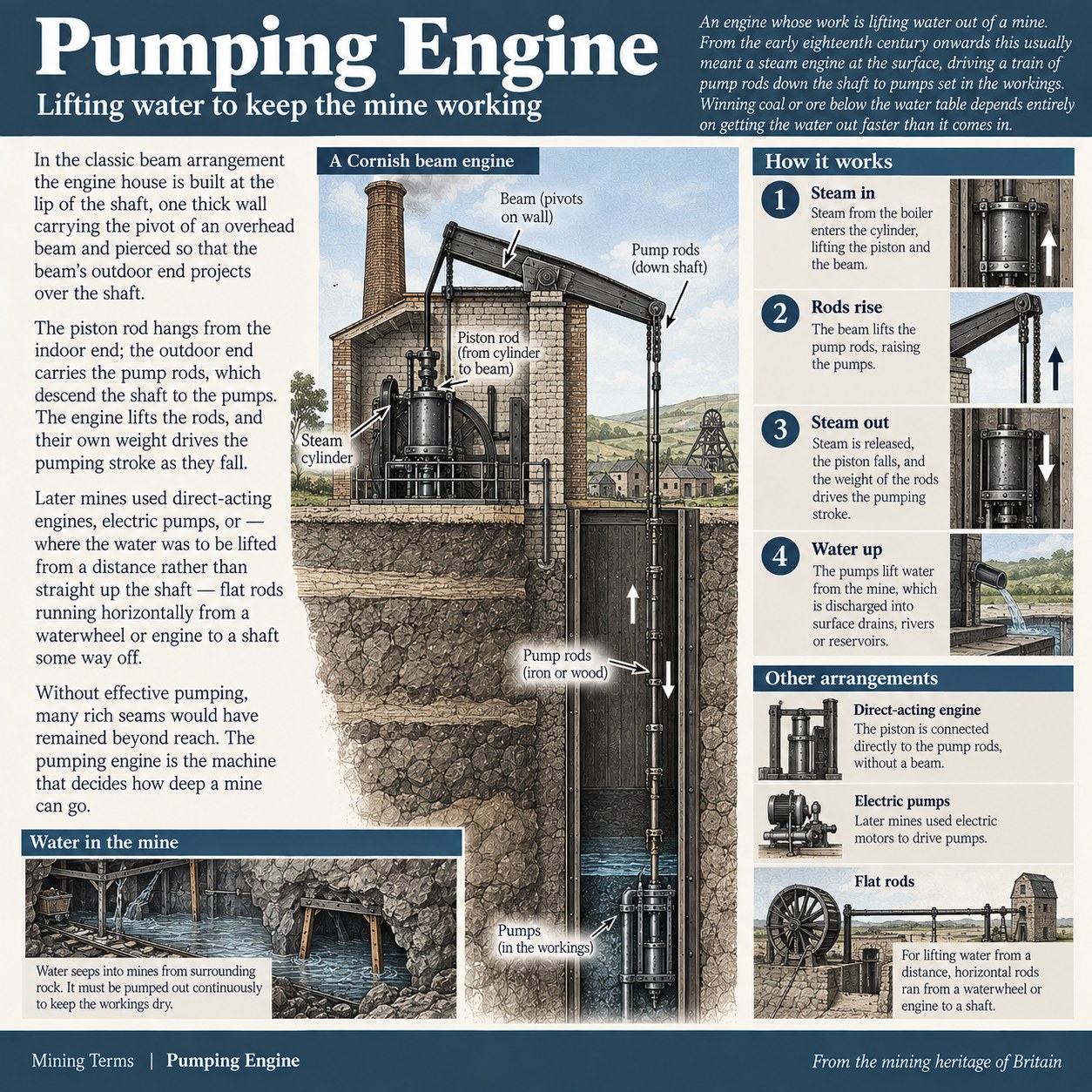
An engine whose work is lifting water out of a mine. From the early eighteenth century onwards this usually meant a steam engine at the surface, driving a train of wooden or iron pump rods down the shaft to pumps set in the workings. Winning coal or ore below the water table depends entirely on getting the water out faster than it comes in, so the pumping engine is the machine that decides how deep a mine can go.
Historical usage
Thomas Newcomen's atmospheric engine, first used around 1705 to draw water from mines in Cornwall, was the earliest practical answer. It worked, but it burned a great deal of fuel — a serious problem in Cornwall, which has no coalfield of its own and had to import coal from South Wales, so that the cost of pumping was a large share of the cost of mining. James Watt's separate condenser removed the main inefficiency by letting the cylinder stay hot, and the type was then developed and enlarged in the tin and copper districts of the south west into the Cornish engine, among the most massive beam engines ever built and famous well beyond Britain.
Pumping engines appear across this archive in every kind of mine and in every period: the seventeenth-century engine at Mostyn that Thomas Pennant drew for his Tour in Wales, the direct-action engine at the same colliery whose cylinder, cast in 1848, was thought one of the largest in the world at 17 feet long and 22 tons, the massive pumps installed by John Musgrave & Sons at Mosley Common when the sinking met heavy water, and the electric pumps that kept Thorne Colliery going at 900 gallons a minute by 1943 and were finally switched off in 2004.
How it worked
In the classic beam arrangement the engine house is built at the lip of the shaft, one thick wall carrying the pivot of an overhead beam and pierced so that the beam's outdoor end projects over the shaft. The piston rod hangs from the indoor end; the outdoor end carries the pump rods, which descend the shaft to the pumps. The engine lifts the rods, and their own weight drives the pumping stroke as they fall. Later mines used direct-acting engines, electric pumps, or — where the water was to be lifted from a distance rather than straight up the shaft — flat rods running horizontally from a waterwheel or engine to a shaft some way off.
Why it was used
Because water is the limiting factor on depth. Below the water table a mine fills as fast as it is dug, and every extra fathom of depth means more water and a longer lift. A pumping engine converts that problem into a running cost, and the whole economics of deep mining turn on whether the coal or ore raised is worth more than the fuel burned keeping the workings dry.
Risks & limitations
The cost is continuous and never falls: pumping must go on whether or not the mine is producing, through strikes, stoppages and even long after closure. That is why so many mines in this archive closed for reasons of water rather than exhausted reserves — Lassodie in 1931, where Thomas Spowart & Co. found the cost of keeping the workings clear prohibitive; Hamilton Palace in 1959; Whitburn in 1968 as the workings ran further under the North Sea; Thorne in 1956. A pumping engine can also simply be outmatched: when the estuary broke into Mostyn Colliery in July 1884 the pumps made no difference at all, because the water was coming in from the sea.
Related terminology
Atmospheric Engine, Balance Bob, Beam Engine, Capstan, Cornish Engine, Engine House, Lancashire Boiler, Man-engine, Rag and Chain Pump, Tubbing, Water Pressure Engine
Mines associated with this term
5 examples chosen from 114 linked records — the term page is not an index.
- Bowhill Colliery — Fife (well documented example)
Named twice in this record, first in the history: “…that never matched the first two commercially. A 100-inch-cylinder pumping engine raised at least 1,400 gallons of water a minute, and coupled 30-inch…” - Gin Pit Colliery — Greater Manchester (well documented example)
Named twice in this record, first in the history: “…Six Foot, or Rams, mine at 375 yards between 1866 and 1872, with a pumping engine built by the Haigh Foundry, and the investment of those years made…” - Marine Colliery — Blaenau Gwent (well documented example)
Named 5 times in this record, first in the summary: “…South Wales colliery disasters. A scheduled Hathorn Davey pumping engine, relocated on site in 2003, survives as the colliery's principal…” - Meliden Lead Mines — Denbighshire (well documented example)
Named 4 times in this record, first in the summary: “…over two centuries by a remarkable sequence of increasingly powerful pumping engines.” - Mostyn Colliery — Flintshire (well documented example)
Named twice in this record, first in the history: “…the largest steam engine cylinders in the world for a direct-action pumping engine here: 17 feet long, 8 ft 4 in in diameter, 22 tons, and 30 tons of…”
Disasters associated with this term
5 examples chosen from 15 linked records, most direct relationship first.
- Bryncoch Colliery inundation, 1859 (rescue/recovery concept)
Pumps worked for months to drain the pit. - Thomas Chapel Colliery inrush, 1838 (rescue/recovery concept)
A steam engine helped pump out the water. - Blaydon Main Colliery boiler explosion, 1860 (contextual relationship)
Named in this record’s narrative: “…as the night shift was coming off, Joseph Gray, in charge of the pumping engine, went out to look at his boilers before going home and met the…” - Bryngwiog Mine inrush, 1862 (contextual relationship)
Named in this record’s rescue and recovery: “The mine's pumping engine worked continuously to clear the water. The first body recovered,…” - Callands Pit explosion, 1816 (contextual relationship)
Named in this record’s narrative: “…its downcast and pumping shaft and one of Swansea's earliest steam pumping engines. On the morning of Friday 5 January 1816 fire-damp exploded in the…”
Sources
- (secondary) Beam engine — Wikipedia
- (secondary) Cornish engine — Wikipedia
Record created: 3 September 2026 · Last researched: 3 September 2026