 MineArchive
Bryngwiog Mine inrush, 1862
Sixteen men drowned when Bryngwiog Mine, on Halkyn Mountain, broke into the flooded old workings of the abandoned Hendre Mine and filled with water within minutes — one of the worst disasters in the district's lead-mining history.
| Date | February 1862 |
|---|---|
| Mine | Halkyn Mountain |
| Region | Flintshire |
| Primary type | Flooding / Inundation |
| Associated types | Rescue |
| Fatalities | 16 (Sixteen men named in the welshcoalmines.co.uk death roll: Edward Jones (Moel-y-Crio), Bennet Roberts (Lixwm), William Pierce (Rhewl), Edward Jones (Rhesycae), John Jones (Foel), Richard Blackwell (Llaneurgain), William Hooson (Cilcen), Job Jones (Cilcen), John Williams (Hendy), Edward Goodwin, Llewelyn Powell (Hersedd), Edward Powell (Hersedd), Joseph Roberts (Bryn Gwiog), William Williams (Llaneurgain), John Jones (Cilcen), George Brookes (Llaneurgain).) |
| Injuries | One survivor, Edwin Powell, reached the shaft and was pulled from the flooding workings having caught a rope; he was nearly unconscious and was hauled out, by one account, by his hair. |
| Context | During active mining |
Cause
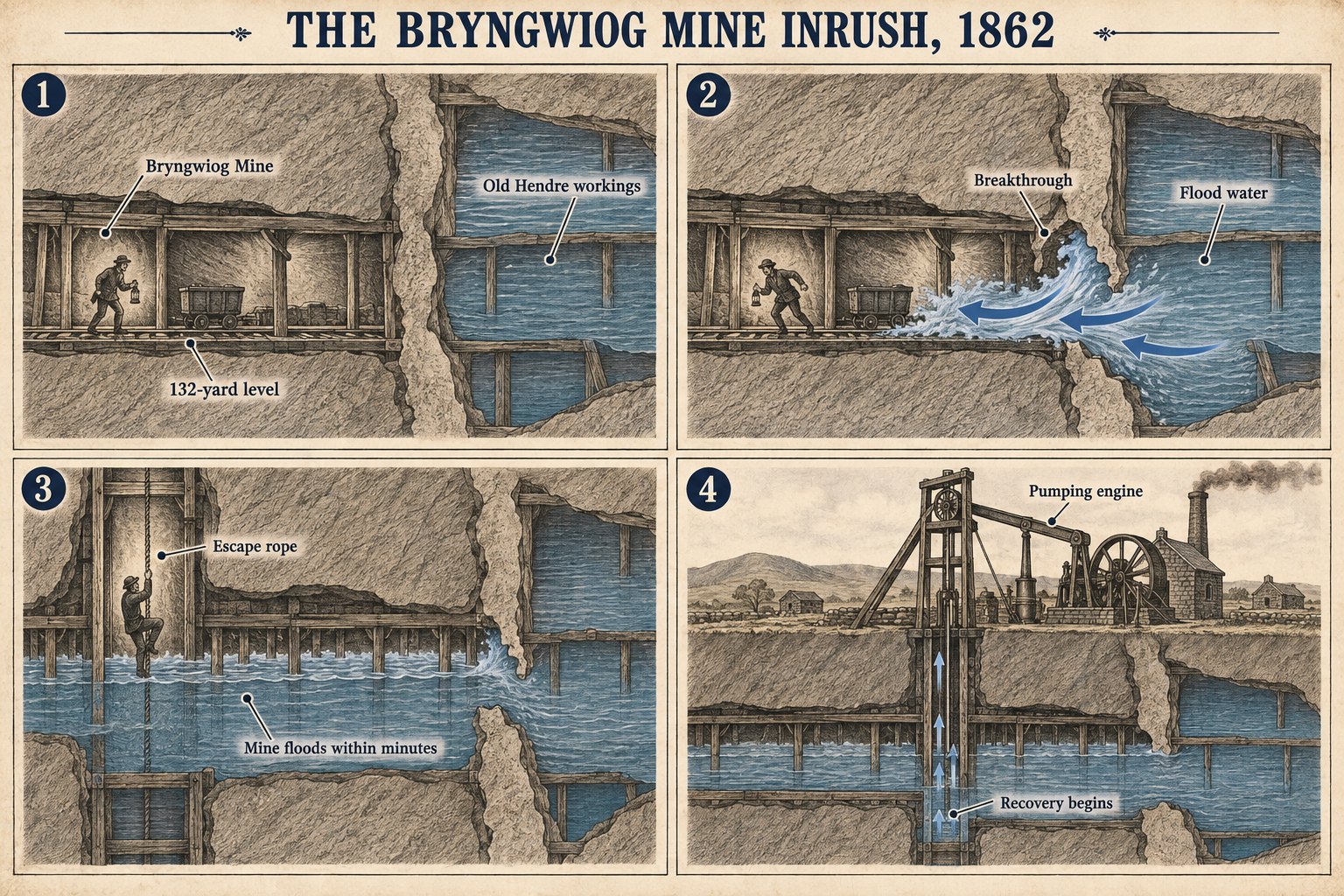
Seventeen men working underground broke through into the old, abandoned and flooded workings of the nearby Hendre Mine, releasing a rapid inrush of water into Bryngwiog.
Contributing factors
The Hendre Mine's old workings were not adequately known or marked before Bryngwiog's own workings were driven close enough to hole into them.
What happened
Bryngwiog Mine, at Moel-y-Crio on Halkyn Mountain, was being developed for lead when its workings broke through a wall into the flooded, abandoned workings of the old Hendre Mine. Seventeen men were underground at the time; water flooded the mine within minutes. One man, Edwin Powell, managed to reach the shaft and catch a rope, and was hauled out barely conscious. The other sixteen drowned.
Rescue & recovery
The mine's pumping engine worked continuously to clear the water. The first body recovered, Edward Goodwin, was brought up the day after the flood; further bodies were recovered over the following days, with most retrieved within the week. Thousands of people are reported to have gathered at the mine while recovery was under way.
Investigation & inquiry
A coroner's inquest was held at the Royal Oak, chaired by Peter Parry. Mines inspector Peter Higson examined the workings and testified that water had broken through into the 132-yard level from the old, deeper Hendre workings. The jury returned a verdict of accidental death.
Legal & regulatory aftermath
Public meetings were held in Mold, Rhyl and Holywell to raise relief funds for the bereaved families.
What's uncertain
Points where sources disagree or the record could not be settled; both accounts are kept. All open questions in the archive.
- The Northern Mine Research Society dates the inrush to 12 February 1862; welshcoalmines.co.uk's death roll instead gives Saturday 22 February 1862. (disputed) 1,2
Recorded claims
Individual factual claims, each attached to the source(s) that support it below. Where sources disagree, both are kept.
- Sixteen men drowned when Bryngwiog Mine broke into the flooded old workings of the abandoned Hendre Mine; one man, Edwin Powell, escaped by reaching the shaft and catching a rope. 1,2
- The Northern Mine Research Society dates the inrush to 12 February 1862; welshcoalmines.co.uk's death roll instead gives Saturday 22 February 1862. (disputed) 1,2
- A coroner's inquest at the Royal Oak, with mines inspector Peter Higson testifying that water had broken through from the old Hendre Mine workings, returned a verdict of accidental death. 2
- Public meetings were held in Mold, Rhyl and Holywell to raise funds for the bereaved families. 2
Related terminology
Mining terms this disaster is structurally linked to, with the nature of the relationship.
- Inrush (contextual relationship)
Seventeen men holed through into the abandoned, flooded workings of the neighbouring Hendre Mine; the water that followed filled Bryngwiog within minutes and drowned sixteen of them. - Lead (contextual relationship)
Bryngwiog was being developed for lead on Halkyn Mountain when it broke through — one of the worst disasters in that district's lead-mining history. - Level (contextual relationship)
The mines inspector traced the breakthrough to the 132-yard level, where the workings met the older and deeper Hendre ground. - Pumping Engine (contextual relationship)
Named in this record’s rescue and recovery: “The mine's pumping engine worked continuously to clear the water. The first body recovered,…” - Shaft (contextual relationship)
The shaft was the one way out: Edwin Powell reached it, caught a rope and was hauled up barely conscious, the only man of seventeen to escape.
Sources
- (secondary) Brngweog Lead Mine Inrush - Mold - 1862 — Northern Mine Research Society
- (secondary) Bryngwiog Lead Mine (death roll) — welshcoalmines.co.uk
Record created: 20 August 2026 · Last researched: 20 August 2026