 MineArchive
Level
| Category | Mine Workings & Access |
|---|
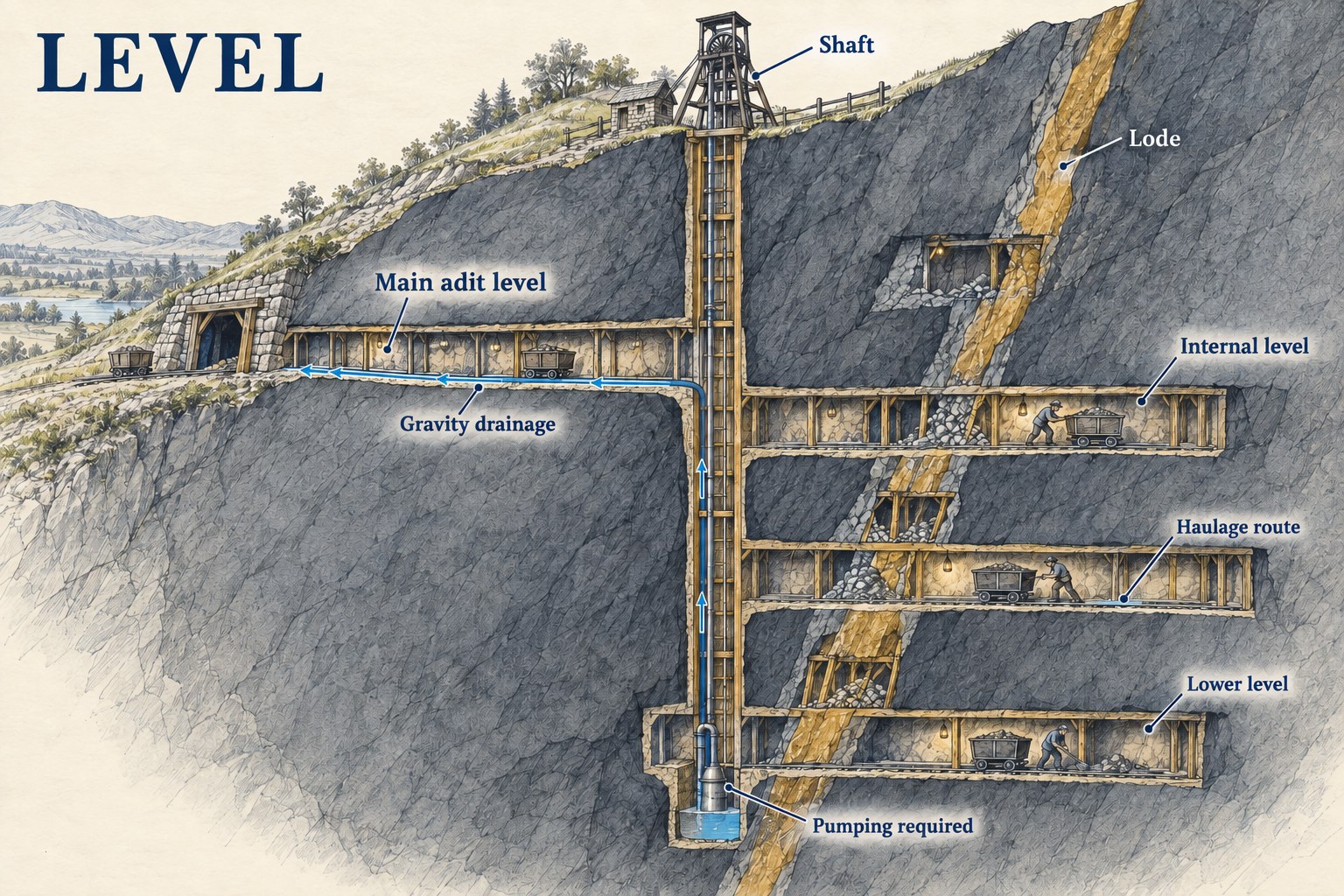
A horizontal underground working, usually numbered by its depth below the surface or below the top of the shaft it branches from, used to reach and work the ore along a lode.
Historical usage
Mines with a lode of any real vertical extent were typically worked from a whole stack of levels, one below another, each driven out sideways from the shaft to follow the vein at that depth — a structure recorded across countless British mines, several of them, like Greenside's named Lucy Tongue Level and Killhope's Park Level, on this site.
How it worked
A level need not reach the surface at all — many are entirely internal, accessed only via the shaft — but where one does daylight on a hillside or in a valley, it is specifically called an 'adit level', and this site's own Adit term page covers that special surface-reaching case in more detail. An ordinary, non-surfacing level served purely as an internal working platform and haulage route at its particular depth.
Why it was used
Working a lode level by level, rather than as one continuous excavation, let a mine organise ore extraction, haulage and ventilation systematically as depth increased, and gave a simple, standard way to describe exactly where in a mine a given piece of work or an accident had taken place.
Risks & limitations
Distinguishing a level from an adit matters for exactly the reason Carrock Fell Mine's own record illustrates: workings above the 'main adit level' drain naturally by gravity out to the surface, while any level below that point cannot, and needs active pumping instead.
Regional variation
The same concept appears under other names depending on mine and period — 'drift' is common in some coalfields for a similar horizontal working — but 'level', usually with a number or a name attached, is the term used across most of this site's own mine records.
Related terminology
Coffin Level, Submarine Mining
Mines associated with this term
5 examples chosen from 251 linked records — the term page is not an index.
- Britannia Copper Mine — Gwynedd (well documented example)
Named 3 times in this record, first in the workings: “Extensive working on a number of interconnected levels, eight of them, some still open. The Britannia company built a…” - Cambrian Colliery — Rhondda Cynon Taf (well documented example)
Named twice in this record, first in the geology: “…air upcast, reached 1,577 feet at the Lower Five Feet/Gellideg level, making it the deepest of the colliery's four shafts.” - Catpund Quarries — Shetland Islands (well documented example)
Named in this record’s history: “…implying a real trade. Similar vessels were found in the later Norse levels at Jarlshof, dated to the 12th and 13th centuries. Vessels were…” - Chislehurst Caves — Kent (well documented example)
Named in this record’s workings: “…to roughly 22 miles of intersecting tunnels and chambers on several levels, worked as galleries with chalk pillars left to carry the roof and…” - Cwmavon Copper Works — Neath Port Talbot (well documented example)
Named twice in this record, first in the workings: “…smelters, which produced highly damaging sulphurous fumes at ground level. The Mining Remediation Authority's own records also show a…”
Disasters associated with this term
5 examples chosen from 67 linked records, most direct relationship first.
- Albion Colliery explosion, 1894 (contextual relationship)
Named in this record’s cause: “…investigator concluded that shotfiring of pit timbers on the Groves level ignited a firedamp accumulation, which in turn ignited coal dust;…” - Alderley Edge West Mine deaths (contextual relationship)
Named in this record’s aftermath: “…Vein and the open-cast shaft was capped with concrete. The lower levels of West and Wood Mines are reached today only through two shafts dug…” - Astley Deep Pit explosion, 1870 (contextual relationship)
Named in this record’s narrative: “…the manager. The workings were reached by a brow from the 1,500-yard level, and the air was led round them past brattice sheets hung across the…” - Bearpark Colliery fall of stone, 1902 (contextual relationship)
Named in this record’s narrative: “…neither of which could be seen beforehand; the roof had looked level, sound and good. The Inspector called it a pure accident of a kind…” - Bent Grange Colliery explosion, 1853 (contextual relationship)
Named twice in this record, first in the summary: “On 1 July 1853 firedamp exploded in the west level of Thomas Butterworth's Bent Grange Colliery, Oldham, killing twenty…”
Sources
- (primary) Definition of adit — Mindat
- (secondary) Decline vs Shaft vs Adit vs Drift — An Underground Miner
- (secondary) Mining terms — Exploring Old Mines (cholla.mmto.org)
Record created: 21 August 2026 · Last researched: 21 August 2026