 MineArchive
Submarine Mining
| Also known as | Undersea mining (modern general usage), Submarine mine (used of the mine itself rather than the practice) |
|---|---|
| Category | Mine Workings & Access |
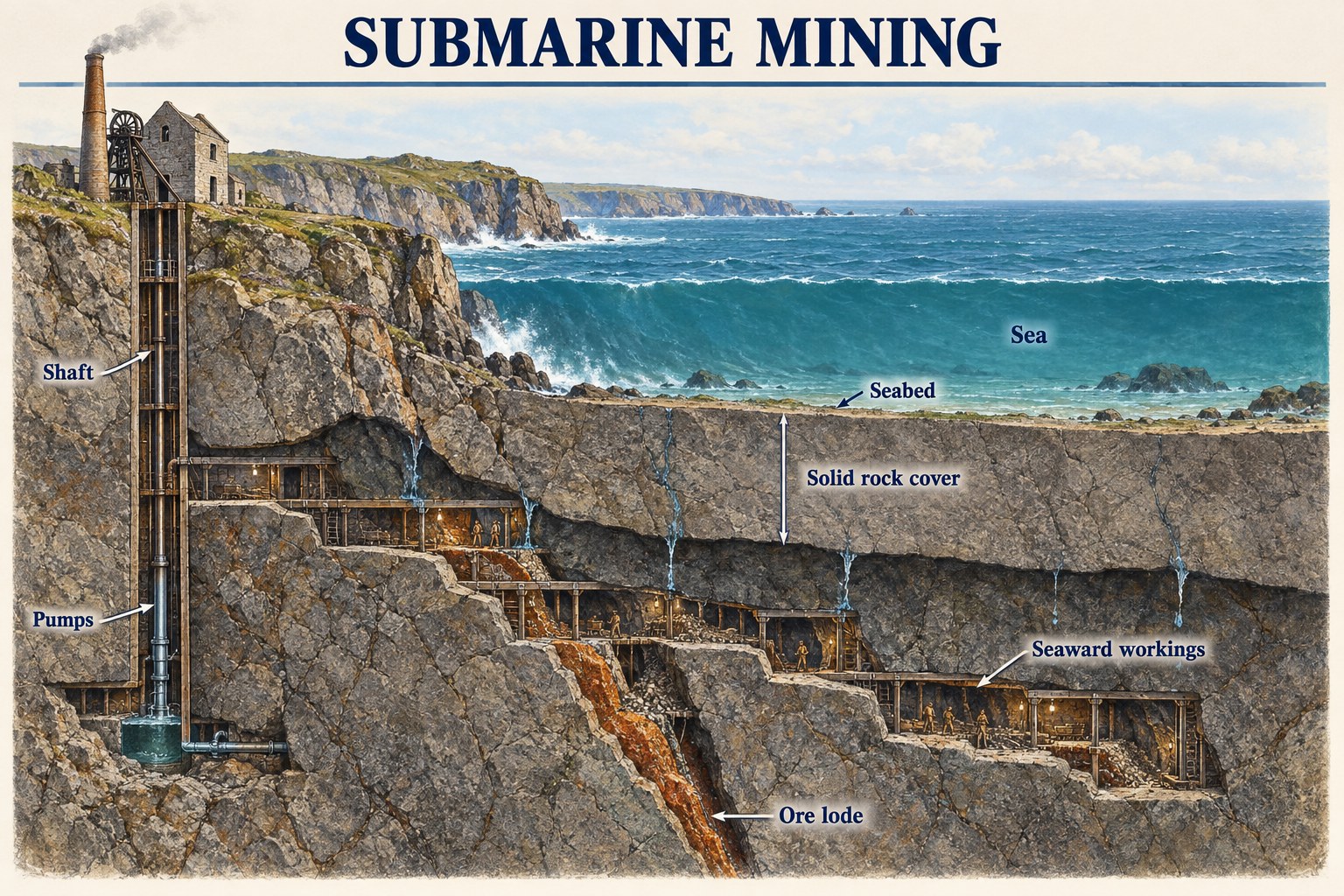
Working a lode outward from the coast until the ground overhead is no longer hillside but seabed, with the Atlantic — or the Irish Sea, or Belfast Lough — standing directly above the miners' heads. Not a distinct method of extraction: the stopes, levels and shafts are those of any hard-rock mine, and what changes is the roof.
Historical usage
Cornwall's St Just coast worked more submarine ground than anywhere else in Britain, and probably anywhere in the world. Wheal Cock was at it in the 16th century, and by 1778 its miners were 150 m out beyond the cliffs, in places only a few metres below the sea bed. Botallack, Levant and Geevor all followed lodes seaward — Levant more than a mile out, through some 60 miles of interconnected workings, and Geevor was still driving new undersea ground in the 1970s, sinking a sub-incline from Victory Shaft to reach Levant's flooded seaward workings. The practice was not confined to Cornwall: Cumberland's Whitehaven collieries and the Northumberland and Durham coalfield worked far out beneath the sea, and Kilroot's salt lies under the shore of Belfast Lough.
How it worked
Everything depended on leaving enough solid rock between the top of the working and the sea floor. Mines drove out along the lode below a deliberately preserved thickness of ground, and the further out they went the more they depended on accurate survey — a level driven a few fathoms too high, or a winze put up in the wrong place, could bring the sea in. Pumping was continuous rather than occasional: seawater percolates through the cover and along any fracture, and a submarine mine that stops pumping does not merely fill, it fills from an inexhaustible source. Engine houses were built on the cliff edge for exactly this reason, putting shafts as close to the seaward lodes as the ground allowed and shortening the distance the water had to be lifted.
Why it was used
Because the ore went that way. The lodes of the St Just district do not stop at the cliff, and abandoning them at the coastline would have meant walking away from the richest ground: Botallack's 1842 copper discovery was made at the 85 fathom level on the Crowns lode, already out under the sea. Submarine working was economically rational as soon as pumping technology could keep pace, which in Cornwall meant from the later 18th century onward.
Risks & limitations
The obvious risk is inundation, and it was not theoretical — at Wheal Owles in 1893 men broke through into the flooded workings of an adjoining mine and twenty were drowned, an inrush from old workings rather than from the sea itself, but the same failure of survey and the same result. The subtler cost is that a submarine mine can never be left alone: pumping is a permanent obligation, and the moment the economics fail the sea takes the workings back. What miners reported most was the noise — at Wheal Cock in storms they could hear the sea raging above them, and elsewhere the grinding of boulders rolled across the sea bed overhead.
Regional variation
Cornish submarine mining is the classic case and gave the practice its vocabulary, but the north-east coalfield worked undersea on a far greater scale in terms of tonnage, and the Cumberland iron and coal mines drove out beneath the Solway. What is distinctively Cornish is the thinness of the cover and the sheer age of the practice — 16th-century miners at Wheal Cock working within a few metres of the sea bed with no means of measuring what they had left above them.
Related terminology
Adit, Inrush, Level, Shaft, Stope, Winze
Mines associated with this term
Included only where MineArchive's own research gives a reasonable evidential basis — not every mine where this might plausibly apply.
- Botallack Mine — Cornwall (well documented example)
The Boscawen Diagonal Shaft followed the lodes about two-thirds of a mile out under the sea. - Geevor Tin Mine — Cornwall (well documented example)
Geevor drove a sub-incline from Victory Shaft in 1975 to reach Levant's undersea ground, working to about 650 m below surface. - Seaham Colliery — County Durham (well documented example)
The Maudlin, Hutton Jubilee and Hutton Nos. 2 and 3 were carried a considerable distance eastward under the North Sea — one of the East Durham coalfield’s defining characteristics. - Levant Mine — Cornwall (well documented example)
Levant's workings ran more than a mile out beneath the Atlantic, reached by two shafts sunk below the sea bed. - Wheal Owles — Cornwall (historical documentary reference)
A St Just submarine mine whose 1893 inrush came from adjoining flooded workings rather than the sea itself.
Disasters associated with this term
Included only where MineArchive's own research gives a reasonable evidential basis, with the nature of the relationship stated — not every disaster where this term might plausibly apply.
- Wheal Owles flooding disaster (contextual relationship)
The disaster happened in a mine working seaward ground, where survey error and water were the standing hazards.
Sources
- (secondary) Cornwall's Submarine Mines — MEI (Barry Wills)
- (secondary) The 'Tin Coast', West Cornwall — Geography South West
Record created: 25 August 2026 · Last researched: 25 August 2026