 MineArchive
Seaham Colliery
| Also known as | New Seaham Colliery, The Nack, Nicky Nack |
|---|---|
| Location | Seaham, County Durham — 54.8401, -1.3607 (exact) |
| Commodities | Coal, Fireclay |
| Type | Coal |
| Worked | 13 April 1849 (sinking)–1988 (merged with Vane Tempest, 1983) |
| Maximum depth | Harvey seam at 282 fathoms (about 1,690 ft / 515 m) to the shaft bottom, 300 fathoms to its lowest point |
| Operators | Marquess of Londonderry (1849–1947), National Coal Board (1947–1986), British Coal Corporation (1986–1988) |
Overview
Seaham Colliery — known locally as the Nack, or Nicky Nack — was sunk from 13 April 1849 for the third Marquess of Londonderry, on the East Durham coalfield a few miles south of Sunderland. It worked the Main, Maudlin, Low Main, Hutton and Harvey seams, latterly a long way out beneath the North Sea, and at its 1910 peak employed over 3,000 people. It is remembered for the explosion of 8 September 1880, which killed more than 160 men and boys and left a message scratched on a water bottle that is still quoted in Durham (see Disasters, below). A smaller explosion in 1871 had already killed 26. The pit was merged with neighbouring Vane Tempest in 1983 and stopped drawing coal in 1988.
History
The third Marquess of Londonderry began the sinking on 13 April 1849, putting a shaft down to the Busty seam, and the colliery was in production by 1853–54. It stood beside the harbour the Londonderrys had built at Seaham specifically to ship their own coal, and almost all its output — between 2,500 and 2,800 tons a day at the end of the nineteenth century — went out by rail to Seaham Harbour and Sunderland Dock. In November 1864 Lord Londonderry bought the adjoining Seaton Colliery and worked the two as one.
The Londonderry connection went beyond ownership. The Marquess commanded the 2nd (Seaham) Durham Artillery Volunteer Corps, a unit largely drawn from his own workforce; when the 1880 explosion came, a substantial number of the dead were his volunteers.
Employment climbed steadily to 3,076 in 1910, then fell away with the interwar depression — the colliery was closed outright for a period from 11 October 1930 and employed only 1,206 by 1935. It passed to the National Coal Board in 1947 and to British Coal in 1986. Seaham was merged with Vane Tempest on 11 July 1983 and the combined undertaking employed 1,160 people in 1988, its last year in the Durham Mining Museum’s record.
Geology
Seaham worked the Durham Coal Measures beneath a thick cover of Permian Magnesian Limestone, which is why the East Durham pits had to be sunk deep before reaching coal at all. The seams worked over the colliery’s life were the Five Quarter, Main, Maudlin, Low Main, High Main, Hutton and Harvey; the Harvey, lowest of them, lay 282 fathoms down to the shaft bottom and 300 fathoms at its lowest point, and was about 3 feet thick. The Main coal ran to 5 feet, the Maudlin to 4 feet.
The ground is heavily faulted. One fault near the pit shaft threw the Hutton No. 2 seam down below the level of the Harvey and disturbed the whole succession around it; another was so large that reaching the coal beyond it took three years of stone drivage. The seam won at the end of that work was named the Hutton Jubilee, after the year it was finally reached — 1887.
Geological setting: Faults and Fractures (well documented example), Sedimentary Beds and Seams (well documented example)
Workings
Three shafts served the colliery: Nos. 1 and 2 as downcasts, drawing from the Harvey seam, and No. 3 — originally the Seaton pit — as the upcast. Ventilation was still by furnace at the end of the nineteenth century, long after fans had become normal elsewhere, and a contemporary description remarks on it. Eastward, the Maudlin, Hutton Jubilee and the Hutton Nos. 2 and 3 were carried a considerable distance out under the sea. Alongside coal, the colliery raised fireclay and plateclay commercially from the 1890s through to the 1950s. A run of abandonment plans for Seaham is catalogued at the British Geological Survey’s Keyworth store.
Closure
Seaham was merged with the neighbouring Vane Tempest colliery on 11 July 1983 and the two were worked together. Sources differ on the end: the Durham Mining Museum’s record closes Seaham in 1988, while Wikipedia describes the merger as taking place in 1988 and the colliery closing by 1993 — the difference turning on whether the date is taken from when Seaham itself stopped drawing coal or when the combined Vane Tempest undertaking finally shut.
What remains
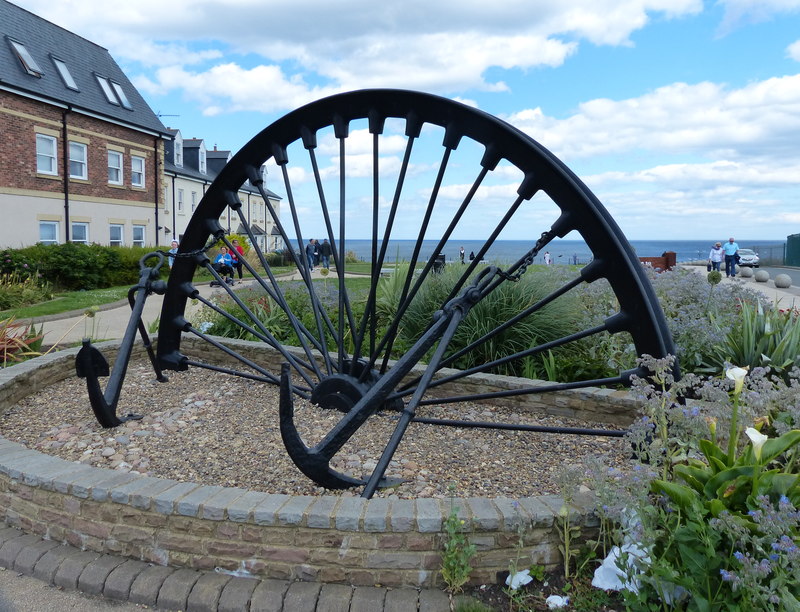
The colliery site has been cleared and reclaimed. Seaham’s seafront and former pit ground are now open space and housing, and the town’s mining past is marked by public sculpture and preserved winding gear rather than by working structures.
A colliery pit wheel is preserved and displayed at Seaham as a memorial. Nearby, interpretive sculpture on the site of the Vane Tempest colliery marks the other half of the town’s coal history, and the graves of the 1880 dead — including Michael Smith and his son — are in Christ Church cemetery.
Related mines
- Dawdon Colliery — Dawdon was sunk specifically to reach coal reserves that had become uneconomic to work from the older Seaham Colliery.
- Framwellgate Moor Colliery — Both were Londonderry collieries.
- Penshaw Colliery — Collieries of the Londonderry family, owners of Penshaw in the 1850s.
- Seaton Colliery — Adjoining colliery; Lord Londonderry bought Seaton in November 1864 and merged it with Seaham, whose No. 3 (Seaton) Pit it became.
- Vane Tempest Colliery — Merged operations on 11 July 1983 and were worked together thereafter.
Nearby mines
- Seaton Colliery — 0.1 miles (0.2 km) S
- Vane Tempest Colliery — 1.2 miles (2.0 km) SE
- Murton Colliery — 1.6 miles (2.6 km) S
- Dawdon Colliery — 2.0 miles (3.2 km) SE
- Ryhope Colliery — 2.5 miles (4.0 km) N, Tyne and Wear
Straight-line distance, within 9 miles (15 km). Show on the map.
Disasters & major incidents
-
Seaham Colliery explosion, 1860
24 September 1860 · Explosion · 2 fatalities
Two shifters blasting down a stone in the roof at Seaham Colliery on 24 September 1860 fired a pocket of gas and were killed; the forty other men in the pit were unhurt. -
Seaham Colliery Explosion, 1871
25 October 1871 · Explosion · 26 fatalities
An outburst of gas from the roof of Seaham Colliery's No. 3 pit was ignited during blasting, killing 26 men and boys — nine years before the far larger disaster that would make the colliery's name. -
Seaham Colliery Explosion
8 September 1880 · Explosion · 161 fatalities
At about 2.30 on the morning of Wednesday 8 September 1880, an explosion — heard at the surface "like the report of a heavy cannon" — tore through the Hutton and Maudlin seams of Seaham Colliery, County Durham. Of the 231 men and boys underground, 161 were killed by the NMRS reckoning; other accounts give 164. Nearly 200 horses and ponies died with them. All three shafts were blocked by jammed cages, fires broke out underground, and 29 bodies were never recovered: the Maudlin seam was sealed with them still in it, and the men refused to go back to work until they came out. -
Seaham Colliery boiler accident, 1901
18 March 1901 · Machinery · 2 fatalities
A new Lancashire boiler slipped off its chocks while being set at Seaham Colliery on 18 March 1901, crushing a fitter and a driller to death.
What's uncertain
Points where sources disagree or the record could not be settled; both accounts are kept. All open questions in the archive.
- The Durham Mining Museum record gives the colliery as closed in 1988, having merged with Vane Tempest on 11 July 1983. (disputed) 1
- Wikipedia dates the Vane Tempest merger to 1988 and the closure to 1993. (disputed) 2
Recorded claims
Individual factual claims, each attached to the source(s) that support it below. Where sources disagree, both are kept.
- Sinking began on 13 April 1849 for the third Marquess of Londonderry, the first shaft going down to the Busty seam. 1
- Employment peaked at 3,076 in 1910 — 2,582 below ground and 494 above. 1
- The Harvey, the lowest seam worked, lay 282 fathoms to the shaft bottom and 300 fathoms at its lowest point, and was about 3 feet thick. 1
- Seaton Colliery was bought by Lord Londonderry in November 1864 and worked as part of Seaham thereafter. 1
- The Durham Mining Museum record gives the colliery as closed in 1988, having merged with Vane Tempest on 11 July 1983. (disputed) 1
- Wikipedia dates the Vane Tempest merger to 1988 and the closure to 1993. (disputed) 2
- A fault so large that driving through it took three years gave its name to the Hutton Jubilee seam, reached in the jubilee year of 1887. 1
- Abandonment plans for Seaham are catalogued in the BGS mine plans collection at Keyworth. 3
Photographs & further reading
A local history account of the 1880 explosion with photographs and the roll of the dead.
View sourceThe catalogue entries for the abandonment plans held at Keyworth — no published scans, but a record of what survives.
View sourceSources
- (primary) Durham Mining Museum: Seaham Colliery — Durham Mining Museum
- (secondary) Seaham Colliery — Wikipedia
- (primary) BGS mine plans catalogue: SEAHAM — British Geological Survey
- (secondary) Seaham Colliery Explosion — Seaham — 1880 — Northern Mine Research Society
Record created: 26 August 2026 · Last researched: 26 August 2026