 MineArchive
Seaham Colliery Explosion
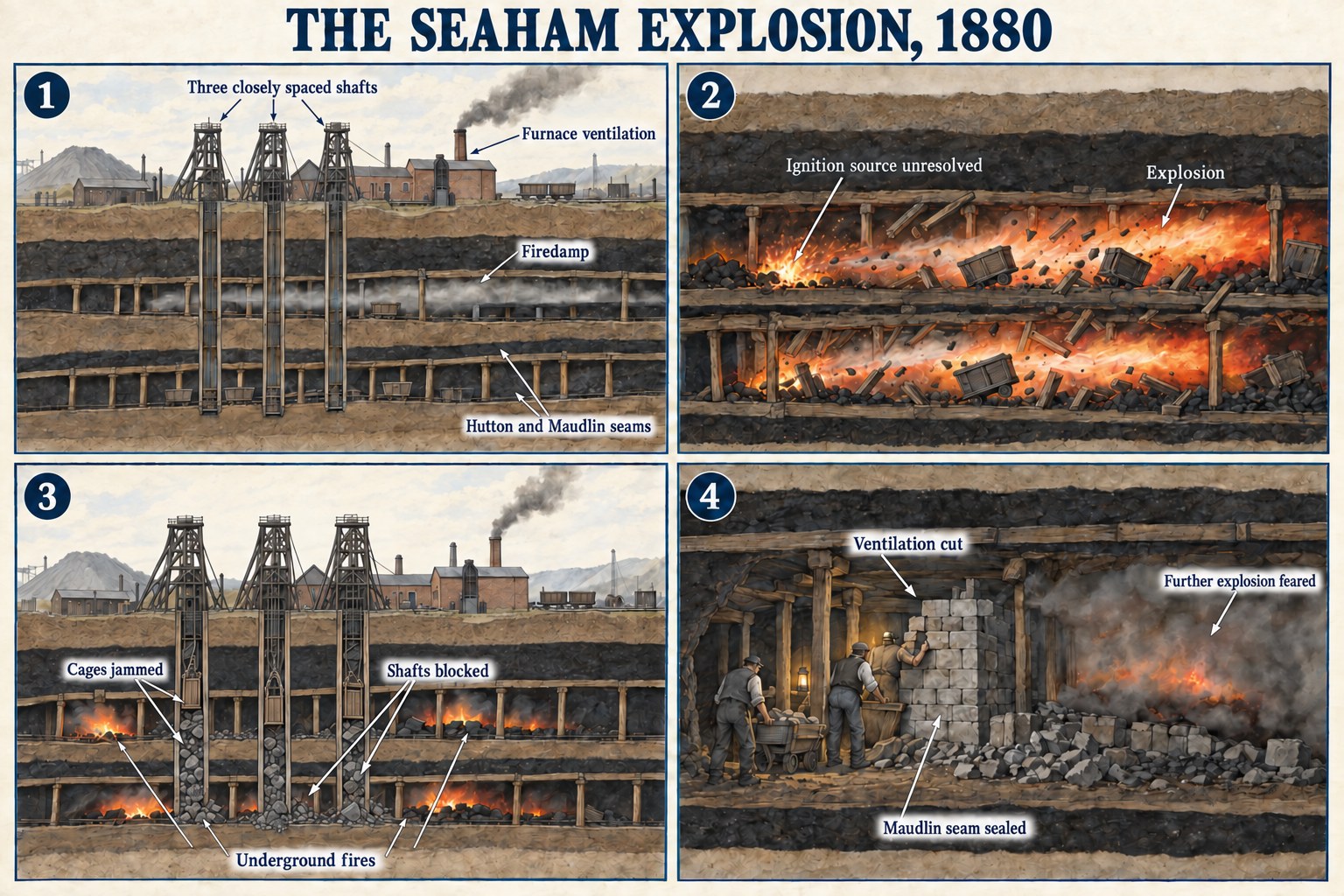
At about 2.30 on the morning of Wednesday 8 September 1880, an explosion — heard at the surface "like the report of a heavy cannon" — tore through the Hutton and Maudlin seams of Seaham Colliery, County Durham. Of the 231 men and boys underground, 161 were killed by the NMRS reckoning; other accounts give 164. Nearly 200 horses and ponies died with them. All three shafts were blocked by jammed cages, fires broke out underground, and 29 bodies were never recovered: the Maudlin seam was sealed with them still in it, and the men refused to go back to work until they came out.
| Date | 8 September 1880 |
|---|---|
| Mine | Seaham Colliery |
| Region | County Durham |
| Primary type | Explosion |
| Associated types | Entrapment, Fire, Rescue |
| Fatalities | 161 (The NMRS account, which itemises the dead by occupation, gives 161. Several other accounts, including local histories and press coverage of the annual commemoration, give 164, and Wikipedia says only "upwards of 160" — the difference turning on whether rescuers and surface workers who died later are counted. Both figures are recorded below rather than reconciled.) |
| Context | During active mining (The night shift; 231 men and boys were underground at half past two in the morning.) |
Cause
The inquest could not settle on a single ignition source. Three theories were argued over twenty sittings: that shots of gunpowder fired by the Venner brothers ignited gas in the Hutton No. 3 or Maudlin seams; that paraffin lamps lit at the main coal staple bottom at around two or three in the morning were responsible; or, as Thomas Burt argued, that the explosion originated at the staple bottom itself. Gas was known to be about — the examiner William Crozier had found it in new returns in the East Maudlin that July.
Contributing factors
The colliery was still ventilated by furnace rather than by fan. Gunpowder shot-firing was in routine use in a pit known to make gas, a practice William Pickard, the Lancashire miners’ agent, attacked directly at the inquest. And the three shafts were close enough together and similarly enough arranged that the blast jammed the cages in all of them at once, cutting off the only ways out and the only ways in.
What happened
Seaham employed 360 men above ground and 1,340 below. At 2.30 a.m. on 8 September, 231 were underground. The men working the Hutton and Main Coal seams largely got out; those in the Nos. 1 and 3 pits and in the Maudlin did not. Only five survived from the Hutton seam, along with one onsetter.
The dead were counted by trade in a way that shows how a colliery was staffed: 28 hewers, 99 stonemen and other workmen, 20 putters and drivers, two enginemen and firemen, four horse keepers and two furnacemen. Nearly 200 horses and ponies died in the stables and the roadways.
Among the last to die was Michael Smith, a hewer trapped with a group of others long enough to scratch a message on his water bottle. It has been quoted in County Durham ever since: he recorded that there were forty of them together at seven in the morning, that some were singing hymns, and that his thoughts were on his little son Michael and their meeting again in heaven. Smith and his son are buried together in Christ Church cemetery.
Rescue & recovery
The manager, T. H. Stratton, went down first and directed the rescue himself. It was immediately hampered by the jammed cages in all three shafts. Sixty-seven men eventually came out alive, the first four being brought up from the Main Coal seam that afternoon. Fires had started in the stables, in the Hutton and Maudlin seams and in the No. 1 engine house; to stop the fires setting off a second explosion, the rescuers took the decision to cut the ventilation, which meant abandoning anyone still alive beyond the fires.
Recovery went on until 1 October, bringing 136 bodies out of the No. 1 and No. 3 pits. About 29 remained in the Maudlin when it was sealed.
Investigation & inquiry
The coroner’s inquest under Mr Crofton Maynard opened on 10 September 1880 and resumed on 5 January 1881. It heard the competing accounts of the gunpowder shots, the paraffin lamps and the staple bottom without resolving between them. The wider significance of the evidence was about practice rather than blame: that gunpowder was still being fired in a fiery pit, and that the northern system of sinking left three shafts vulnerable to a single blast.
Legal & regulatory aftermath
The 161 dead left 105 widows, 126 sons and 139 daughters — 382 dependants in all needing relief. Most of the men had belonged to the Northumberland and Durham Permanent Relief Association, which carried the bulk of the payments.
Changes to practice & legislation
The Seaham men would not return to work while their fellows were still sealed in the Maudlin. On 28 January 1881 Lord Londonderry reopened the long-idle Old Durham Colliery to give about 700 of them work in the meantime. The inquest’s evidence on gunpowder in gassy seams fed directly into the argument that produced the Royal Commission on Accidents in Mines and, in time, the restriction of blasting practice in fiery pits.
Memorials & commemoration
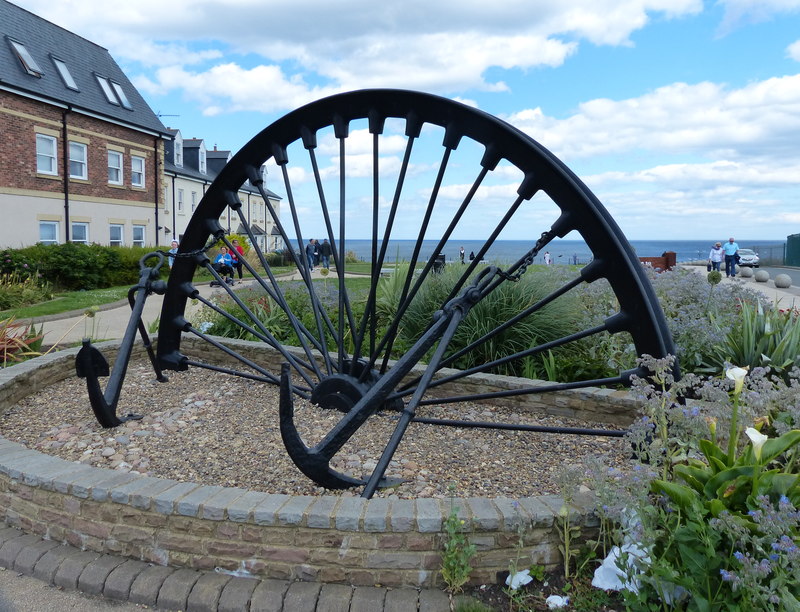
The dead are buried in Christ Church cemetery, Seaham, Michael Smith and his son among them. A memorial service is still held in the town for the men and boys lost in both the 1880 and the 1871 explosions.
What's uncertain
Points where sources disagree or the record could not be settled; both accounts are kept. All open questions in the archive.
- The NMRS account, itemising the dead by occupation, gives 161 killed of 231 underground. (disputed) 1
- Several accounts, including the local commemoration, give the toll as 164 men and boys; Wikipedia says "upwards of 160", including surface workers and rescuers. (disputed) 2
- The inquest heard three competing explanations — gunpowder shots fired by the Venner brothers, paraffin lamps at the main coal staple bottom, and an origin at the staple bottom itself — and did not decide between them. (uncertain) 1
Recorded claims
Individual factual claims, each attached to the source(s) that support it below. Where sources disagree, both are kept.
- The NMRS account, itemising the dead by occupation, gives 161 killed of 231 underground. (disputed) 1
- Several accounts, including the local commemoration, give the toll as 164 men and boys; Wikipedia says "upwards of 160", including surface workers and rescuers. (disputed) 2
- Nearly 200 horses and ponies were killed. 1
- The inquest heard three competing explanations — gunpowder shots fired by the Venner brothers, paraffin lamps at the main coal staple bottom, and an origin at the staple bottom itself — and did not decide between them. (uncertain) 1
- All three shafts were blocked by jammed cages after the blast; 67 men were eventually brought out alive. 1
- Recovery continued until 1 October 1880, when 136 bodies had been brought out. About 29 remained in the Maudlin seam when it was sealed. 1
- The dead left 105 widows, 126 sons and 139 daughters — 382 dependants requiring relief. 1
- Lord Londonderry reopened the disused Old Durham Colliery on 28 January 1881 to employ about 700 Seaham men who refused to return while bodies remained sealed underground. 1
Related terminology
Mining terms this disaster is structurally linked to, with the nature of the relationship.
- Cage (hazard involved)
The blast jammed the cages in all three shafts at once, closing the only routes in or out at the moment the rescue depended on them. - Firedamp (direct cause)
Gas had been found in the East Maudlin returns that July, and every theory the inquest considered ended in an ignition of it. - Hewer (contextual relationship)
Named twice in this record, first in the narrative: “…counted by trade in a way that shows how a colliery was staffed: 28 hewers, 99 stonemen and other workmen, 20 putters and drivers, two…” - Mines Rescue Station (contextual relationship)
Seaham was one of the disasters that made the case for organised rescue: the men who went down did so without apparatus, and the fires were finally dealt with by cutting the ventilation. - Onsetter (contextual relationship)
This disaster's own narrative notes that 'only five survived from the Hutton seam, along with one onsetter' — a direct textual match; manually linked after the automated sweep capped it at the disaster's existing 5-term limit, since Onsetter had zero backlinks anywhere else on the site. - Shot-firing (contextual relationship)
Named twice in this record, first in the contributing factors: “…was still ventilated by furnace rather than by fan. Gunpowder shot-firing was in routine use in a pit known to make gas, a practice William…”
Photographs & further reading
This page doesn't try to reproduce everything — these are the best original sources found for this disaster.
A local account with photographs of the pit and the funerals, and the roll of the dead as the town records it.
View sourceThe fullest account online: the breakdown of the dead by trade, the course of the rescue and the sealing of the Maudlin, and the inquest evidence on all three theories of the cause.
View sourceSources
- (secondary) Seaham Colliery Explosion — Seaham — 1880 — Northern Mine Research Society
- (secondary) Seaham Colliery — Wikipedia
- (primary) Durham Mining Museum: Seaham Colliery — Durham Mining Museum
Record created: 26 August 2026 · Last researched: 26 August 2026