 MineArchive
Onsetter
| Also known as | Bottomer (Scottish), Pit-bottomer (Scottish), Pit Bottomer (Scottish), Hooker-on (Scottish), Cager (Scottish), Hitcher (The commonest alternative to Onsetter in the English and Welsh coalfields; the Apedale glossary gives it as 'another name for the onsetter', and Welsh Coal Mines defines a hitcher as the person responsible for loading and unloading drams and men on and off the cage at pit bottom and signalling that the cage is ready to be moved.), Knocker (Lancashire and Wales) |
|---|---|
| Category | Labour & Roles |
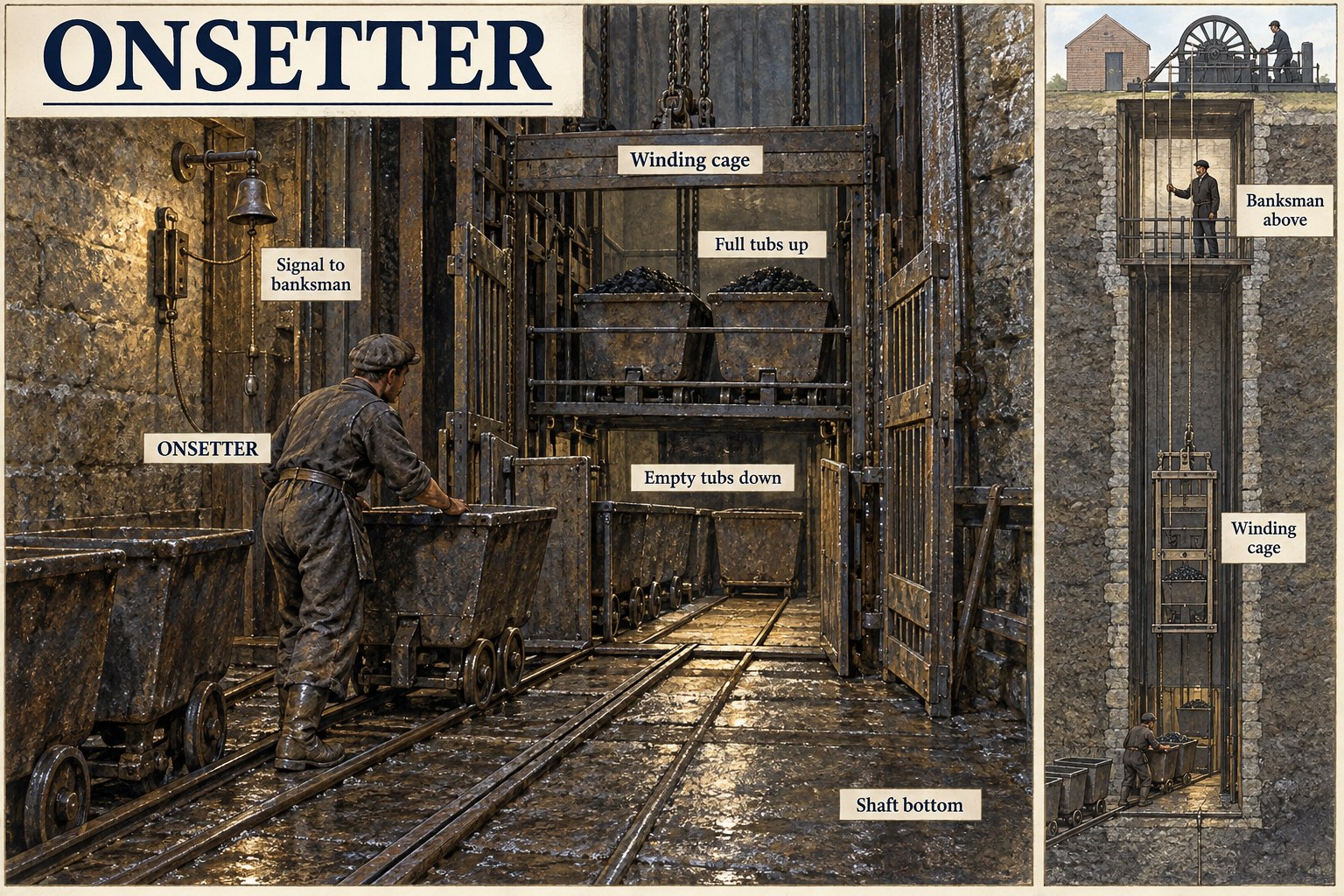
The person stationed at the shaft bottom responsible for loading and unloading the winding cage, hooking and unhooking tubs or corves, and signalling up to the surface Banksman — the underground counterpart to the banksman, working the same shaft from the opposite end.
Historical usage
Recorded as historical, dialect vocabulary of Northern England: an onsetter was, in its original sense, 'a worker at the bottom of a mineshaft who exchanges the empty and full corves.' As winding technology and signalling systems developed, the role's core duty stayed constant — controlling cage traffic and signalling at the shaft bottom — while its technology moved from hand-hooked corves to tub and cage systems with coded bell signals.
How it worked
Positioned at the inset or shaft bottom, the onsetter received the descending cage, unhooked or unloaded it, hooked on or loaded whatever was to be raised — tubs, materials, or men — and signalled to the banksman above when the cage was ready to be wound up. In modern mining the same role is typically performed from a fixed cabin with signalling and cage controls close to hand, but the underlying job, controlling shaft-bottom traffic and signalling the surface, is unchanged.
Why it was used
Whoever wound the cage from the surface could not see the shaft bottom, so a reliable, correctly-signalling onsetter was as essential to safe winding as the banksman above — the two formed either end of the same signalling chain, with the winding engineman acting on what both of them told him.
Risks & limitations
The onsetter worked at one of the most dangerous fixed points in the mine, immediately beside an active shaft where a miscue, an overwind or a mechanical failure could kill him along with anyone in the cage; several documented shaft disasters record an onsetter among the dead or among the few who survived a wider catastrophe by chance of position.
Regional variation
Northern England dialect term; the role itself was universal wherever shaft winding was used. In Scotland the same man was the bottomer or pit-bottomer, defined by Barrowman in 1886 as 'the person who loads and unloads the cages at the bottom or intermediate landings in a shaft', and also the hooker-on, from the days when he hooked hutches to the rope; the Scottish shale field also called him the cager or bellman. Barrowman adds that when signalling to the pithead by hammer on an iron plate the bottomer was said to chap. It was a boy's first job: one shale miner started as a bottomer at fourteen in 1927 and was moved to the endless haulage after six months. Gresley's 1883 glossary has the same definition under bottomer, so the word was in wider use than Scotland.
Related terminology
Banksman, Endless Rope Haulage
Mines associated with this term
5 examples chosen from 17 linked records — the term page is not an index.
- Greenrigg Colliery — West Lothian (notable incident)
Frank Shields, bottomer, fell 84 feet down the shaft in 1910 after pushing a hutch through the gate at a mid-working with no cage there. - Dipton Colliery — County Durham (well documented example)
Named in this record’s history: “…who died in 1936 of tuberculosis brought on by silicosis, and an onsetter who fell 200 feet to the shaft bottom in 1937 after more than 51…” - Dunkerton Colliery — Somerset (well documented example)
Named in this record’s history: “…the ordinary ones of a small deep mine — a sixteen-year-old incline hitcher riding a journey of full trams against rules the inspector noted had…” - Elphingstone Colliery — East Lothian (well documented example)
Named in this record’s history: “…and knocked him into the shaft to fall 300 feet. John Henderson, a bottomer of 38, went down on 10 August 1898 and, through a misunderstanding,…” - Far Green Colliery — Staffordshire (well documented example)
Named in this record’s workings: “…raised the cage about fifty feet. Men rode sixteen to a cage, the hooker-on signalling with three knocks before a load of men was drawn, and a…”
Disasters associated with this term
5 examples chosen from 40 linked records, most direct relationship first.
- Astley Deep Pit explosion, 1874 (contextual relationship)
Named in this record’s narrative: “…roof when there was a heavy fall of earth and an explosion. The hooker-on George Harrison was blown several yards, then carried out a youth,…” - Auldhouseburn Colliery inundation, 1898 (contextual relationship)
Named in this record’s narrative: “…out came through water to the knees and waist, and Gibson the bottomer stood at his post until he was in to the armpits, sending…” - Bersham Colliery explosion (contextual relationship)
Named in this record’s rescue and recovery: “…Valentine alive. The afterdamp stopped them going further. The hooker-on's body was found under the guide rods blown into the south inset,…” - Bothwell Castle Colliery shaft accident, 1922 (contextual relationship)
Named in this record’s narrative: “…to be in order, and the accident was thought to have turned on the onsetter or the engineman.” - Brookhouse Colliery Overwind, 1958 (contextual relationship)
Named in this record’s rescue and recovery: “The onsetter at the Silkstone Seam entrance saw the cage for only a fleeting…”
Sources
- (primary) A Glossary of Terms Used in Coal Mining, by William S. Gresley, 1883 — Internet Archive
- (primary) Glossary of Scotch Mining Terms — James Barrowman (1886), via Scottish Mining Website
- (secondary) Bottomer — Scottish Shale occupations — Museum of the Scottish Shale Oil Industry
- (secondary) Glossary of South Wales colliery terms — Welsh Coal Mines
- (secondary) Glossary of mining terms (H) — North Staffordshire Miners’ Group, Apedale
- (secondary) Glossary of mining terms (O) — Apedale Heritage Centre / North Staffordshire Mining Group
- (secondary) Glossary of mining terms (P) — North Staffordshire Miners' Group — Apedale Heritage Centre
- (secondary) Local Mining Terms — Trimdon Snippets
- (secondary) Pit Terminology — Healey Hero
- (secondary) onsetter — Wiktionary
Record created: 27 August 2026 · Last researched: 12 September 2026