 MineArchive
Brookhouse Colliery Overwind, 1958
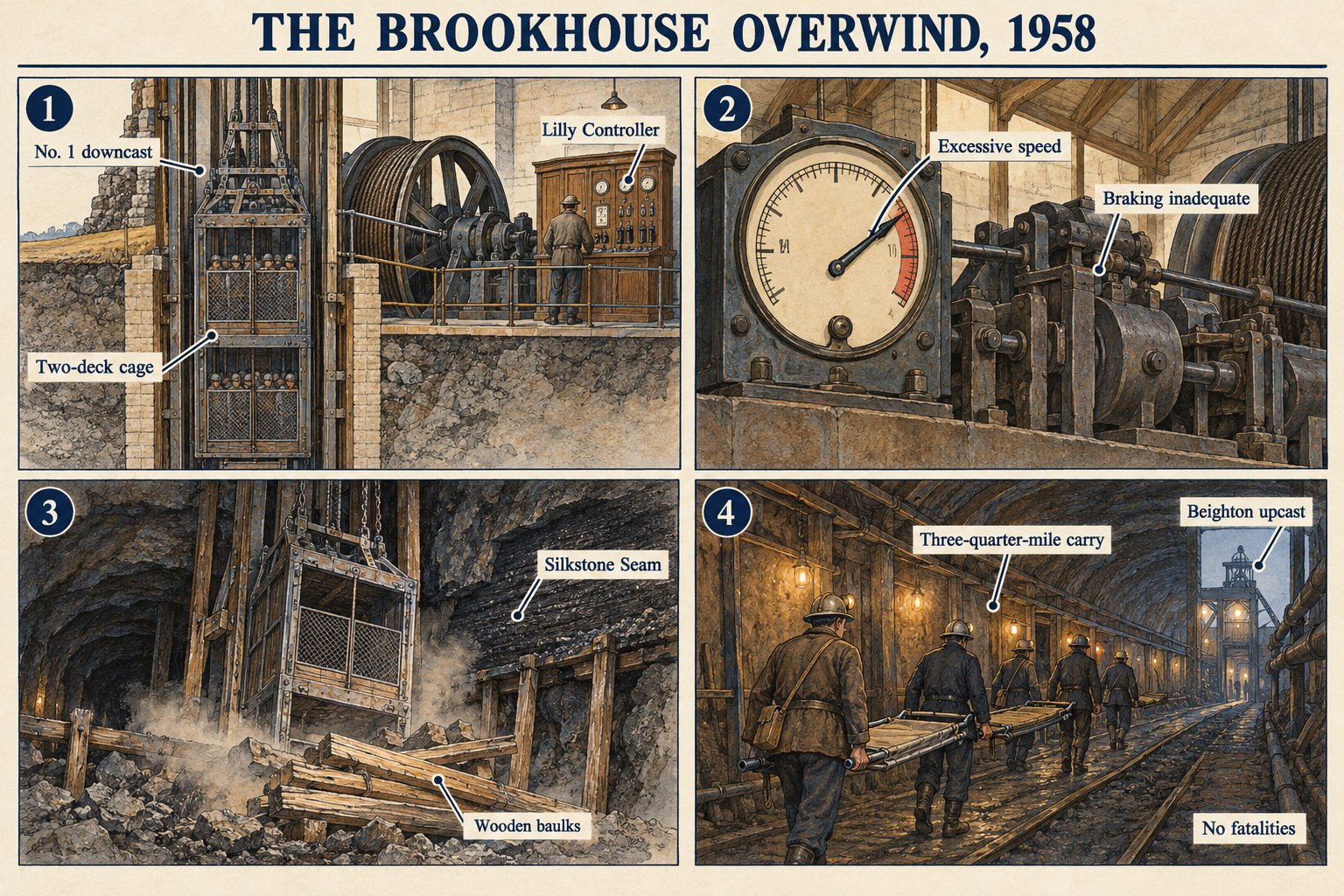
An overwind in the No. 1 downcast shaft at Brookhouse Colliery injured 36 of the 44 men in a descending cage, after excessive winding speed went unchecked by faulty braking and an improperly equipped automatic safety device.
| Date | 4 March 1958 |
|---|---|
| Mine | Brookhouse Colliery |
| Region | South Yorkshire |
| Type | Winding / Shaft Accident |
| Fatalities | 0 (No fatalities were recorded; 36 of the 44 occupants of the descending cage sustained reportable injuries, several serious.) |
| Injuries | 36 of 44 persons in the cage sustained reportable injuries. |
| Context | During active mining |
Cause
Excessive speed of the winding engine, not sufficiently controlled by regenerative or mechanical braking, combined with a Lilly Controller (the automatic device meant to prevent overwinding) that was not properly equipped.
What happened
At 6.30 a.m. on 4 March 1958, during a man-winding shift that had already raised 260 men and lowered 507, the descending cage in Brookhouse Colliery's No. 1 downcast shaft -- carrying the maximum permitted 44 persons, 22 on each of its two decks -- overwound and crashed onto wooden baulks at the Silkstone Seam entrance. The ascending, overlap-rope cage was empty at the time. The official inquiry found the cause to be excessive winding-engine speed that had not been properly checked: both the regenerative and mechanical braking applied by the winding engineman, and the automatic overwind-prevention device (a Lilly Controller), proved inadequate -- the Controller itself was found not to have been properly equipped.
Rescue & recovery
The onsetter at the Silkstone Seam entrance saw the cage for only a fleeting moment before it crashed, and immediately began, with other workmen and officials present, to extricate the injured men. The colliery manager was not informed of the scale of the accident until 7.00 a.m., delayed because the telephone exchange operator could not reach him -- his number had changed two days earlier when the local exchange was automated. On arrival at 7.10 a.m. he organised stretchers, ambulances, first-aid equipment and casualty stations, and alerted Sheffield Royal Infirmary to expect a large number of casualties. Injured men were carried by stretcher some three-quarters of a mile underground from the Brookhouse downcast shaft to the Beighton upcast shaft, raised to the surface, and taken by ambulance to casualty stations near the Brookhouse pit-head, arriving between 8.30 and 10.30 a.m.; they were treated there under the National Coal Board's area medical officer before transfer to the Infirmary.
Investigation & inquiry
The official investigation, led by H.M. Principal Inspector of Mechanical Engineering A. E. Crook, C.B.E., began about two hours after the accident and continued until normal winding resumed on 6 March 1958, with representatives of the National Union of Mineworkers, the British Association of Colliery Management, the National Coal Board and H.M. Inspectors of Mines all present. Crook's report was submitted to the Minister of Power, Lord Mills, under Section 121 of the Mines and Quarries Act 1954.
Changes to practice & legislation
The report made recommendations concerning winding-engine braking systems and the proper equipping and maintenance of automatic overwind-prevention devices such as the Lilly Controller.
What's uncertain
Points where sources disagree or the record could not be settled; both accounts are kept. All open questions in the archive.
- The official Ministry of Power inspector's report records no fatalities. A family member's testimony submitted to HealeyHero states that Derrick Smith ('Carrots') was killed in the incident, leaving a pregnant wife and two young sons. No official record names him, and this is kept as a family account rather than an established fact. (uncertain) 2
Recorded claims
Individual factual claims, each attached to the source(s) that support it below. Where sources disagree, both are kept.
- The overwind resulted from excessive winding-engine speed, insufficiently checked by either the regenerative and mechanical braking applied by the engineman or by the automatic Lilly Controller, which was found not to have been properly equipped. 1
- Family testimony collected by HealeyHero names two of the injured: Arthur Davison, whose leg was amputated as a result of the crash, and Arnold Clarke, who suffered a crushed pelvis and never returned underground, working afterwards as a gateman for the National Coal Board. 2
- The official Ministry of Power inspector's report records no fatalities. A family member's testimony submitted to HealeyHero states that Derrick Smith ('Carrots') was killed in the incident, leaving a pregnant wife and two young sons. No official record names him, and this is kept as a family account rather than an established fact. (uncertain) 2
Related terminology
Mining terms this disaster is structurally linked to, with the nature of the relationship.
- Cage (contextual relationship)
Named 4 times in this record, first in the summary: “…at Brookhouse Colliery injured 36 of the 44 men in a descending cage, after excessive winding speed went unchecked by faulty braking and…” - National Union of Mineworkers (contextual relationship)
Named in this record’s investigation: “…normal winding resumed on 6 March 1958, with representatives of the National Union of Mineworkers, the British Association of Colliery Management, the National Coal…” - Onsetter (contextual relationship)
Named in this record’s rescue and recovery: “The onsetter at the Silkstone Seam entrance saw the cage for only a fleeting…” - Overwind (contextual relationship)
Named in this record’s summary: “An overwind in the No. 1 downcast shaft at Brookhouse Colliery injured 36 of the…” - Winding Engine (contextual relationship)
Named in this record’s cause: “Excessive speed of the winding engine, not sufficiently controlled by regenerative or mechanical braking,…”
Sources
- (primary) Brookhouse Colliery, Overwind, 4th March 1958 — Durham Mining Museum (reproducing the official Ministry of Power inspector's report)
- (observational) Brookhouse Colliery - 1958 'Overwind' incident (subscriber emails/testimony) — HealeyHero (subscriber-submitted family and eyewitness testimony)
Record created: 2 September 2026 · Last researched: 2 September 2026