 MineArchive
Cage
| Category | Structures & Machinery |
|---|
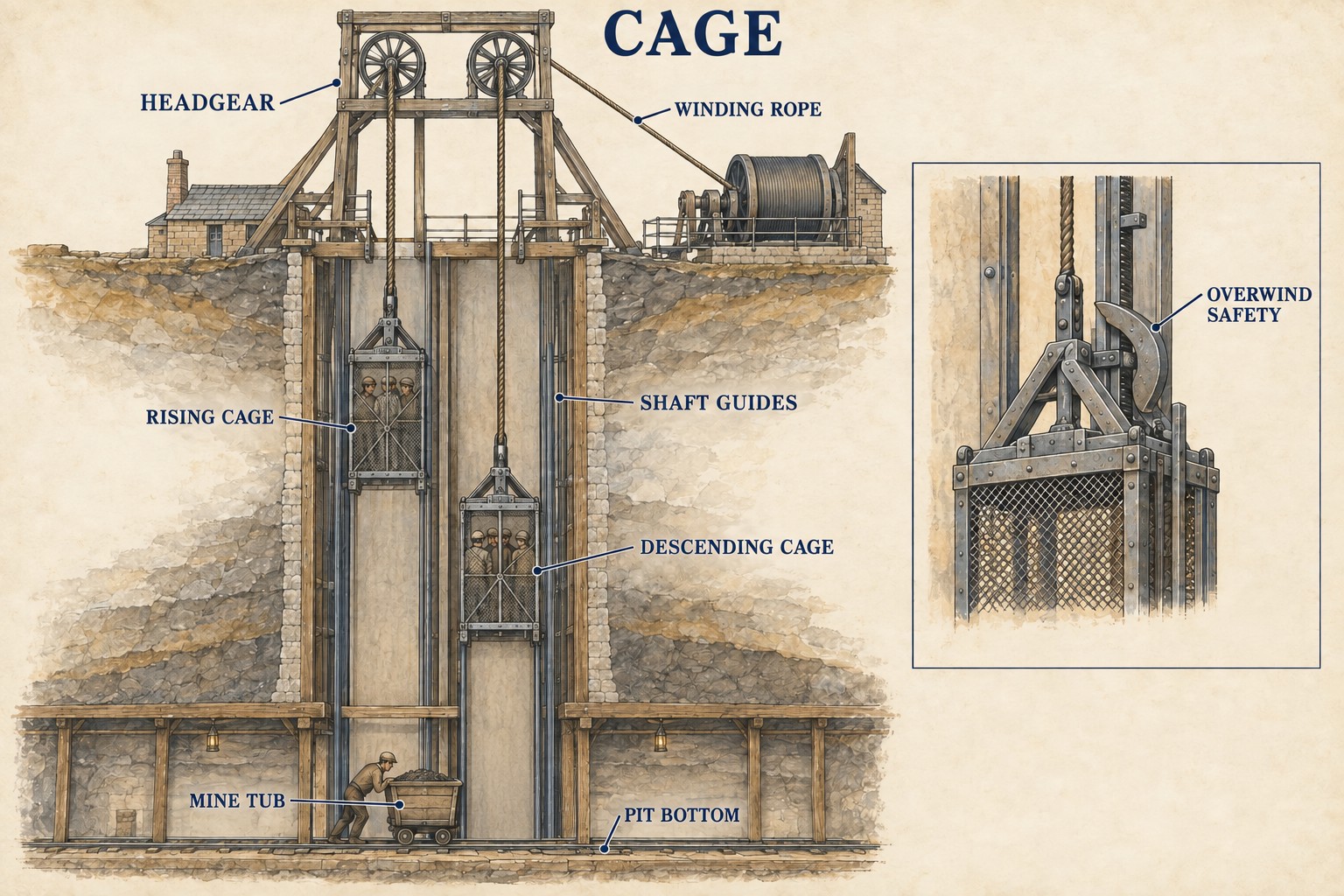
The lift used to raise and lower miners, materials and ore in a mine shaft, named for the strong wire mesh that formed its sides.
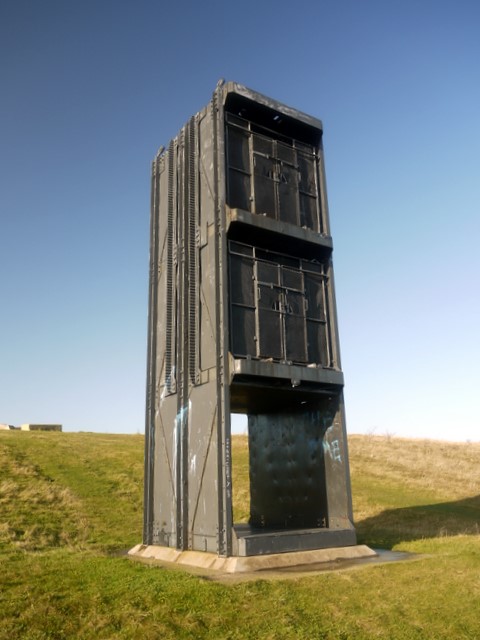
Historical usage
The mine cage is credited to John Curr of Sheffield, who introduced it around 1787; before cages came into general use, miners were commonly lowered and raised by a rope, a basket, or simply by climbing ladders down the shaft. Cages became standard equipment at deep shaft mines across Britain through the 19th and 20th centuries.
How it worked
A cage ran on guides fixed to the shaft walls, hauled up and down by a winding engine on a steel cable. Most shafts had two cages sharing one winding drum, arranged so that as one was wound to the surface the other descended — cutting the power needed to move each one, since the load of one partly balanced the other. At the pit bottom, tubs of coal or ore were loaded into the cage for the return trip; the whole cycle, over a shaft several hundred yards deep, could take only around a minute.
Why it was used
A cage let large numbers of miners and heavy loads of ore move quickly and safely between the surface and deep underground workings — indispensable once mines went too deep to make ladders practical for daily use.
Risks & limitations
A cage travelling at speed on a long cable was inherently dangerous if anything failed: an 'overwind', where the cage was wound too far and struck the headgear, was a serious hazard until devices like the 'King Hook' — which automatically released and caught an overwound cage — were introduced to prevent it falling back down the shaft.
Related terminology
Bunton, King Hook, Man-riding, Skip-winding, Winding Engine
Mines associated with this term
5 examples chosen from 88 linked records — the term page is not an index.
- Alexandra Colliery — Merseyside (well documented example)
Named 10 times in this record, first in the summary: “…or nine years started his engine the wrong way and overwound the cage into the headgear in the dark. The jury blamed the unlit pit brow…” - Houghton Main Colliery — South Yorkshire (well documented example)
Named twice in this record, first in the summary: “…each with a fully named list of the dead, spanning a Victorian cage accident, an inter-war explosion and a 1975 blast that led to a…” - Nixon's Navigation Colliery — Rhondda Cynon Taf (well documented example)
Named in this record’s history: “…cylinders and a six-foot stroke, steel ropes and double-decked cages that completed a wind in 75 seconds. The North Pit, 130 yards away…” - Tynewydd Colliery, Porth — Rhondda Cynon Taf (well documented example)
Named in this record’s workings: “Winding by water balance: a tank of water in the descending cage raised the coal, and the water was pumped back up from the pit…” - Wollaton Colliery — Nottinghamshire (well documented example)
Named 3 times in this record, first in the workings: “…day, winding two sixteen-hundredweight tubs on a single-deck cage. Winding ropes were inch-and-a-quarter crucible steel and the cages…”
Disasters associated with this term
5 examples chosen from 87 linked records, most direct relationship first.
- Blantyre Colliery No. 3 Pit overwinding, 1878 (direct cause)
The cage was overwound. - Medomsley Colliery cage accident, 1923 (direct cause)
The ascending cage left its guides and fell. - Milfraen Colliery cage accident, 1902 (direct cause)
Men were thrown from the ascending cage. - Nelson Pit cage accident, Shakerley, 1883 (direct cause)
The cage fell 280 yards into the sump. - Tirpentwys Colliery shaft accident, 1902 (direct cause)
The men fell in the cage.
Sources
- (secondary) Down t'pit — Down by the Dougie
- (secondary) Underground at Big Pit National Coal Museum — Google Arts & Culture
Record created: 22 August 2026 · Last researched: 22 August 2026