 MineArchive
Bunton
| Category | Structures & Machinery |
|---|
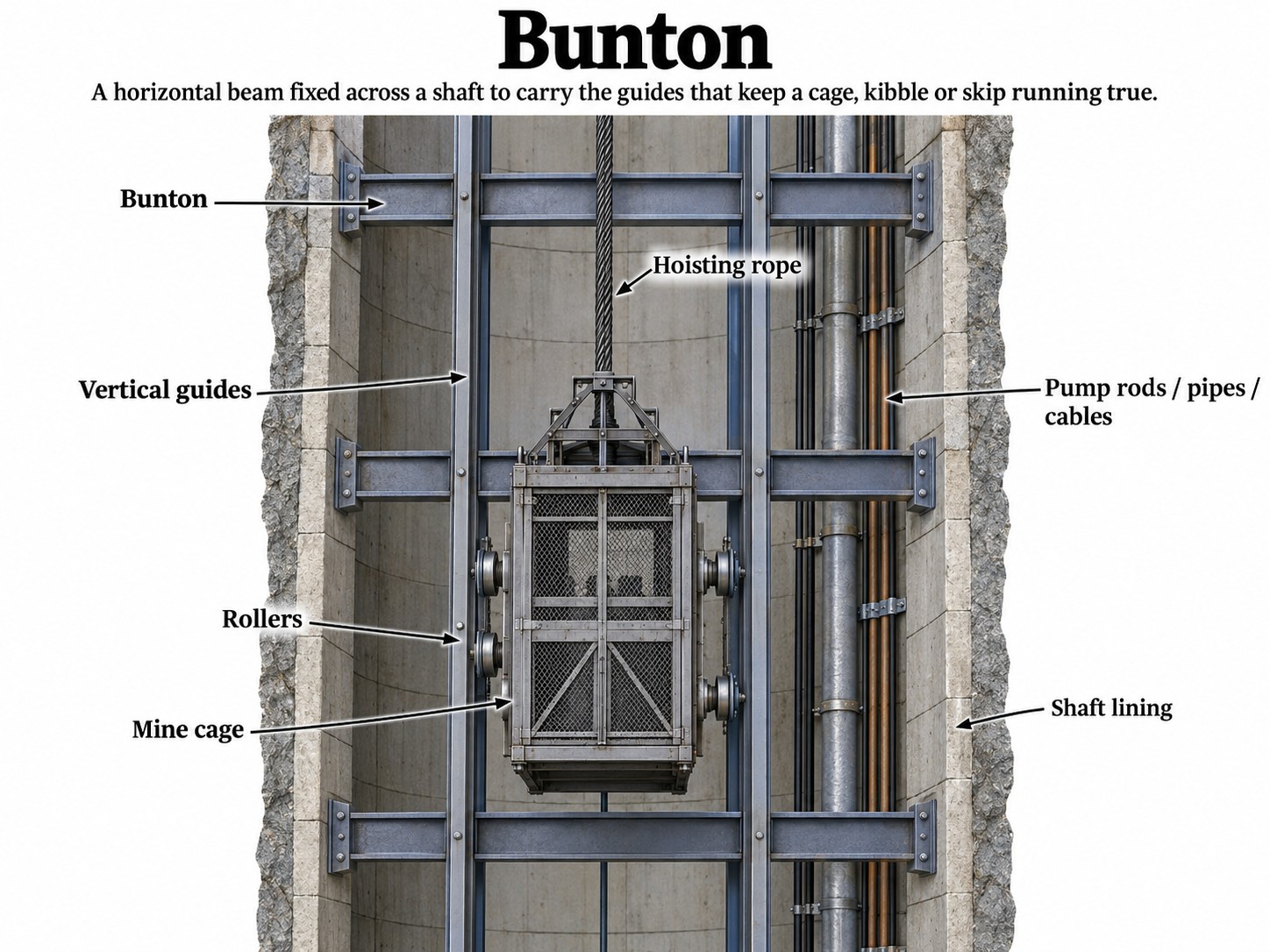
A horizontal timber or steel beam fixed across a mine shaft, generally at intervals of 4 to 8 feet, carrying the vertical guides that keep a cage, kibble or skip running true as it is raised and lowered.
Historical usage
Buntons appear throughout British shaft engineering from at least the 18th century onward; the Cornish Mining World Heritage glossary lists them among the components of 'pitwork' -- the pump rods, rising main and shaft guides fitted within a working shaft -- and notes that later skips ran on shaft guides that were themselves called buntons interchangeably with the beams that carried them.
How it worked
Buntons and the vertical guides they carry together form a 'shaft set': the guides act as rails that a cage or skip's rollers run along, while the buntons brace the shaft lining and hold the guides rigidly in place across the full width of the shaft. Timber buntons were typically around 6 inches square; later shafts increasingly used rolled steel joists instead.
Why it was used
Without guides held firmly in place by buntons, a hoisted conveyance would swing loosely on its rope, risking a collision with the shaft walls, other equipment, or men working nearby -- particularly dangerous in a shaft also carrying pump rods, cables and pipework.
Risks & limitations
A bunton struck by a conveyance that has come off its guides -- through a broken rope, an overwind, or a mechanical failure -- can capsize or wreck it outright: at Kilton Mine in 1873, a sinking kibble struck a bunton and capsized, killing two of the three men riding in it.
Related terminology
Mines associated with this term
Included only where MineArchive's own research gives a reasonable evidential basis — not every mine where this might plausibly apply.
- Gilmilnscroft Colliery — East Ayrshire (well documented example)
Named in this record’s history: “…overwound the cage fell down the shaft in 1890; a joiner fell when a bunton gave way in 1895; and in 1913 a stoneminer's drill struck gelignite…” - Ludlows Colliery — Somerset (well documented example)
Named in this record’s history: “…sinkers were killed in 1860, when a scaffold strip nailed to a bunton gave way, and in 1888, when a brick was knocked from the shaft side…” - Mells Colliery — Somerset (well documented example)
Named in this record’s history: “…were killed in separate falls when the kibbles they rode struck the buntons in the shaft. Its owners are listed as Mells Collieries Limited, the…”
Disasters associated with this term
5 examples chosen from 8 linked records, most direct relationship first.
- Kilton Mine Kibble Accident, 1873 (direct cause)
The disaster's own narrative directly names the bunton the sinking kibble struck, capsizing it and throwing the three men to the bottom of the shaft. - Medomsley Colliery cage accident, 1923 (direct cause)
The cage struck a cast-iron bunton at 80 feet. - Milfraen Colliery cage accident, 1902 (direct cause)
The cage struck an iron girder or byatt across the shaft. - Adelaide Colliery cage accident, 1889 (contextual relationship)
Named 4 times in this record, first in the summary: “…and Partners' Adelaide Colliery caught on a newly fitted 'beating bunton' at the Busty seam; a shifter, William Kell, was thrown out and fell…” - Bothwell Castle Colliery shaft accident, 1895 (contextual relationship)
Named 4 times in this record, first in the cause: “The ascending sinking kettle caught the shaft buntons or mid-wall, its bow broke, and it fell to the shaft bottom.”
Sources
- (secondary) A Cornish mining glossary — Cornish Mining World Heritage Site (UNESCO)
- (secondary) Shaft Guides & Shaft Sets — Sell Lumber Corporation
Record created: 2 September 2026 · Last researched: 2 September 2026