 MineArchive
Skip
| Category | Structures & Machinery |
|---|
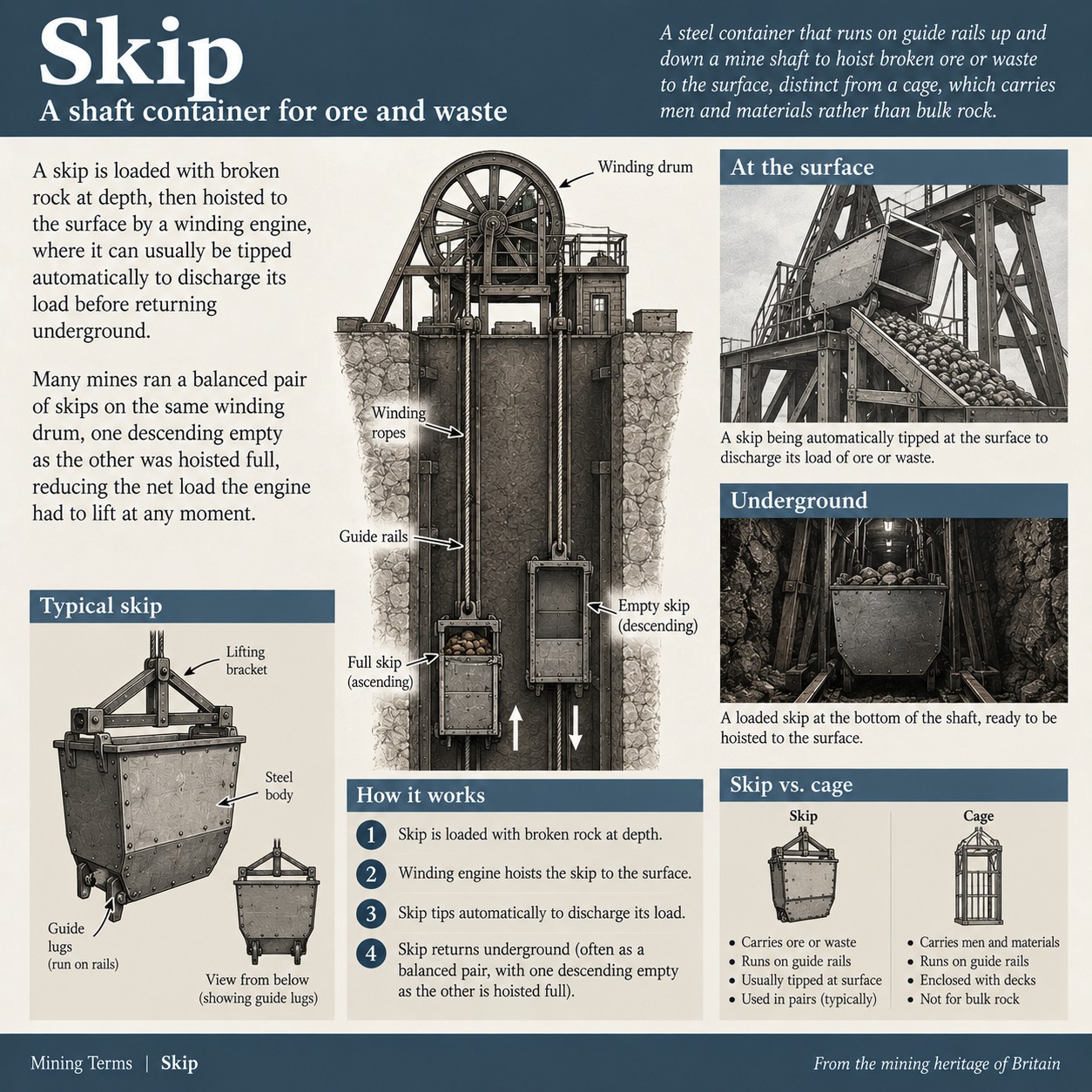
A steel container that runs on guide rails up and down a mine shaft to hoist broken ore or waste to the surface, distinct from a cage, which carries men and materials rather than bulk rock.
Historical usage
Skips became the standard means of shaft haulage as mines mechanised beyond simple kibbles and horse whims, running in fixed guides within the shaft rather than hanging freely on a rope, allowing much higher speeds and loads without swinging or snagging.
How it worked
A skip is loaded with broken rock at depth, then hoisted to the surface by a winding engine, where it can usually be tipped automatically to discharge its load before returning underground; many mines ran a balanced pair of skips on the same winding drum, one descending empty as the other was hoisted full, reducing the net load the engine had to lift at any moment.
Why it was used
A guided skip could be hoisted much faster and more safely than a freely hanging kibble, and its automatic tipping mechanism did away with the manual unloading a kibble or bucket required at the surface, making it far better suited to the continuous, high-volume haulage that larger, deeper 19th- and 20th-century mines needed.
Risks & limitations
A skip's guided rails demanded a straighter, better-engineered shaft than older, less regular workings could always offer, so converting an older mine to skip haulage was itself a significant engineering undertaking, not a simple like-for-like swap.
Regional variation
'Skip' is used across British coal and metal mining alike for this kind of guided ore/waste conveyance, distinguishing it consistently from the 'cage' used to carry men.
Related terminology
Aerial Ropeway, Skip-winding, Winding Engine
Mines associated with this term
5 examples chosen from 27 linked records — the term page is not an index.
- Calverton Colliery — Nottinghamshire (well documented example)
Named in this record’s workings: “…3 in, for men and materials, and No. 2, 20 ft 3 in, winding coal in skips of 10.5 tons, later 12.5. The High Main was reached from the shaft…” - Levant Mine — Cornwall (well documented example)
Named twice in this record, first in the workings: “…and built by Harvey's of Hayle, was installed in 1840 to wind from Skip Shaft at some 400 feet a minute; it remains the only engine of its…” - Littleton Colliery — Staffordshire (well documented example)
Named twice in this record, first in the history: “…Coalfield. Substantially modernised by the National Coal Board with skip winding in the 1960s, it was regularly raising over a million tons…” - Polkemmet Colliery — West Lothian (well documented example)
Named in this record’s history: “…in the mid-1950s replaced steam winding with electric winders and skip winding, and added new preparation, compressor and administration…” - Wheldale Colliery — West Yorkshire (well documented example)
Named twice in this record, first in the history: “…was substantially modernised in 1949: fully electrified, fitted with skip winding and conveyor belts that included, at around a mile long, the…”
Disasters associated with this term
Included only where MineArchive's own research gives a reasonable evidential basis, with the nature of the relationship stated — not every disaster where this term might plausibly apply.
- Cannock Chase Colliery shaft accident, 1868 (contextual relationship)
Named twice in this record, first in the narrative: “…The banksman, John Thompson, felt the weight go off the engine. The skip fell to the bottom, killing five outright. A youth of 16 died soon…” - Pelsall Hall Colliery inundation, 1872 (contextual relationship)
Named in this record’s narrative: “…an archway into the pumping shaft and brought up unconscious. The skip went down into men swimming and clinging to supports, some pulled in…” - Snydale Colliery shaft accident (contextual relationship)
Named twice in this record, first in the narrative: “…and the men wanted the second cage sent down. Two men descended in a skip on a new rope and found the fallen cage wedged between the shaft…”
Sources
- (secondary) Hoist (mining) — Wikipedia
- (secondary) Mining Buckets and Skip Mechanism Explained — Firgelli Automations
Record created: 21 August 2026 · Last researched: 21 August 2026