 MineArchive
Levant Mine
| Location | Trewellard, near St Just, Cornwall — 50.1522, -5.6856 (approximate) |
|---|---|
| Commodities | Arsenic, Tin, Copper |
| Type | Metal |
| Worked | 1787–1930 |
| Maximum depth | 350 fathoms (about 640 m) below adit, reached in 1904 |
| Operators | Levant Mining Company (1820–1930), Levant Tin Mines Limited (1920–1930) |
Overview
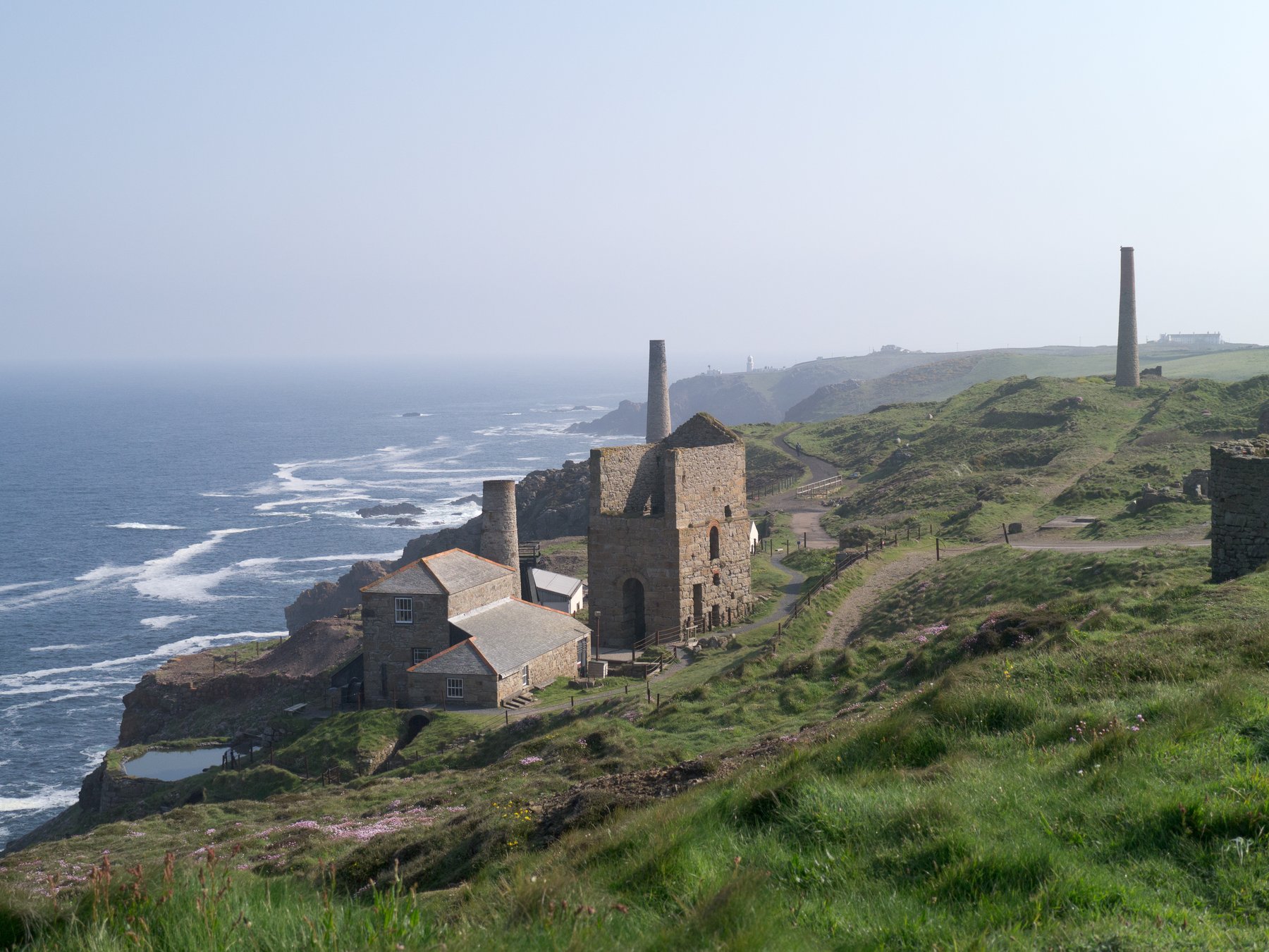
Levant, on Cornwall's Tin Coast, worked tin and copper lodes running out under the sea for over a century. It's remembered today above all for the 1919 man-engine disaster, one of Cornish mining's worst accidents — and for the beam engine that survived it, still the only one of its kind still turning in its original engine house anywhere in the world.
History
Documented mining at Levant dates from April 1787, though the site may have been worked in some form as early as the Roman period. The Levant Mining Company was formally established in 1820 with 20 investors, including the tin smelting-house owner Lewis Charles Daubuz, and the mine grew steadily — by 1836 it employed 320 men, 44 women and 186 children. Copper was the mainstay of the early decades, tin becoming increasingly important after a substantial deposit was struck in the 1830s; over its working life Levant produced in excess of 130,000 tons of copper and 24,000 tons of tin, along with a substantial quantity of arsenic. Workings extended progressively further out beneath the sea as the lodes were followed.
In 1857 a man-engine was installed to carry miners up and down the shaft, saving the punishing climb men had previously faced on foot at the start and end of every shift. On 20 October 1919 the man-engine collapsed down the shaft during a shift change, killing 31 men (see Disasters, below); it was never repaired, and the deepest sections of the mine it served were never worked again. The company was restructured as Levant Tin Mines Limited in 1920 under Colonel F. F. Oats, but Levant finally closed in October 1930, principally on falling tin prices amid the wider economic depression.
Geology
Levant worked tin and copper lodes in the St Just district, in the metamorphic aureole around the Land's End granite and part of the wider Cornwall and West Devon orefield. The lodes are hydrothermal, driven by heat from the cooling granite, and show the district's characteristic zoning: copper dominated the ground the mine first worked, with tin becoming the main product as the lodes were followed further down and outward. The productive ground ran seaward, and the workings followed it more than a mile out beneath the Atlantic.
Geological setting: Hydrothermal Deposits (well documented example), Veins and Lodes (well documented example)
Workings
A 24-inch beam engine, designed by Francis Mitchell and built by Harvey's of Hayle, was installed in 1840 to wind from Skip Shaft at some 400 feet a minute; it remains the only engine of its kind still operating in its original engine house anywhere in the world. The mine was worked through several shafts — Badden to 300 fathoms, Boscregan to 73, and Skip Shaft, later refurbished to the 190 — with the undersea ground reached by two shafts sunk out below the seabed: the Old Submarine Shaft connecting the 210 to the 302 fathom level, and the New Submarine Shaft the 260 to the 350, the deepest level reached in 1904. The 1857 man-engine, a system of reciprocating ladders and stationary platforms, served the shaft until its collapse in 1919.
Closure
The mine closed in October 1930, principally due to falling tin prices during the wider economic depression of the period; the deep sections served by the wrecked man-engine had already been abandoned since the 1919 disaster. Levant's undersea ground was not finished with, however: seawater was found to have broken into the abandoned workings at the 40 fathom level, and it took two attempts through the 1950s before the breach was sealed in the 1960s. Neighbouring Geevor drove an inclined shaft into the Levant ground and reopened it in November 1980, working it until Geevor itself closed.
What remains
The site is managed by the National Trust and forms part of the Cornwall and West Devon Mining Landscape World Heritage Site. The 1840 beam engine was rescued from scrap in 1935 by the Cornish Engines Preservation Committee for £35, restored over decades by volunteers known as the “Greasy Gang”, and returned to steam operation in 1992 — the first time it had run under its own power in 60 years. A January 2023 survey of Cornish headstocks found it still working under steam, the only Cornish engine of its kind doing so.
Surviving structures include the 1840 beam engine and its engine house, along with other mine buildings and ruins typical of the Tin Coast's clifftop mining landscape.
Redevelopment
The beam engine is demonstrated in steam on open days, and the wider site is open to the public as a National Trust property with exhibitions on the mine's history, including the 1919 disaster.
Related mines
- Geevor Tin Mine — Geevor's 1960s underground development broke into Levant's own flooded workings, which had to be sealed before work could continue.
- Higher Levant Mine — Named directly in this record's own scheduling reasoning as having group value through proximity and historic association; absorbed into the Levant Mine sett in 1877.
Nearby mines
- Higher Levant Mine — 0.3 miles (0.5 km) SE
- Geevor Tin Mine — 0.4 miles (0.7 km) E
- Wheal Cock — 0.5 miles (0.8 km) SW
- Wheal Edward — 0.7 miles (1.1 km) S
- Botallack Mine — 0.9 miles (1.4 km) S
Straight-line distance, within 9 miles (15 km). Show on the map.
Disasters & major incidents
-
Levant Mine man-engine disaster
20 October 1919 · Winding / Shaft Accident · 31 fatalities
During a shift change at Levant Mine, a link between the man-engine's reciprocating rod and its surface beam broke, collapsing the engine down the shaft while 130-150 miners were using it.
What's uncertain
Points where sources disagree or the record could not be settled; both accounts are kept. All open questions in the archive.
- Documented mining at Levant dates from April 1787; claims that the site was worked as early as the Roman period (around 200 AD) are not backed by firm evidence. (uncertain) 1
- Over its working life Levant produced in excess of 130,000 tons of copper and 24,000 tons of tin, along with substantial arsenic. (uncertain) 3
- The company was restructured as Levant Tin Mines Limited in 1920 under Colonel F. F. Oats. (uncertain) 3
- Seawater was found to have broken into the abandoned workings at the 40 fathom level; two sealing attempts in the 1950s were needed before the breach was closed in the 1960s. (uncertain) 3
- Geevor reopened Levant's undersea ground in November 1980 by way of an inclined shaft driven at about 25 degrees, working it until Geevor itself closed. (uncertain) 4
Recorded claims
Individual factual claims, each attached to the source(s) that support it below. Where sources disagree, both are kept.
- On 20 October 1919 a link between the man-engine's reciprocating rod and beam broke while 130-150 miners were using it for the shift change; 31 died and many more were injured. The engine was never repaired. 1,2
- Documented mining at Levant dates from April 1787; claims that the site was worked as early as the Roman period (around 200 AD) are not backed by firm evidence. (uncertain) 1
- The mine's 1840 beam engine is the only engine of its kind still operating in its original engine house anywhere in the world. 1
- Levant reached the 350 fathom level in 1904, the New Submarine Shaft connecting the 260 to the 350 fathom level and the Old Submarine Shaft the 210 to the 302. 3
- Over its working life Levant produced in excess of 130,000 tons of copper and 24,000 tons of tin, along with substantial arsenic. (uncertain) 3
- The company was restructured as Levant Tin Mines Limited in 1920 under Colonel F. F. Oats. (uncertain) 3
- Seawater was found to have broken into the abandoned workings at the 40 fathom level; two sealing attempts in the 1950s were needed before the breach was closed in the 1960s. (uncertain) 3
- Geevor reopened Levant's undersea ground in November 1980 by way of an inclined shaft driven at about 25 degrees, working it until Geevor itself closed. (uncertain) 4
- BGS holds a publicly scanned Levant Mine lode map, alongside plans of the Levant North Lode and of the combined Geevor-Levant-Botallack group of mines. 5
Photographs & further reading
The site's owner and manager, with visiting information and steam demonstration days for the beam engine.
View sourceCatalogue entry for the scanned lode map held by the British Geological Survey.
View sourceShaft-by-shaft account of the workings, including the two submarine shafts and lifetime output.
View sourceAround 280 further freely-licensed photographs of the engine houses and clifftop mine buildings.
View sourceSources
- (secondary) History of Levant Mine and Beam Engine — National Trust
- (secondary) Accident at Levant Tin Mine 1919 — Northern Mine Research Society
- (secondary) Levant Mine, Cornwall — Cornwall Calling
- (observational) Deep Mine Headstocks, Part 2: Wales & Cornwall, 2022-23 — 28DaysLater
- (primary) BGS mine plans catalogue: Levant Mine lode map (record 24037) — British Geological Survey
Record created: 19 August 2026 · Last researched: 25 August 2026