 MineArchive
Ladders
| Category | Mine Workings & Access |
|---|
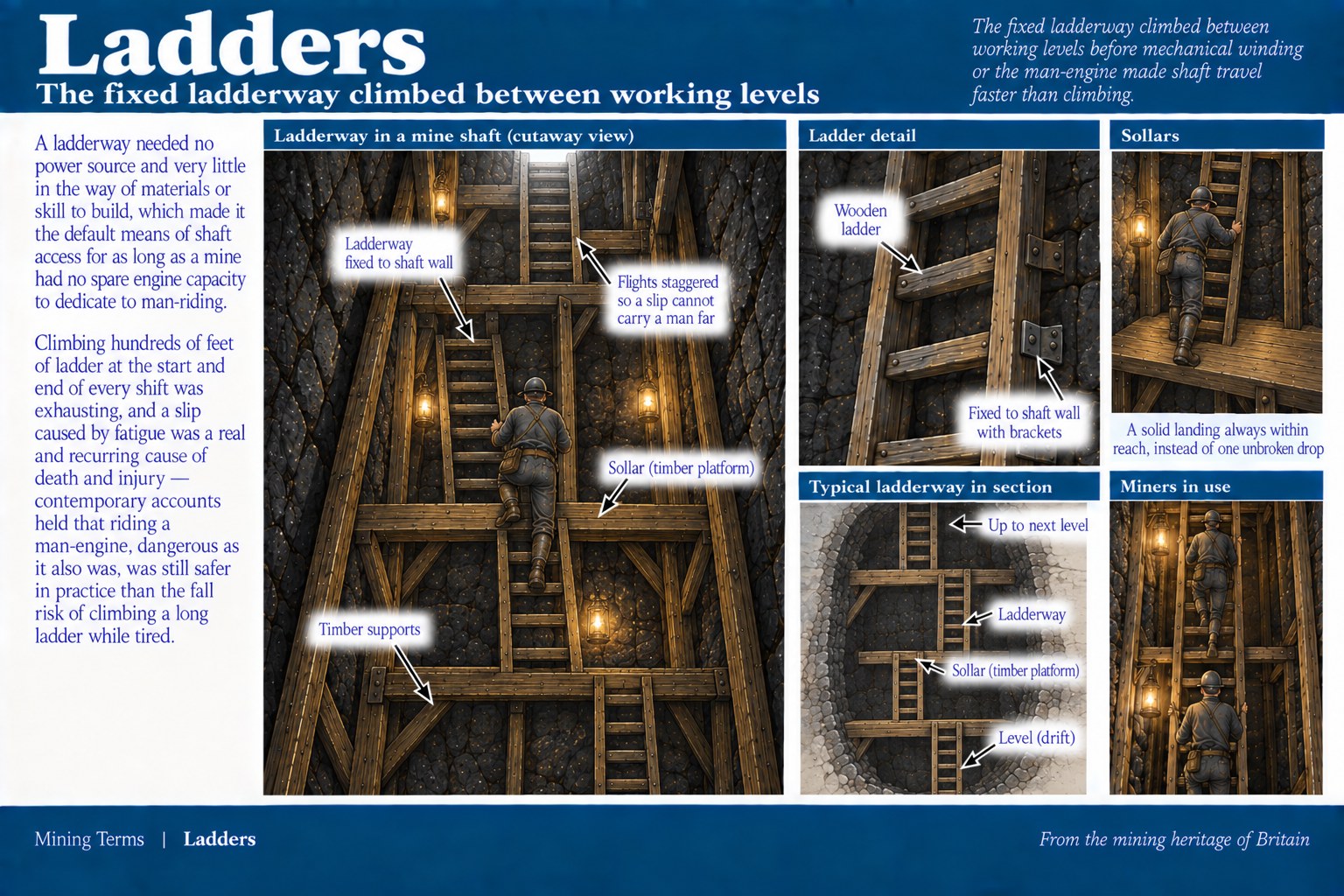
The fixed ladderway climbed between working levels before mechanical winding or the man-engine made shaft travel faster than climbing.
Historical usage
Before steam winding and man-engines became widespread, a ladderway was the only way in or out of most mines for the men themselves (as distinct from ore or coal, which was often wound separately even in an otherwise ladder-only mine). Early ladderways were built entirely of timber; deeper and longer-lived mines later fitted iron or steel ladders and rungs where timber wore out too quickly under constant traffic. The physical toll of climbing was severe enough to shape mining history directly: before the man-engine was installed at Tresavean Mine, Gwennap, in 1842, it could take Cornish miners more than an hour just to climb down to the working level, on top of a full shift's labour once they got there. That toll is exactly what the man-engine (see Man-engine) was built to remove, and its rapid adoption across Cornwall's deep tin and copper mines through the rest of the 19th century reflects how urgently a mechanised alternative to ladder-climbing was wanted.
How it worked
A shaft's ladderway ran in short flights between sollars -- horizontal timber platforms set at intervals down the shaft -- rather than as one continuous run, so a climber always had a solid landing within reach rather than an unbroken drop. Successive flights were commonly staggered or offset from each other rather than stacked directly in line, limiting how far a slip on one ladder could carry a falling man.
Why it was used
A ladderway needed no power source and very little in the way of materials or skill to build, which made it the default means of shaft access for as long as a mine had no spare engine capacity to dedicate to man-riding.
Risks & limitations
Climbing hundreds of feet of ladder at the start and end of every shift was exhausting, and a slip caused by fatigue was a real and recurring cause of death and injury -- contemporary accounts held that riding a man-engine, dangerous as it also was, was still safer in practice than the fall risk of climbing a long ladder while tired.
Related terminology
Mines associated with this term
5 examples chosen from 17 linked records — the term page is not an index.
- Dolaucothi Gold Mines — Carmarthenshire (well documented example)
Named twice in this record, first in the history: “…Ltd developed the site further in the 1930s, uncovering Roman wooden ladders, scaffolding and a drainage wheel in the process, and a small…” - Snake Mine — Derbyshire (well documented example)
Named in this record’s history: “…from the climbing route he had used prior to the 1930s; chain ladders still in position at the time were removed to allow a safe descent,…” - Banks Slate Quarry, Chapel Stile — Cumbria (well documented example)
Named in this record’s workings: “Underground slate chambers, one thirty feet high in 1905, reached by ladders; blocks shot down and filled from behind pillars. Employment: 8 in…” - Brownley Hill Mine — Cumbria (well documented example)
Named in this record’s current condition: “…with rusting pipework and deteriorating wooden supports and ladders; the connection through to the neighbouring Nentsberry Haggs Mine…” - Cligga Head — Cornwall (well documented example)
Named in this record’s current condition: “…receding. A 2024 account of a guided descent made in 2010 describes ladders and tight passages underground and a surviving Cousin Jack chute,…”
Disasters associated with this term
5 examples chosen from 9 linked records, most direct relationship first.
- Diglake Colliery Inrush, 1895 (contextual relationship)
Named in this record’s narrative: “…was swept twenty yards and saved himself on a post, climbed the ladders of an air shaft against the flow and lost consciousness at the top,…” - Glyncorrwg Colliery Explosion (contextual relationship)
Named in this record’s rescue and recovery: “…in the return — the last requiring every sack to be carried down two ladders in a steep drift and a further 90 yards. A mobile laboratory…” - Leycett Colliery explosion, 1880 (contextual relationship)
Named in this record’s narrative: “…descend, and even then the cage would not go the full depth and ladders were used. Samuel Lawton, manager of the neighbouring Harrison and…” - Long Grass Quarry cliff fall, Tintagel, 1886 (contextual relationship)
Named twice in this record, first in the contributing factors: “The faces were reached by flights of wooden ladders down a sheer cliff above the sea, with iron handrails, chains and…” - Middle Duffryn Colliery Explosion, 1852 (contextual relationship)
Named in this record’s narrative: “…mouth told the men above what had happened. Shipley went down the ladders of the descending shaft as fast as he could, met men climbing out,…”
Sources
- (secondary) Man engine — Wikipedia
- (secondary) Man-engine or movable ladder adopted in Cornish mines — Alamy (historic print, contemporary caption)
Record created: 29 August 2026 · Last researched: 30 August 2026