 MineArchive
Glyncorrwg Colliery Explosion
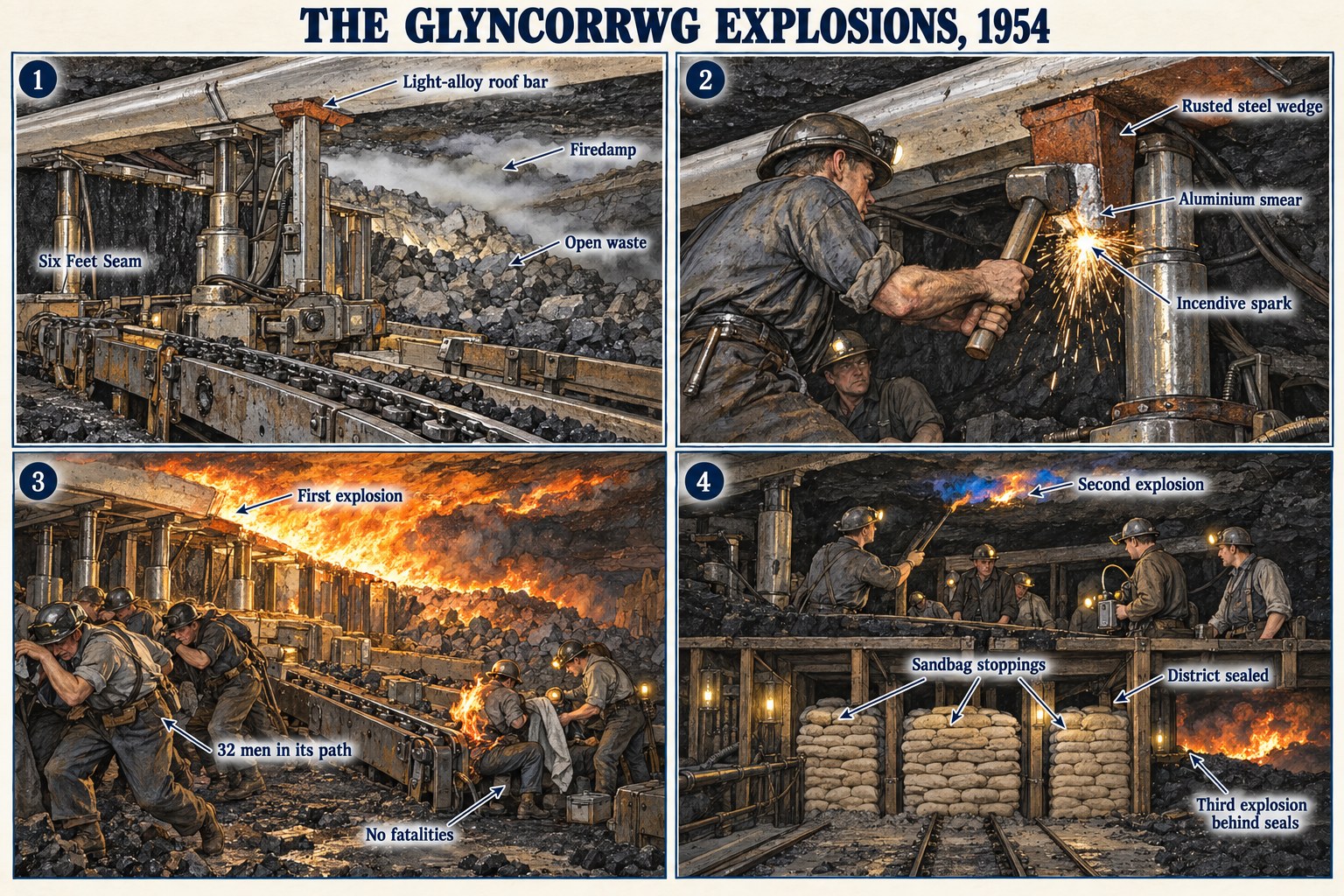
On the morning of 13 January 1954 an explosion ran along the Panzer Face in the Six Feet Seam at Glyncorrwg Colliery. Of the 32 men in its path, 17 were severely burned and seven slightly; eight escaped unhurt and nobody was killed. A second explosion followed before noon the same day, and a third within the sealed district on 16-17 January. The official inquiry traced the ignition to a light-alloy roof bar: its rusted steel wedge had become smeared with aluminium in ordinary use, and when a collier struck it with a sledgehammer the resulting spark fired the methane. The Inspector recommended that light-alloy bars be prohibited on longwall faces with open wastes where inflammable gas was likely.
| Date | 13 January 1954 |
|---|---|
| Mine | Glyncorrwg Colliery |
| Region | Neath Port Talbot |
| Primary type | Explosion |
| Associated types | Gas / Asphyxiation |
| Fatalities | 0 (No one was killed: the Inspector records that in no case did the injuries prove fatal. Of the 32 people in the path of the explosion, 17 sustained severe burns, seven slight burns and eight were uninjured.) |
| Injuries | 24 |
| Context | During active mining (The colliery was in normal working.) |
Cause
Incendive sparking from a light-alloy (Schloms) roof bar. Rust-coated steel wedges on the bars had become smeared with aluminium in normal use, producing a surface that threw sparks when struck by steel and readily ignited methane.
Contributing factors
Firedamp accumulating in the open wastes behind the longwall face, and an insufficient number of firedamp detectors on the face to comply with the Coal Mines General Regulations (Firedamp Detectors), 1939 — only three of the face workers carried flame safety lamps as detectors.
What happened
The explosion ran partly along the face and partly inside the waste edge, which is why several men within its limits were untouched while others close by were badly burned — of three men together in front of No. 8 waste, two were severely burned and the third only singed. Overman G. Thomas, examining No. 6 pack between two steel chocks, heard a thud and shouting and saw flame travel past him towards the loading gate and back towards the return; men came running down the face with their clothing on fire. He saw them off the face, telephoned for help and organised first aid. Before noon a second exploring party including the agent, the manager, H.M. District Inspector and the superintendent of the Brynmenin Rescue Station reached No. 7 waste and found gas burning near the roof; while they considered how to put it out a rumbling noise was followed by flame issuing from several wastes. No one was hurt, but the district was sealed. A third explosion occurred inside the seals on 16-17 January.
Rescue & recovery
The district was sealed with three sandbag stoppings, one in each intake roadway and one in the return — the last requiring every sack to be carried down two ladders in a steep drift and a further 90 yards. A mobile laboratory monitored the atmosphere behind the seals until it went extinctive, and the stoppings were broached at about 5 a.m. on 22 January. The Inspector singled out the treatment of the injured, who received plasma infusions throughout the journey out, as 'a truly remarkable feat of first-aid, medical attention and plastic surgery', comparing it with the Bedwas Colliery explosion of October 1952.
Investigation & inquiry
A formal investigation was held under Section 82 of the Coal Mines Act 1911, and T. A. Jones O.B.E., H.M. Divisional Inspector of Mines, reported to the Minister of Fuel and Power in March 1955; the report was presented to Parliament in August 1955 as Cmd. 9553. Every other possible means of ignition was examined and ruled out. Officers of the Safety in Mines Research Establishment tested Schloms bars from the face at Buxton and proved that the rusted wedges, smeared with aluminium in normal use, gave off sparks when struck by steel that readily ignited methane. The evidence of Lewis, Griffiths and Owen, once they had recovered enough to give it, pointed conclusively to sparking at the wedge of the bar in front of No. 8 pack when Lewis struck it with a sledgehammer. The alloy was found to be 93.64 per cent aluminium, 0.61 per cent silicon and 0.59 per cent magnesium.
Changes to practice & legislation
The Inspector recommended that the use of light-alloy bars be prohibited on all longwall faces with open wastes unless it was known that inflammable gas was unlikely to occur in them, and that effective steps be taken to prevent firedamp accumulating in wastes behind the face or escaping dangerously from them. The second recommendation was already addressed by the Mines and Quarries Act 1954. Testing at Buxton showed the sparking hazard was not confined to friction at the wedge: incendive sparks could also be struck from the edge or flat side of a bar against rusted steel, or by a glancing blow from a light hammer on rusted steel already smeared with aluminium.
What's uncertain
Points where sources disagree or the record could not be settled; both accounts are kept. All open questions in the archive.
- The Welsh Coal Mines account states that after this explosion 'the use of aluminium at the coalface was prohibited'. The Inspector's actual recommendation was narrower: that light-alloy bars be prohibited on longwall faces with open wastes unless inflammable gas was known to be unlikely there. (disputed)
Recorded claims
Individual factual claims, each attached to the source(s) that support it below. Where sources disagree, both are kept.
- The ignition source was attributed to the impact of aluminium on rusty steel, and following the explosion the use of aluminium at the coalface was prohibited.
- Twenty-four men were burned, seventeen seriously. No fatalities are recorded.
- There were three explosions: the first on the morning of 13 January 1954, a second before noon the same day, and a third inside the sealed district on 16-17 January.
- The Welsh Coal Mines account states that after this explosion 'the use of aluminium at the coalface was prohibited'. The Inspector's actual recommendation was narrower: that light-alloy bars be prohibited on longwall faces with open wastes unless inflammable gas was known to be unlikely there. (disputed)
Related terminology
Mining terms this disaster is structurally linked to, with the nature of the relationship.
- Coal Mines Act 1911 (contextual relationship)
Named in this record’s investigation: “A formal investigation was held under Section 82 of the Coal Mines Act 1911, and T. A. Jones O.B.E., H.M. Divisional Inspector of Mines,…” - Ladders (contextual relationship)
Named in this record’s rescue and recovery: “…in the return — the last requiring every sack to be carried down two ladders in a steep drift and a further 90 yards. A mobile laboratory…” - Longwall (contextual relationship)
Named 3 times in this record, first in the summary: “…The Inspector recommended that light-alloy bars be prohibited on longwall faces with open wastes where inflammable gas was likely.” - Powered Roof Supports (contextual relationship)
Named in this record’s narrative: “…singed. Overman G. Thomas, examining No. 6 pack between two steel chocks, heard a thud and shouting and saw flame travel past him towards the…” - Stopping (contextual relationship)
Named twice in this record, first in the rescue and recovery: “The district was sealed with three sandbag stoppings, one in each intake roadway and one in the return — the last…”
Photographs & further reading
This page doesn't try to reproduce everything — these are the best original sources found for this disaster.
The Inspector's full report on the explosion — the Panzer Face and its ventilation, the three explosions, the sealing and reopening of the district, the Buxton spark tests that identified the light-alloy bars, and the recommendations that followed.
View sourceSources
- (primary) Jones, T. A. (1955). Explosion at Glyncorrwg Colliery, Glamorganshire: report on the causes of, and circumstances attending, the explosion which occurred on 13th January 1954. Ministry of Fuel and Power, Cmd. 9553. HMSO — H.M. Divisional Inspector of Mines, via Edinburgh Research Archive
- (secondary) Glyncorrwg Colliery — Welsh Coal Mines
Record created: 4 September 2026 · Last researched: 4 September 2026