 MineArchive
Longwall
| Category | Mine Workings & Access |
|---|
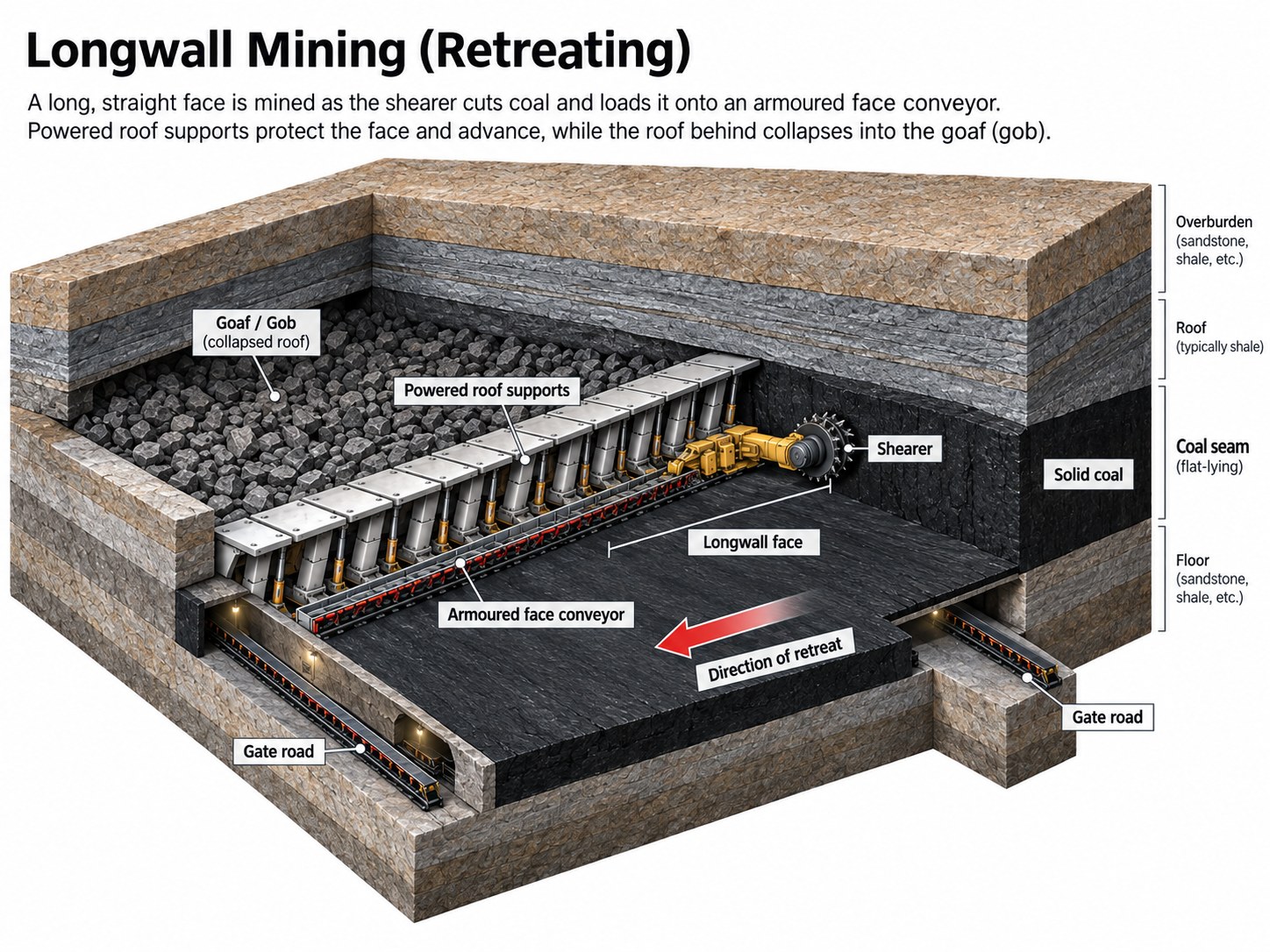
A method of working a coal (or other flat-lying) seam in which a long, straight face is advanced or retreated across a panel of ground, with the entire seam extracted along that face and the roof behind it allowed to collapse or be deliberately packed with waste.
Historical usage
Longwall working originated in Shropshire in the late 17th century and spread gradually across British coalfields over the following two centuries, worked entirely by hand with pick and shovel until the 20th century. From the 1950s and 1960s onward it became fully mechanised, with power-driven coal cutters and shearers working the face and self-advancing hydraulic roof supports following behind them, and it remained the dominant method of British deep coal mining through to the end of large-scale deep mining in the 1990s and 2000s.
How it worked
A face, typically tens to a couple of hundred metres long, is worked along its full length: in the 'advancing' variant, work starts near the shaft and proceeds outward toward the panel boundary; in the 'retreating' variant, access roadways are driven out to the boundary first and the face is then worked back toward the shaft. As coal is cut away, temporary roof supports along the face are advanced forward, and the roof over the worked-out area behind — the goaf, or gob — is left to collapse naturally, or is packed with stone or waste to control subsidence and contain the void.
Why it was used
Working the full width of a seam along one continuous face, rather than leaving unworked pillars as in room-and-pillar mining, allowed a far higher proportion of the coal to be recovered and lent itself readily to mechanisation, since cutting machinery and roof supports could advance along a single straight line rather than around a irregular network of pillars and roadways.
Risks & limitations
The goaf left behind a longwall face is where much of the method's real danger lies: if the roof does not collapse and seal as expected, firedamp can accumulate undetected in cavities within the waste, later being released suddenly by further roof movement — the specific mechanism identified in the 1951 Easington Colliery disaster, where gas built up in unfilled roof cavities behind a retreating face. HM Inspector of Mines Joseph Dickenson also attributed part of the blame for the 1866 Oaks Colliery disaster to the longwall method then in use.
Regional variation
Longwall working largely displaced the bord-and-pillar (or room-and-pillar) method that had dominated earlier British coal mining, particularly in the Midlands and parts of Wales; Scotland's older 'stoop and room' working followed a broadly similar pillar-based logic before longwall spread there too.
Related terminology
Gate Road, Power Loading, Powered Roof Supports, Retreat Mining, Ripping, Shearer, Shot-firing, Stall
Mines associated with this term
5 examples chosen from 76 linked records — the term page is not an index.
- Cronton Colliery — Merseyside (well documented example)
Cronton pioneered retreat longwall working — driving roadways to the panel boundary before extracting coal as the face retreats — at a British colliery in 1966. - Hyde Colliery — Greater Manchester (well documented example)
Named twice in this record, first in the history: “…below that; by 1889 attention had turned to the Black Mine, worked longwall, its coal brought to the engine brow by endless rope haulage and…” - Lletty Shenkin Colliery — Rhondda Cynon Taf (well documented example)
Named in this record’s workings: “…they could earn twice as much by candlelight. Later working was by longwall, with the roof at the face carried on timber and the mines…” - Trimdon Grange Colliery — County Durham (well documented example)
Named in this record’s workings: “…part of the downcast for Trimdon Grange. The Harvey seam was worked longwall by 1882, with the Pit Narrow Board district on the northern edge of…” - Wistow Mine — North Yorkshire (well documented example)
Named in this record’s geology: “…the seam itself: a Permian aquifer over the Coal Measures. Where longwall faces retreat, the roof is expected to cave and consolidate; here…”
Disasters associated with this term
5 examples chosen from 22 linked records, most direct relationship first.
- Easington Colliery explosion, 1951 (direct cause)
The official inquiry found firedamp had accumulated in cavities behind a retreating longwall coalface where the roof failed to collapse and seal as intended. - Oaks Colliery explosion, 1866 (contributing factor)
HM Inspector Joseph Dickenson attributed the disaster in part to the longwall mining method used on the Barnsley Seam. - William Pit Explosion (relevant method/equipment)
The explosion originated in shot-firing in the waste at the No. 2 Dip longwall face. - Abram Colliery explosion, 1881 (contextual relationship)
Named in this record’s narrative: “…shafts; the Lower Arley was deeper still. Both were worked longwall, with locked safety lamps and blasting forbidden; a 46-foot Guibal…” - Cardowan Colliery explosion, 1960 (contextual relationship)
No. 4 East was a double-unit longwall conveyor face.
Sources
- (secondary) Brief History of Longwall Coal Mining in Illinois — Illinois State Geological Survey
- (secondary) Longwall Mining - History and Methods — Mining Science and Technology
Record created: 23 August 2026 · Last researched: 23 August 2026