 MineArchive
Retreat Mining
| Category | Mine Workings & Access |
|---|
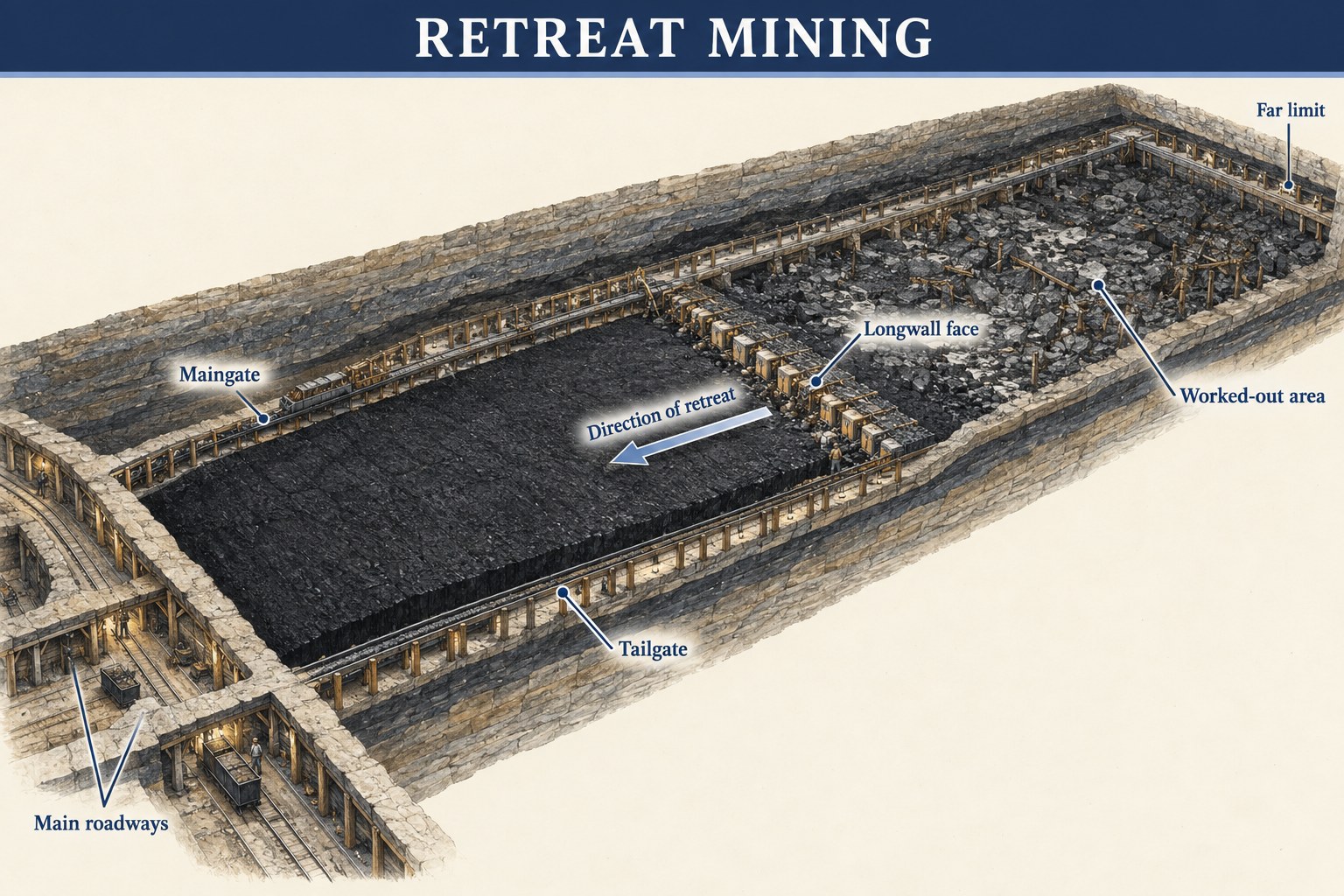
Working a seam or panel back toward the mine entrance or main roadways, after the roadways needed to define the panel have already been driven out to its far limit; contrasted with advancing, in which development and extraction proceed together, moving away from the entrance.
Historical usage
Recorded at Cefn Parc Arlais Colliery, Bryn, where by the mid-1970s a conveyor-equipped coalface 45 yards long was worked to the retreat.
How it worked
In longwall mining, the roadways bounding a panel (the gateroads either side of the face) are driven out first, on the advance, to the panel's far limit and connected there; only then does face extraction begin, working back from that far end toward the entrance the roadways were driven from. In room-and-pillar mining, the equivalent retreat phase is the deliberate removal, or 'pulling', of the pillars left to support the roof during the advance, again worked back toward the entrance.
Why it was used
Retreat working lets the whole panel be surveyed, ventilated and, in room-and-pillar mining, have its pillars sized correctly before extraction starts, and avoids extracting past ground whose roof has not yet been proved; its price is a longer lead time between development and first production than advancing, where coal comes out as the roadways themselves are driven.
Risks & limitations
In room-and-pillar mining particularly, pulling pillars on the retreat is dangerous: nothing is left to support the roof and overburden once a pillar is removed. The U.S. Mine Safety and Health Administration attributes about a quarter of American coal-mining deaths from roof or wall failure to pillar-recovery retreat mining, despite it accounting for only about a tenth of coal output; six miners were killed in the 2007 Crandall Canyon Mine collapse during retreat pillar extraction.
Related terminology
Mines associated with this term
Included only where MineArchive's own research gives a reasonable evidential basis — not every mine where this might plausibly apply.
- Abernant Colliery — Neath Port Talbot (well documented example)
Named in this record’s summary: “…shallower Red Vein, peaked at over 1,000 men around 1970, pioneered retreat mining in the coalfield and closed in March 1988.” - Cronton Colliery — Merseyside (well documented example)
Named 3 times in this record, first in the summary: “…to Cunard and other Mersey shipping lines, remembered for pioneering retreat mining at a British colliery and for a fatal explosion in 1917. The site is…” - Cefn Parc Arlais Colliery — Neath Port Talbot (well documented example)
The colliery's own working method by the mid-1970s ('worked to the retreat'); automated sweep missed it since the mine's own prose never pairs 'retreat' with 'mining' as an exact phrase. - Comrie Colliery — Fife (well documented example)
Named 3 times in this record, first in the history: “…workforce from 660 to 530 and the shifts from three to two, opened a retreat-mining face in the two-foot seam and closed the rail link, sending the coal…”
Sources
- (secondary) 10.4.2c Longwall Mining (MNG 230: An Introduction to Mining Engineering) — Penn State University, Department of Energy and Mineral Engineering
- (secondary) Retreat mining — Wikipedia
- (secondary) West Glamorgan Small Mines (Welsh Coal Mines) — Welsh Coal Mines
Record created: 14 September 2026 · Last researched: 14 September 2026