 MineArchive
Abernant Colliery
| Location | Pwllfawatkin, between Pontardawe and Gwaun-cae-Gurwen, Neath Port Talbot — 51.7592, -3.8828 (approximate) |
|---|---|
| Commodity | Coal |
| Type | Coal |
| Worked | Sunk 1954-1958–26 March 1988 |
| Maximum depth | 987 yards (No. 2 or South shaft); North shaft 836-837 yards |
| Operators | National Coal Board (1954–1987), British Coal Corporation (1987–1988) |
Overview
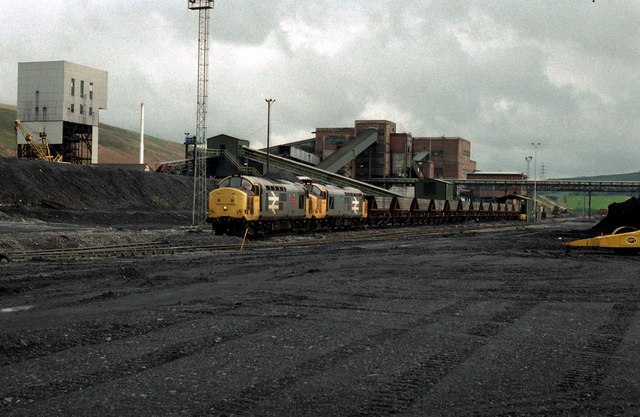
One of the National Coal Board's two West Wales anthracite 'super pits', sunk from 1954 at Pwllfawatkin between Pontardawe and Gwaun-cae-Gurwen with the deepest shafts in the South Wales Coalfield. Planned for 2,000 men working the Peacock seam, it ended up living on the shallower Red Vein, peaked at over 1,000 men around 1970, pioneered retreat mining in the coalfield and closed in March 1988.
History
Amalgamated Anthracite Collieries put down exploratory boreholes here in 1926-28, but the depression stopped any further work. In the 1950s the anthracite district was losing money heavily, until the Clean Air Act and the spread of central heating created a new demand for smokeless Welsh anthracite. The National Coal Board decided to sink two new super pits, Cynheidre and Abernant, at a cost of £10 million, and hoped Abernant would win back the pre-war trade of a million tons a year with Canada. The South pit was begun on 8 January 1954 and the North pit on 25 January; sinking was finished in 1958. The North (upcast) shaft reached 836 or 837 yards and the South (downcast) 987 yards, the deepest in the coalfield. The plan was to work the Peacock and other deep seams from horizons at 692 and 792 yards and eventually employ 2,000 men, drawn from the closing Cwmgorse, West, Steer and Cwmllynfell collieries. Pressure at 2,378 feet wrecked the roadways near the pit bottom, and the Peacock was abandoned in 1963; from 1962 the colliery turned to the 57-inch Red Vein, much higher in the shafts, which proved to be its only workable seam. Working every face on the retreat method, it was the pioneer of that system in South Wales. Manpower rose from 76 on development in 1960 to 1,085 in 1970, and in the 1970s about 900 men raised some 300,000 tons a year. In 1968 men transferred from the closed Yniscedwyn Colliery, used to slants, refused to go down a shaft; in 1970 the NCB spent a further £4.5 million on a smokeless fuel plant. By 1983 the pit was losing £16.20 on every tonne. It lost a face during the 1984-85 strike, when strike-breakers took out a High Court injunction against the lodge officials, and faults on its other faces kept output to about half of what was expected. In July 1985 the NCB offered £4 million for a drift to the Four-Feet seam in return for closing the southern workings. British Coal announced closure early in 1988, together with the Wernos washery; about 800 men were affected, and the men set aside their decision to fight it because the £5,000 severance offer would lapse after March. Abernant closed on 26 March 1988, and its 100-foot winding towers were demolished on 10 June 1995.
Geology
Worked the Red Vein, 57 inches thick, from 1962; the deeper Peacock seam was tried and abandoned in 1963. The NCB had estimated 134 million tons in 16 seams, including the Big, Black, Peacock, Brynlloi, Middle and Lower veins. The take was bounded east by the Gardner's Fault, which dropped the coal 1,100 feet, and west by the Duffryn Fault.
Geological setting: Sedimentary Beds and Seams (well documented example)
Workings
Two 24-foot shafts, the North (upcast, 836-837 yards) and South (downcast, 987 yards), with insets at 692 and 792 yards, electrically wound by 1,500 hp and 2,000 hp engines. The workings covered about 8 square miles, with 44 miles of roads and 10 miles of conveyors by 1980, all faces worked on the retreat method. The colliery had its own coal preparation plant and, from 1970, a smokeless fuel plant; coal left by the Amman Valley branch railway.
Closure
Closed by British Coal on 26 March 1988 on the grounds of physical conditions in the pit. It had been losing £16.20 a tonne in 1983, lost a face during the 1984-85 strike and was troubled by geological faults. The Neath MP raised the closure, and that of the Wernos washery, in the Commons in February 1988.
What remains
The winding towers were demolished in 1995 and a photographer who revisited in 2008 reported the site razed and the railway removed.
Unknown.
Redevelopment
In 2011 Waste Recycling Group submitted plans for an anaerobic digestion plant on the former colliery site; whether it was built has not been checked.
Nearby mines
- Cwmgorse Colliery — 2.5 km N
- Gwaun Cae Gurwen Colliery — 3.6 km N
- Cawdor Colliery — 4.1 km NW, Carmarthenshire
- Gwyn's Colliery — 4.3 km SE
- Boundary Level — 4.7 km SE
Straight-line distance, within 15 km. Show on the map.
Recorded claims
Individual factual claims, each attached to the source(s) that support it below. Where sources disagree, both are kept.
- Abernant and Cynheidre were sunk by the NCB as anthracite super pits at a cost of £10 million; the South pit was started on 8 January 1954, the North on 25 January 1954, and sinking completed in 1958. 1,2,3
- The North (upcast) shaft was 836 yards deep according to NMRS and 837 yards according to Welsh Coal Mines and Wikipedia; the South (downcast) was 987 yards; both were 24 feet in diameter. 1,2,3
- The Peacock seam was worked first but pressure damaged the roadways and it was abandoned in 1963; from 1962 production concentrated on the Red Vein. 1,2,3
- Abernant was one of the first NCB pits, and the pioneer in South Wales, to work all its faces by retreat mining. 1,2,3
- During the 1970s about 900 men produced an average of 300,000 tons a year from the Red Vein, over some 8 square miles and 40-plus miles of roadway. 2,3
- Manpower: 76 (1960), 259 (1961), 845 (1965), 942 (1969), 1,085 (1970), 1,007 (1972, 365,000 tons), 1,080 (1974), 916 (1979), 883 (1980, 203,942 tons), 845 (1985), 1,007 (1987). 1
- In 1983 the NCB reported the colliery was losing £16.20 per tonne, with 835 men. 1
- In February 1988 British Coal announced the closure of Abernant and the Wernos washery, affecting about 800 men; the Neath MP Donald Coleman raised it in an adjournment debate on 18 February 1988. 4
- The colliery closed on 26 March 1988 and its winding towers were demolished on 10 June 1995. 1
- In September 2011 Waste Recycling Group submitted plans for an anaerobic digestion facility on the old colliery site. (uncertain) 3
- Mining Remediation Authority catalogue lists plans under ABERNANT COLLIERY, including tip plan SWT3859 (spoil tip no. 276, dated 1968). (uncertain) 5
Photographs & further reading
Detailed history from Ray Lawrence: planning, sinking, shafts, seams, manpower and output year by year, and closure.
View sourceThe Commons adjournment debate on British Coal's decision to close the colliery and the Wernos washery.
View sourceShort history with a 1987 photograph of the colliery.
View sourceSources
- (secondary) Abernant Colliery — Northern Mine Research Society (Ray Lawrence)
- (secondary) Abernant Colliery Pontardawe — Welsh Coal Mines
- (secondary) Abernant Colliery — Wikipedia
- (primary) Abernant Colliery, HC Deb 18 February 1988 vol 127 cc1253-8 — Hansard (UK Parliament)
- (primary) BGS / Mining Remediation Authority mine plans: ABERNANT COLLIERY — British Geological Survey / Mining Remediation Authority
Record created: 16 September 2026 · Last researched: 16 September 2026