 MineArchive
Spontaneous Combustion
| Also known as | Spontaneous heating (The stage before ignition), Gob fire (Colliery usage), Heating (What a developing case was called underground) |
|---|---|
| Category | Ground Conditions & Hazards |
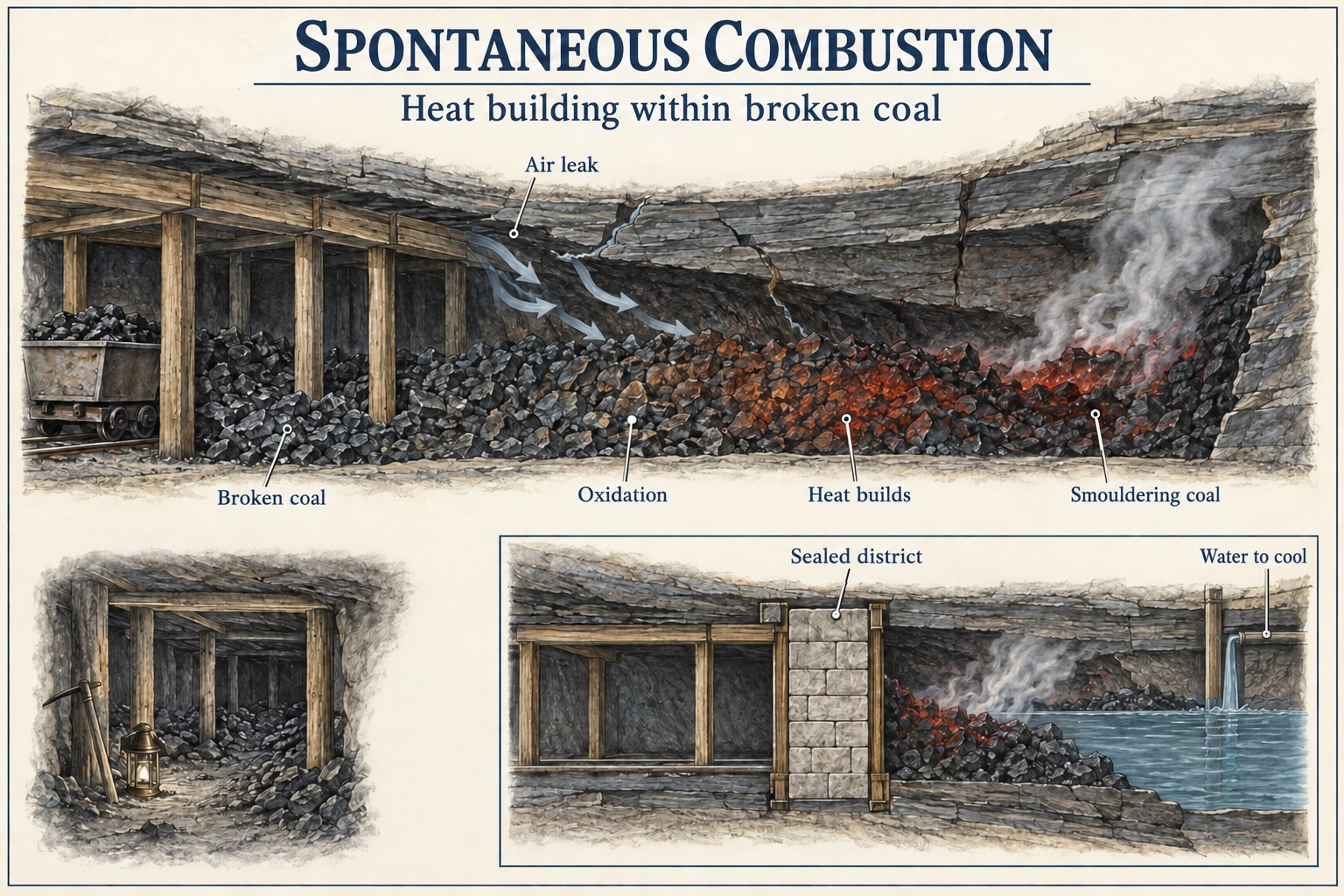
Coal catching fire underground with nothing to light it. Broken coal left in the waste reacts slowly with oxygen in the air, giving out heat; where the ventilation is too weak to carry that heat away but strong enough to keep feeding oxygen in, the temperature climbs until the coal ignites itself.
Historical usage
Some coals are far more liable to it than others, and a colliery that had the problem had it for its whole working life. Brora, on the Sutherland coast, worked a Jurassic seam contaminated with iron pyrites and suffered fires repeatedly across four centuries of working — the last of them closing the Ross Pit for good in May 1969. Argyll Colliery at Machrihanish lost its Slope Dook to a heating in September 1958, and the pit at Trodigal that preceded it had been abandoned in 1925 after a fire in the seam. Daw Mill in Warwickshire, the last deep mine in the Midlands, was destroyed by an underground fire in 2013.
How it worked
The reaction is slow oxidation: coal at ordinary temperatures takes up oxygen and releases heat. Ordinarily the ventilation carries that heat away and nothing happens. The danger comes where air leaks slowly into broken coal left behind in the goaf, or into a crushed pillar or a spoil heap — enough oxygen to sustain the reaction, not enough movement to cool it. The mass self-heats over a period known in the industry as the incubation period, which is why panels were sized so that the coal could be got out before a heating could develop. Iron pyrites in the coal makes it markedly worse. The first sign is usually not flame but smell and gas — the characteristic 'gob stink' and rising carbon monoxide readings — and the standard remedy is to shut off the air: build seals around the district and, if necessary, flood it.
Risks & limitations
The response is what makes it so costly: sealing a district means abandoning the coal in it, and the seals may have to stay in for months. Brora's 1969 fire and Machrihanish's 1958 heating both ended in flooding the affected ground, and at Machrihanish the fire lay higher than the working places, so four seals had to be built before water could be put in at all. A heating can also fill workings with carbon monoxide long before anything is visibly alight, which is what makes it dangerous to people rather than merely expensive.
Regional variation
Called a 'heating' or a 'gob fire' in the British coalfields, the latter after the goaf where it usually starts; 'spontaneous heating' is the technical term for the stage before ignition.
Related terminology
Barricading, Coal, Goaf, Pyrite, Spoil Heap, Whitedamp
Mines associated with this term
5 examples chosen from 31 linked records — the term page is not an index.
- Abernant Colliery — Neath Port Talbot (well documented example)
Named in this record’s history: “…money heavily, until the Clean Air Act and the spread of central heating created a new demand for smokeless Welsh anthracite. The National…” - Frances Colliery — Fife (well documented example)
Named twice in this record, first in the history: “…on 10 February 1984. At the height of the strike, fires caused by spontaneous combustion broke out in the D51 workings, destroying the colliery's only…” - Minnie Pit — Staffordshire (well documented example)
The Bullhurst was liable to spontaneous combustion, worked in sealed panels with a gob-stink examiner; the 1898 and 1915 explosions were attributed to gob fires. - Polkemmet Colliery — West Lothian (well documented example)
Named in this record’s history: “…of flooding'; the colliery formally closed in 1986. Afterward, spontaneous combustion in the spoil bing produced fumes 'instantly recognisable to regular…” - Ackton Hall Colliery — West Yorkshire (well documented example)
Named twice in this record, first in the history: “…miners' strike of 1984-85 proved fatal to the pit's future: spontaneous combustion took hold in the Barnsley Bed seam during the stoppage, and Ackton…”
Disasters associated with this term
5 examples chosen from 23 linked records, most direct relationship first.
- Cardowan Colliery explosion, 1960 (direct cause)
Half-burned coal reheated in fresh air. - Cwrt Herbert Colliery explosion, 1906 (direct cause)
The colliery was prone to gob fires. - Leycett Colliery explosion, 1883 (hazard involved)
The men were sealing off a fire in the gob. - Agecroft Colliery fire suffocations, 1891 (contextual relationship)
Named twice in this record, first in the cause: “…while sealing off a fire in the mine, thought to have started by spontaneous combustion.” - Bentley Colliery explosion, 1931 (contextual relationship)
Named 4 times in this record, first in the summary: “…boys on the evening of 20 November 1931, most likely ignited by a gob fire smouldering in the mine's old workings; the rescue that followed…”
Sources
- (primary) Assessing and managing spontaneous combustion of coal (CCC/259) — L. L. Sloss, IEA Clean Coal Centre
- (primary) Brora Coalfield — Northern Mine Research Society — Northern Mine Research Society
Record created: 25 August 2026 · Last researched: 25 August 2026