 MineArchive
Frances Colliery
| Location | Dysart, Kirkcaldy, Fife — 56.1327, -3.1120 (exact) |
|---|---|
| Commodity | Coal |
| Type | Coal |
| Worked | 1874 (sinking)–3 February 1985 |
| Maximum depth | Shaft deepened from around 600ft to around 840ft |
| Operators | Fife Coal Company (1923–1947), National Coal Board (1947–1988) |
Overview
An undersea Fife colliery, sunk at Dysart in 1874, that became one of Scotland's largest pit complexes after linking with neighbouring Seafield in 1980 — only to close during the 1984-85 miners' strike after underground fires broke out and destroyed its only working coal face, becoming an early symbol of the Fife coalfield's collapse.
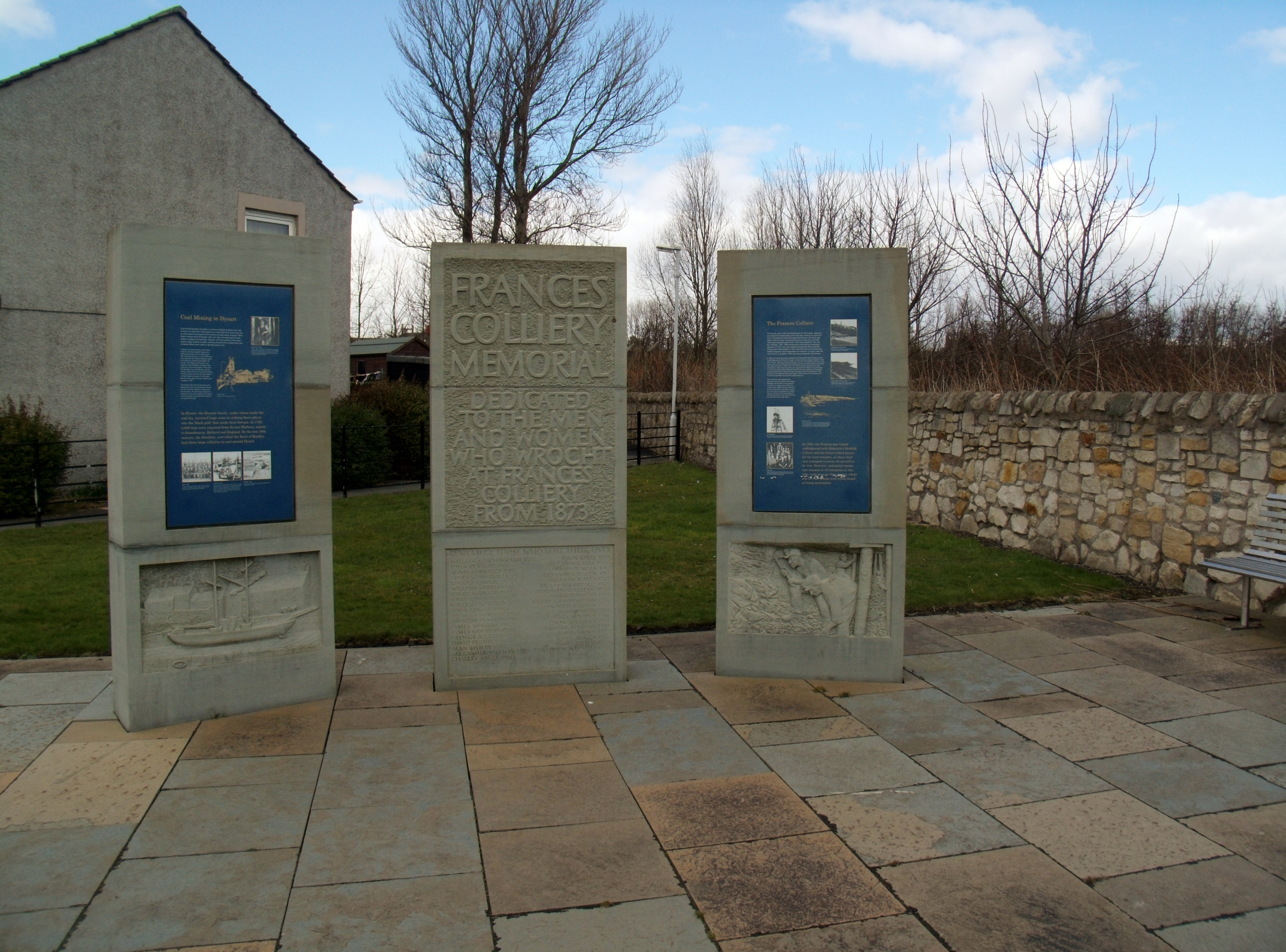
History
Frances Colliery, known locally as 'the Dubbie', was sunk at Dysart on the Fife coast starting in 1874, reaching the thick Dysart Main seam — over 30ft thick in places — by 1878. It was originally owned by the Earl of Rosslyn's Collieries Ltd before passing to the Fife Coal Company in July 1923, and then to the National Coal Board on nationalisation in 1947. The Fife Coal Company opened an additional surface mine in 1924 and redeveloped the pit through the 1930s; the shaft was eventually deepened from around 600ft to around 840ft, and the colliery went on to work the Dysart Main, Lower Dysart, Bowhouse, Branxton and Lethamwell seams, extending its workings out under the Firth of Forth. Employment peaked at 1,174 men underground in 1958. After the Michael Colliery disaster of 1967 closed that neighbouring Fife pit, Frances took over working the Michael's remaining reserves, and in March 1980 it was formally linked underground with Kirkcaldy's Seafield Colliery to form what was then Scotland's largest single pit complex.
Frances was among the first pits in Britain to strike when the 1984-85 miners' strike began, with its workforce walking out on 10 February 1984. At the height of the strike, fires caused by spontaneous combustion broke out in the D51 workings, destroying the colliery's only working coal face. Rescue teams and National Coal Board scientists fought a two-week battle to locate and contain the underground heating, some 3,000ft beneath the surface, but temperatures began rising again and the Board decided the pit could not be saved. Production ceased on 3 February 1985 — remembered locally as 'Black Sunday' — with the loss of around 500 jobs, though the colliery was not formally closed until January 1988, following its underground connection to Seafield.
Geology
Frances worked the Upper Carboniferous Coal Measures of the Fife coalfield, extending its workings out beneath the Firth of Forth to reach undersea reserves — among the steepest, most consistently pitched seams worked anywhere in Britain, a product of the folding and faulting that affects the Fife coalfield's structure.
Workings
A conventional deep shaft mine, its shaft deepened over time from around 600ft to around 840ft to reach successive seams, ultimately extending workings out under the Forth. The surviving headframe, built in 1943 to a design by Dickson Mann Ltd, was constructed around the pit's existing 1878 headgear so that the pulleys and winding ropes could be transferred across in a single Sunday shutdown, losing only a few hours' production; the 111ft steel structure and its 1943 electric winding engine — supplied by Metropolitan-Vickers, Robeys and Barclays of Kilmarnock — are recorded by Historic Environment Scotland as the last complete example of this type of traditional Scottish colliery winding equipment still in place.
Closure
Production ended on 3 February 1985 after fire damage during the 1984-85 strike destroyed the colliery's working face; the pit was formally closed in January 1988, following its 1980 underground connection to Seafield Colliery.
What remains
The 1943 headframe and winding engine house survive at Dysart and were listed Category B by Historic Environment Scotland in 1995, preserved as a memorial to the Fife coal industry and marking the town's northern boundary; the engine house still holds its original electric winding engine, rope system and control equipment.
The red-painted headframe and winding engine house are the principal surviving structures, a landmark visible across Dysart and along the Fife Coastal Path.
Related mines
- Bogside Colliery — Bogside's workforce transferred to Frances (among other Longannet-complex collieries) when it closed in 1984-85.
- Michael Colliery — After the 1967 Michael Colliery disaster closed that pit, Frances took over working its remaining reserves.
- Seafield Colliery — Formally linked underground in March 1980 to form what was then Scotland's largest single pit complex.
Nearby mines
- Victoria Pit, West Wemyss — 0.9 miles (1.4 km) NE
- Randolph Colliery — 1.2 miles (2.0 km) N
- Dunnikier Colliery — 1.9 miles (3.1 km) W
- Michael Colliery — 2.1 miles (3.4 km) NE
- Thornton Colliery — 2.4 miles (3.8 km) NW
Straight-line distance, within 9 miles (15 km). Show on the map.
Recorded claims
Individual factual claims, each attached to the source(s) that support it below. Where sources disagree, both are kept.
- Sinking began in 1874, reaching the Dysart Main seam by 1878; the colliery was owned successively by the Earl of Rosslyn's Collieries Ltd, the Fife Coal Company (from July 1923) and the National Coal Board (from 1947). 1,2
- Underground employment peaked at 1,174 in 1958; in March 1980 Frances was linked underground with Seafield Colliery, Kirkcaldy, to form Scotland's largest pit complex at the time. 1
- Fires from spontaneous combustion broke out in the D51 workings during the 1984-85 strike, destroying the colliery's only working face; production ceased 3 February 1985 with the loss of around 500 jobs, and the colliery formally closed in January 1988. 1
- The surviving headframe, designed by Dickson Mann Ltd and built around the existing 1878 headgear in 1943, is recorded by Historic Environment Scotland as the last complete example of its type of traditional winding equipment in Scotland, and was listed Category B in 1995. 2
Sources
- (secondary) Pit F-1: Frances (Dubbie) Pit, Dysart — Fife Pits (Fife colliery history resource)
- (primary) Dysart, Frances Colliery, Headframe and Winding Engine House (LB13638) — Historic Environment Scotland
Record created: 26 August 2026 · Last researched: 26 August 2026