 MineArchive
Thornton Colliery
| Also known as | Thornton Engine Pit, Middlefield Engine Pit |
|---|---|
| Location | Middlefield, on the River Ore south-east of Thornton, parish of Markinch, Fife — 56.1628, -3.1417 (exact) |
| Commodity | Coal |
| Type | Coal |
| Worked | By 1785–1845 |
| Maximum depth | 30 fathoms (55 m), the depth the engine kept dry |
| Operators | James Balfour (1842–1842), Charles Balfour (1846–1846), David Leslie, 6th Earl of Leven |
Overview
The Balgonie estate's colliery at Thornton, in the parish of Markinch, which worked the Dysart Main seam from Balgonie Castle to the Bridge of the Ore. Its engine pit at Middlefield was drained by a beam engine probably fitted up by Lord Balgonie in 1785; the work stopped when the waste collapsed in 1845, and the engine house survives as part of a house.
History
Thornton Colliery was the coal work of the Balgonie estate of David Leslie, 6th Earl of Leven and 5th Earl of Melville. It worked the seam now called the Dysart Main, and its workings ran from near Balgonie Castle through Coaltown of Balgonie to the Bridge of the Ore at Thornton; it may have grown out of the Easter Strathore pit worked in the eighteenth century. The Old Statistical Account records that in 1785 Lord Balgonie 'fitted up the present engine', and the beam-engine house at Middlefield, by the River Ore on the south-east side of Thornton, marked 'old engine pit' on a drawing in the Fife archives, may be that engine's house. The New Statistical Account says the Dysart coal at Thornton could be kept dry to 30 fathoms, enough to work only the upper nine-foot seam. The coal was sold locally, to the works along the Leven and the Ore and in Kirkcaldy.
James Balfour owned the colliery in 1842 and Charles Balfour in 1846, the year Alexander Welch retired after about thirty years as its manager. Roof falls injured two colliers in 1840 and broke both thighs of a lad of fifteen in 1841, though the Fifeshire Journal credited the rarity of accidents at the work to the manager's care; in November 1843 the price of large coal at Thornton was cut from 4s. 7d. to 4s. 2d. a ton. In February 1845 the waste collapsed, squeezing the engine pit together at the bottom and breaking the cast-iron pumps, and the work came to a stand; the paper feared for the price of coal across Fife, upwards of 3,000 loads a week having been sold there. By the Ordnance Survey of 1854 the engine pit was an 'Old Coal Pit'. The estate's later colliery, Balgonie, was sunk in 1883-85, and small Thornton pits worked by the Fife Coal Company employed 36 people in 1918 and 63 in 1920.
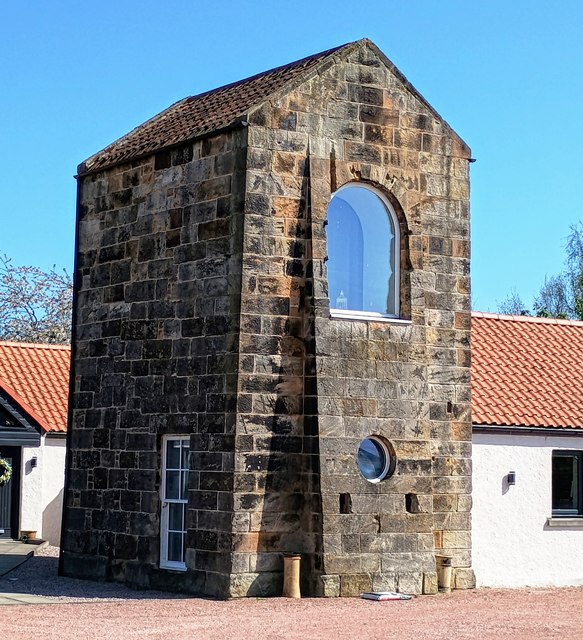
The engine house survives: three storeys, about nine metres high, of ashlar and squared rubble, its west bob wall buttressed to carry the beam. Its boiler house and the other ranges have gone; the buildings were in farm use in the 1970s, the south range was demolished in the mid-1980s, and in 2017 the engine house was built into a private house. Historic Environment Scotland surveyed it in 2018 and could not settle whether it held a late Newcomen atmospheric engine or a Cornish one.
Geology
Fife coalfield: the Dysart Main seam (the nine-foot or upper seam at Thornton).
Workings
An engine pit at Middlefield drained by a beam pumping engine, with workings in the Dysart Main from Balgonie Castle to the Bridge of the Ore.
Closure
The waste collapsed in February 1845 and broke the engine pit's pumps, stopping the work; the 1854 Ordnance Survey shows the engine pit as an old coal pit.
What remains
The beam-engine house stands, incorporated into a private house since 2017; the pump shaft is capped.
The three-storey Middlefield beam-engine house, of ashlar and squared rubble with a buttressed bob wall.
Redevelopment
The engine house was converted into a dwelling in 2017.
Related mines
- Balgonie Colliery — Both Balgonie estate collieries at Thornton; Balgonie was sunk in 1883-85, after Thornton's engine pit was abandoned.
Nearby mines
- Rothes Colliery — 0.7 miles (1.1 km) W
- Balgonie Colliery — 1.1 miles (1.8 km) NE
- Randolph Colliery — 1.1 miles (1.8 km) SE
- Earlseat Colliery — 1.6 miles (2.6 km) E
- Frances Colliery — 2.4 miles (3.8 km) SE
Straight-line distance, within 9 miles (15 km). Show on the map.
What's uncertain
Points where sources disagree or the record could not be settled; both accounts are kept. All open questions in the archive.
- In 1785 Lord Balgonie fitted up the engine at Thornton; the Middlefield engine house may be the one he built. (uncertain) 1
Recorded claims
Individual factual claims, each attached to the source(s) that support it below. Where sources disagree, both are kept.
- Thornton Colliery lay on the Balgonie estate of David Leslie, 6th Earl of Leven, and worked the Dysart Main seam. 1
- In 1785 Lord Balgonie fitted up the engine at Thornton; the Middlefield engine house may be the one he built. (uncertain) 1
- James Balfour owned Thornton Colliery in 1842 and Charles Balfour in 1846. 2,1
- Alexander Welch retired in November 1846 after about thirty years as manager of Thornton Colliery. 2
- In February 1845 the waste collapsed, squeezing the engine pit together at the bottom and breaking the cast-iron pumps, which stopped the work. 3,2,1
- The Ordnance Survey of 1854 marked the engine pit as an old coal pit. 3,1
- The Middlefield beam-engine house is three storeys of ashlar and squared rubble with a buttressed bob wall, incorporated into a private house in 2017. 1,4
- The Dysart coal at Thornton could be kept dry to 30 fathoms, giving access to the upper nine-foot seam only. 1
Photographs & further reading
Geoff Hayes's photographs of the pumping engine house, c.1979 and c.2000.
View sourceOwners, managers and newspaper reports from 1831 to 1872.
View sourceSurvey report with plans, sections and the colliery's history.
View sourceThe national record of the site, with its photographs.
View sourceSources
- (primary) Middlefield Beam Engine House, Thornton, Fife (NT29NE 6) — Historic Environment Scotland
- (secondary) Pit-T-2. Thornton Engine Pit — Fife Pits
- (secondary) Thornton Colliery — Northern Mine Research Society
- (primary) Thornton, Middlefield Beam Engine House — trove.scot (Historic Environment Scotland)
Record created: 5 October 2026 · Last researched: 5 October 2026